
EcoFlow 4800W Battery Generator vs. Power Kits: The 2026 Whole-Home Backup Blueprint
By UnitVerseHQ | Updated March 2026
When the lights go out, the questions change fast. It’s not about charging a phone anymore. It’s about whether your central AC will survive a Texas summer blackout. Whether your refrigerator will hold through a three-day Carolina ice storm. Whether your off-grid cabin in Montana can run a heat pump in January. Whether you can actually unplug from the grid entirely and never look back.
The EcoFlow 4800W battery generator search captures all of these people — and it leads to a genuinely nuanced answer. Depending on what you’re building, the right system is either the EcoFlow Power Kit (the 48V modular ecosystem designed for van life, RVs, and off-grid cabins), the EcoFlow Delta Pro Ultra (the 7,200W whole-home titan that runs central AC from a single unit), or the new Delta Pro Ultra X (12–36kW of permanent installation power that redefines what portable energy company even means).
This guide decodes every option, compares every spec, and gives homeowners, off-grid cabin owners, and DIY solar installers the exact blueprint they need to choose correctly the first time.
Decoding “EcoFlow 4800W Battery Generator” — What the Search Actually Means
Before comparing systems, let’s address the most important SEO reality in this guide: 4800W means different things for different EcoFlow products, and understanding which meaning applies to your search determines which product is right for you.
The Three Ways 4800W Appears in EcoFlow’s Lineup
4800W as solar input — EcoFlow Power Kit: Maximize your solar energy with our range of rigid and flexible solar panels, offering up to 4800W total input through three 1600W ports. The Power Sphere The EcoFlow Power Kit accepts up to 4,800W of solar input across three MPPT controllers. When people search “EcoFlow 4800W battery generator” from a van life or off-grid cabin context, this is typically the product they’re finding.
4800W as AC surge — DELTA 3 Max: DELTA 3 Max: 2,400W Powerful Output with 4,800W surge output. EcoFlow Some searchers reach this unit. It’s a portable station — not a whole-home solution — but it catches the 4800W search term.
4800W as the floor, not ceiling — Delta Pro Ultra: The EcoFlow Delta Pro Ultra outputs 7,200W continuously — well beyond 4800W — and is the product most serious whole-home backup searchers actually need. The 4800W search intent often resolves here once buyers understand what their actual load requirements are.
The bottom line: The “EcoFlow 4800W battery generator” search is a gateway query. This article maps every product it could represent and tells you exactly which one matches your real need.
EcoFlow Power Kit: The 48V Modular Off-Grid King
The EcoFlow Power Kit is EcoFlow’s answer to the question: “How do I build a complete, professional-grade power system for my van, RV, tiny home, or off-grid cabin without needing an electrician or a custom wiring diagram?”
EcoFlow Power Kits are the world’s first integrated, plug-and-play power solutions designed especially for tiny homes and RVs. With a plug-and-play design, customizing your energy is quicker and easier than ever. Portablepowerstations
The Power Hub: Five Components in One Box
The heart of every EcoFlow Power Kit is the Power Hub — a single unit that replaces what traditionally required five separate components:
Power Hub has a 3600W output, and includes two MPPT solar charge controllers, a DC-DC battery charger with MPPT, an inverter charger, and a DC-DC step-down converter. Everything you need to power your tiny home or van. Solar Generator
| Component Integrated | Traditional Equivalent | Benefit |
|---|---|---|
| 2× MPPT Solar Charge Controllers | Separate units (~$200 each) | Saves space + wiring |
| DC-DC Battery Charger with MPPT | Separate unit (~$150) | Alternator charging built-in |
| Inverter-Charger | Separate unit (~$400-800) | AC output + grid input |
| DC-DC Step-Down Converter | Separate unit (~$80) | Powers 12V devices from 48V |
| Wi-Fi + Bluetooth Module | Add-on hardware | App control built-in |
With fewer wires and modules, it’s 5 times faster to set up, saves masses of space, and your wallet too. EcoFlow
Power Hub verified specs:
- AC Output: 3,600W continuous / 7,200W surge
- Solar Input: 4,800W (3× 1,600W MPPT ports) — this is the “4800W” in the EcoFlow 4800W battery generator search
- Shore Power Input: 3,000W
- Alternator Input: 1,000W
- Smart Generator Input: 1,800W
- System Voltage: 48V
Why 48V Changes Everything
Power Kits offer you a safe, 48V power solution for your van. A 48V system produces the same amount of power, but unlike 12Vs, only a quarter of the electric current passes through the wires, producing significantly less heat and power loss. DIY Solar Forum
The physics are straightforward: Power = Voltage × Current. To deliver 3,600W at 12V requires 300A of current — which demands massive, expensive, heavy copper wiring and produces significant heat. The same 3,600W at 48V requires only 75A — allowing thinner wires, less heat, greater efficiency, and smaller installation footprint.
The 48V system used in Power Kits offers increased efficiency, enhanced safety through lower current, and space savings that benefit space-constrained environments like RVs and tiny homes. EcoFlow
Battery Capacity and Expansion
Our 2 and 5kWh batteries securely stack in threes, giving you an expandable capacity of up to 15kWh. DIY Solar Forum
| Configuration | Capacity | Practical Use |
|---|---|---|
| 1× 2kWh Battery | 2kWh | Starter weekend van setup |
| 3× 2kWh Batteries | 6kWh | Small van or weekend cabin |
| 1× 5kWh Battery | 5kWh | Solo full-time van |
| 2× 5kWh Batteries | 10kWh | Couple van life / small cabin |
| 3× 5kWh Batteries | 15kWh | Full tiny home / large cabin |
Critical compatibility note: We never recommend mixing 2kWh and 5kWh batteries, as this may shorten the battery cycle life. EcoFlow Europe Stick to one battery size throughout your system.
The auto-heating feature deserves specific mention for cold-climate cabin users: With built-in auto-heating, you can use the batteries safely in temperatures as low as -4°F (-20°C). Charge heating is automatically activated when ambient temperature is below 0°C (32°F) and the battery is in charging mode.
EcoFlow Power Kit Charging Methods
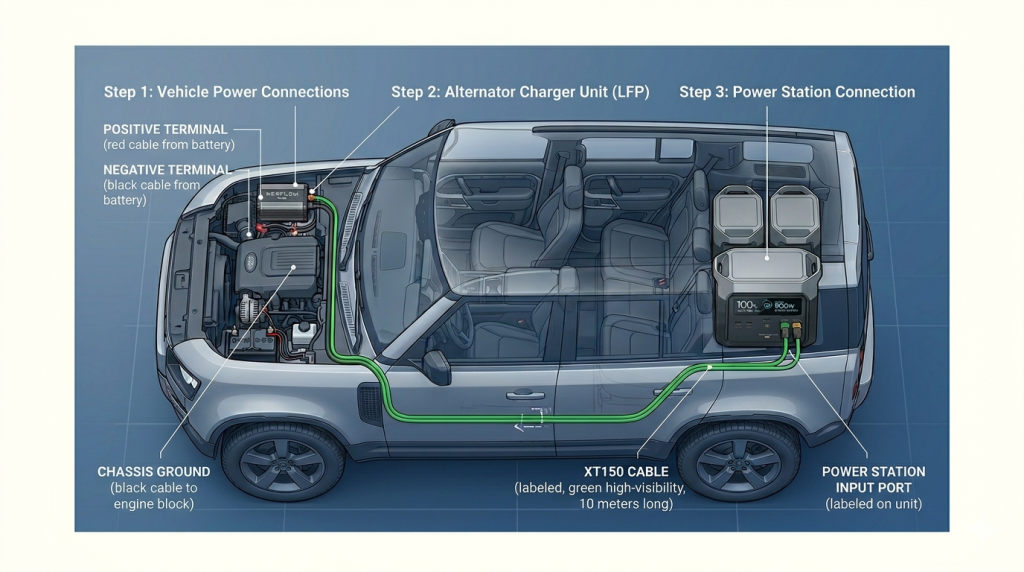
4800W Solar Input: Maximize your solar energy through three 1600W ports. 1000W Alternator Input: Recharge while on the move. 3000W Shore Power: Access 3000W at campgrounds or RV parks. 1800W Smart Generator Input: Emergency backup power. The Power Sphere
For mobile users — van lifers, overlanding rigs, and travel trailers — the alternator input deserves special attention:
Honest Caveat: The Power Kit UPS Limitation
UPSs have a transfer time of 0–20 ms. Power Kits currently take 30 ms and can only serve as EPS. Solar Generator
The EcoFlow Power Kit is an EPS (Emergency Power Supply) with 30ms switchover — not a true UPS. For desktop computers, NAS servers, and sensitive electronics, 30ms may cause a perceived power blip. This is an important distinction versus the Delta Pro Ultra’s 0ms online UPS. For most van life and cabin loads — lighting, refrigerator, CPAP, phone charging — 30ms is imperceptible.
Who the EcoFlow Power Kit Is For
The EcoFlow Power Kit is the right EcoFlow 4800W battery generator solution if:
- You’re building a van conversion, RV upgrade, or tiny home
- You want DIY installation without an electrician
- Your space budget is constrained (the entire system fits under a van bench)
- You need 15kWh maximum capacity at 3,600W continuous
- You want the most versatile 48V off-grid system available
EcoFlow Delta Pro Ultra: The 7,200W Whole-Home Titan
For homeowners whose loads exceed what the EcoFlow Power Kit can handle — central AC systems, clothes dryers, EV charging, well pumps — the EcoFlow Delta Pro Ultra is the real answer behind the EcoFlow 4800W battery generator search intent.
EcoFlow DELTA Pro Ultra is a residential power backup system designed for both extended outages and daily use. With an unrivaled capacity of 6kWh, 7200W output, and 5.6kW solar input, a single unit can run your entire home. DIY Solar Forum
Core Delta Pro Ultra Specs (Verified)
One inverter supports 120V & 240V and has an exceptional 7200W output, allowing you to run almost any heavy household appliance, even a 3-ton central air conditioner. Triple the inverters for an incredible 21.6kW AC output, allowing you to live life to the fullest even during an outage. The first LFP portable power station with a 6kWh capacity stackable to 90kWh. EcoFlow
| Specification | Single Unit | 3 Units (Maximum) |
|---|---|---|
| AC Output | 7,200W | 21,600W (21.6kW) |
| Voltage | 120V + 240V native | 120V + 240V |
| Base Capacity | 6,144Wh | 18,432Wh |
| Max Capacity | 30kWh | 90kWh |
| Solar Input | 5,600W | 16,800W |
| UPS Type | 0ms Online UPS | 0ms |
| Silent Mode | 0dB under 2,000W | — |
| Charge Speed | 6,200W (1 battery) | 8,800W (2 batteries) |
| Battery Chemistry | LFP, 3,500 cycles | LFP |
X-Fusion: The Zero-Downtime Technology
With DELTA Pro Ultra and the EcoFlow Smart Home Panel 2, when the grid goes down, your power stays on. In the fast charging mode, the output will always be 7.2kW no matter how much the input is. This means you receive optimal power output regardless of the device’s operating mode. DIY Solar Forum
X-Fusion is EcoFlow’s bypass technology that ensures the EcoFlow Delta Pro Ultra delivers constant 7,200W output even when simultaneously charging. Standard power stations reduce output when also accepting charge input — X-Fusion eliminates this limitation, making the Delta Pro Ultra functionally equivalent to an always-on grid connection.
For low draws under 2000W, it’s completely silent with a whisper-quiet 0 dB, your nights remain undisturbed as it powers your devices. For a maximum of 30 minutes. DIY Solar Forum
The 0dB silent mode is a genuine quality-of-life feature for overnight operation — running essential circuits silently while the household sleeps.
Delta Pro Ultra Capacity: From 6kWh to 90kWh
The DELTA Pro Ultra unit has a scalable capacity up to 30kWh with one inverter stack and a massive 90kWh with three inverter stacks — which has the potential to power your home for up to a month. DIY Solar Forum
Runtime at whole-home moderate consumption (3kW average draw):
| System Config | Capacity | Runtime |
|---|---|---|
| 1× DPU, 1 battery | 6kWh | ~1.7 hours |
| 1× DPU, 5 batteries | 30kWh | ~8.5 hours |
| 3× DPU, 15 batteries | 90kWh | ~25.5 hours (1+ day) |
| 3× DPU, max + solar | 90kWh + 16.8kW solar | Indefinite in sun |
For homeowners in hurricane corridors, ice storm zones, or simply serious about energy independence — the 90kWh maximum configuration provides genuine multi-day whole-home coverage that no portable station category has historically offered.
For small-scale backup needs — where 2kWh to 6kWh is sufficient — the EcoFlow Delta 2 Extra Battery paired with a DELTA 2 is a far more economical starting point:
Smart Home Panel 2: The Brain of Any Whole-Home System
The EcoFlow Smart Home Panel 2 is what transforms a portable power station — no matter how capable — into an automatic, whole-home backup system that operates without any manual intervention when the grid fails.
Smart Home Panel 2 Integration enables automatic power switchover, precise control over individual circuits, and maximized savings through time-of-use optimization. JAG35
What Smart Home Panel 2 Actually Does
With DELTA Pro Ultra and the EcoFlow Smart Home Panel 2, when the grid goes down, your power stays on. DIY Solar Forum
The Smart Home Panel 2 installs between your utility meter and your home’s main panel. It monitors grid power continuously. When grid power fails, it switches your protected circuits to battery power automatically — in 20ms. Up to 3 EcoFlow DELTA Pro Ultra Inverters can connect to the EcoFlow Smart Home Panel 2, with each inverter allowing for 5 batteries. DIY Solar Forum
Smart Home Panel 2 key capabilities:
| Feature | Specification |
|---|---|
| Compatible Units | Up to 3× Delta Pro Ultra OR 3× Delta Pro 3 |
| Circuits Controlled | Up to 12 home circuits |
| Automatic Switchover | 20ms |
| Max Output (3× DPU) | 21,600W |
| TOU Programming | ✅ Yes (via EcoFlow app) |
| Circuit Prioritization | ✅ Yes — choose which circuits get backup |
| App Integration | ✅ Full EcoFlow app control |
| Installation | Licensed electrician required |
Circuit Prioritization: The Hidden Power Feature
The Smart Home Panel 2 allows you to designate priority circuits that receive battery power first during an outage. You can assign:
Tier 1 — Always protected: Medical equipment (oxygen concentrator, CPAP), refrigerator, security system, internet modem/router
Tier 2 — Protected with sufficient capacity: Home office, primary lighting, phone charging
Tier 3 — Protected only at full capacity: AC system, electric vehicle charger, entertainment systems
During a partial capacity event (battery at 20%, no solar, extended outage), the EcoFlow Smart Home Panel 2 automatically sheds Tier 3 and Tier 2 circuits to preserve Tier 1 loads — all without any manual intervention. You configure this priority scheme once in the EcoFlow app, and it operates autonomously from that point forward.
TOU Optimization: The EcoFlow App’s Most Powerful Feature
Smart Home Panel 2 maximizes savings through time-of-use optimization. JAG35
The EcoFlow app integration with Smart Home Panel 2 enables the most sophisticated residential electricity arbitrage for home strategy available — charging from the grid at cheap off-peak rates (midnight to 6 AM), discharging to run home circuits during expensive peak hours (4–9 PM), and automatically switching to grid power when battery levels drop below user-set thresholds.
For California SDG&E customers with a 3× Delta Pro Ultra system (90kWh maximum capacity), TOU optimization between the $0.09 off-peak rate and the $0.48 on-peak rate produces:
- Daily shift: ~30kWh × $0.39 spread = $11.70/day
- Monthly: ~$351/month
- Annual: ~$4,212/year
At this scale, the TOU arbitrage savings alone justify a meaningful portion of the system’s cost over a 5-year period.
The Complete Comparison: EcoFlow 4800W Battery Generator Systems
| Feature | EcoFlow Power Kit | Delta Pro Ultra | Delta Pro Ultra X |
|---|---|---|---|
| Primary Use | Van / RV / Cabin | Whole-Home | Permanent Whole-Home |
| AC Output (Continuous) | 3,600W | 7,200W | 12,000W |
| AC Output (Surge) | 7,200W | — | — |
| Max Output (Multi-Unit) | — | 21,600W (3 units) | 36,000W (3 units) |
| Base Capacity | 2–5kWh | 6kWh | Varies |
| Max Capacity | 15kWh | 90kWh | 180kWh |
| Solar Input (Single) | 4,800W | 5,600W | 10,000W |
| Solar Input (3 Units) | — | 16,800W | 30,000W |
| UPS Switchover | 30ms EPS | 0ms Online | 0ms Online |
| Native 240V | ✅ | ✅ | ✅ |
| Smart Home Panel 2 | ❌ | ✅ (3 units max) | ✅ |
| TOU Optimization | ✅ (via app) | ✅ (via app) | ✅ |
| DIY Installation | ✅ Yes | Partial | ❌ Electrician required |
| Portability | ✅ Mobile | Semi-portable | ❌ Wall-mounted |
| Battery Chemistry | LFP | LFP | LFP |
| Auto-Heating | ✅ (-4°F) | No | No |
| EcoFlow App | ✅ | ✅ | ✅ |
| Starting Price | ~$2,999 | ~$3,499 | Premium (TBD) |
| Best For | Van / off-grid cabin | Homeowners | Large homes / commercial |
EcoFlow Delta Pro Ultra X: The 2026 CES Innovation That Changes Everything
The EcoFlow Delta Pro Ultra X debuted at CES 2026 as the most powerful residential battery system EcoFlow has ever built — and it signals a fundamental shift from “portable home backup” to “permanent home energy infrastructure.”
DELTA Pro Ultra X delivers 12–36kW whole-home power and 12–180kWh capacity. Ready in 7 days with smart panel control, weather protection, and generator backup. EcoFlow
Delta Pro Ultra X Verified Specs
The total output power is increased from 7200W to 12000W; The maximum number of connectable battery packs is increased from 5 to 10; The maximum total PV input power is increased from 5600W to 10000W. Supports two-way high-voltage PV inputs, with a voltage range of 80-500V for each way, a maximum working current of 15A per way, and a total power of up to 10,000W. EcoFlow
| Specification | Per Inverter | 3-Unit Maximum |
|---|---|---|
| AC Output | 12,000W | 36,000W |
| Solar Input | 10,000W (80–500V) | 30,000W |
| Max Capacity | 60kWh (10 batteries) | 180kWh |
| AC Input | 12,000W (50A) | — |
| Installation | Electrician required | Electrician required |
| Portability | ❌ Wall system | ❌ Wall system |
The high-voltage solar input (80–500V) is particularly significant — it means the Delta Pro Ultra X can accept input directly from string solar arrays at commercial voltage levels, without the step-down losses of lower-voltage residential systems. This enables direct integration with larger rooftop solar installations that traditional portable power stations can’t connect to.
The “ready in 7 days” claim refers to EcoFlow’s professional installation service — a full-home system, fully commissioned, in one week. For homeowners who want a Tesla Powerwall-class system with EcoFlow’s ecosystem integration, the EcoFlow Delta Pro Ultra X is the 2026 answer.
Who the Delta Pro Ultra X is for: Large homes (3,000+ sq ft), homes with EV fleets and high daily energy consumption, small businesses with critical power needs, and early adopters who want the most future-proof EcoFlow system available.
Which System Is Right for You: The Decision Framework
Ask These Three Questions
Question 1: Are you mobile or stationary?
- Mobile (van, RV, boat): EcoFlow Power Kit — it’s built for motion, has alternator charging, and fits in tight spaces
- Stationary but portable (apartment, rental, frequent mover): EcoFlow Delta Pro Ultra or Delta Pro 3 — powerful enough for whole-home but moveable
- Permanent installation (owned home, cabin, business): EcoFlow Delta Pro Ultra X with Smart Home Panel 2
Question 2: What is your highest single load?
- Under 3,600W (laptops, mini fridges, lights, CPAP, small appliances): EcoFlow Power Kit handles it
- 3,600W–7,200W (central AC, dryer, well pump, EV charging): EcoFlow Delta Pro Ultra
- Over 7,200W (multiple HVAC systems, commercial equipment, large EV fleet): EcoFlow Delta Pro Ultra X
Question 3: How many days of autonomy do you need?
- 1 day: EcoFlow Power Kit (15kWh) or Delta Pro Ultra (single unit, 6kWh)
- 2–3 days: Delta Pro Ultra with expansion batteries (up to 30kWh single inverter)
- Week or more: Delta Pro Ultra (3-unit, 90kWh) or Delta Pro Ultra X (up to 180kWh)
Three Real Installation Scenarios
Scenario 1: The Van Life Builder (Denver, CO)
Profile: Full-time van lifer converting a Transit cargo van, needs to run a 12V fridge, laptop, phone charging, LED lighting, occasional Starlink, and a portable AC in summer.
Daily consumption: ~1,200Wh Peak single load: ~600W (Wave 3 AC or laptop + accessories)
Recommended system: EcoFlow Power Kit, 10kWh configuration (2× 5kWh batteries + Power Hub)
- 4,800W solar input supports 400W roof panels + additional flexible panels
- 1,000W alternator input covers 5+ days of driving between sunny periods
- 3,600W AC output handles every load comfortably
- DIY installation, no electrician needed
- Total system cost: ~$3,500–$4,500
“For mobile users, this system works perfectly with the EcoFlow Alternator Charger to keep your home-on-wheels charged while driving.”
Scenario 2: The Suburban Homeowner (Houston, TX)
Profile: 2,200 sq ft home in a hurricane zone, central AC (3-ton, 3,500W running), refrigerator, medical oxygen concentrator, home office, EV charging.
Daily consumption: ~35–45kWh Peak single load: 7,000W (AC startup surge)
Recommended system: 2× EcoFlow Delta Pro Ultra + Smart Home Panel 2
- One EcoFlow DELTA Pro Ultra can power a 3-ton central air conditioning unit. DIY Solar Forum
- Two units provide 14,400W output and 12kWh base capacity (expandable to 60kWh)
- Smart Home Panel 2 protects 12 circuits automatically
- 11,200W combined solar input recharges both units in under 3 hours
- TOU optimization via EcoFlow app saves $150–$300/month on electricity
- Installation: electrician required for panel integration (~$800–$1,500)
- Total system cost: ~$8,000–$12,000
Scenario 3: The Montana Off-Grid Cabin
Profile: 1,400 sq ft cabin 8 miles from nearest utility line, year-round occupancy, propane backup for heating but wants electric as primary, needs to handle -20°F winters.
Daily consumption: ~12–18kWh (winter heating/cooking heavy) Constraint: No grid connection whatsoever — 100% solar + generator backup
Recommended system: EcoFlow Power Kit 15kWh + EcoFlow Smart Generator + 4,800W solar array
- 15kWh LFP batteries with auto-heating handle -4°F safely
- 4,800W solar input through three 1,600W MPPT channels
- 1,800W Smart Generator input for backup during extended cloudy periods
- Perfect for all off-grid living situations, including remote cabins, tiny homes, and off-grid communities. Ecoflow
- Full DIY installation — no utility interconnection required
- 5-year system warranty
- Total system cost: ~$6,000–$9,000 depending on solar array size
Cost vs. Value: The Full Financial Picture
| System | Starting Price | Max Capacity | 10-Year TCO* | Best ROI Scenario |
|---|---|---|---|---|
| EcoFlow Power Kit (15kWh) | ~$4,499 | 15kWh | ~$5,000 | Van life / DIY cabin |
| EcoFlow Delta Pro Ultra (1 unit) | ~$3,499 | 30kWh | ~$4,500 | Home essentials backup |
| 2× Delta Pro Ultra + Panel 2 | ~$9,000 | 60kWh | ~$6,000 net (TOU savings) | Houston/CA homeowner |
| 3× Delta Pro Ultra + Panel 2 | ~$14,000+ | 90kWh | Positive (TOU + solar) | Full independence |
| Delta Pro Ultra X (1 unit) | Premium TBD | 60kWh | TBD | Large home / commercial |
*10-Year Total Cost of Ownership accounts for electricity savings, TOU arbitrage, and reduced generator fuel costs. California and Texas figures reflect highest regional savings potential.
The EcoFlow Delta 2 Extra Battery entry point: For buyers who aren’t yet ready for the 4,800W+ tier, the EcoFlow Delta 2 Extra Battery at ~$299–$349 expands a DELTA 2 to 2,048Wh — an excellent starting point that demonstrates the value of battery backup before committing to whole-home systems.
Frequently Asked Questions
What is the EcoFlow 4800W battery generator?
The “EcoFlow 4800W battery generator” search refers to two different products depending on context. The EcoFlow Power Kit accepts 4,800W of solar input through its three 1,600W MPPT controllers — making it the “4800W solar” system. The EcoFlow Delta Pro Ultra delivers 7,200W of AC output — exceeding 4,800W — making it the whole-home “4800W+” backup generator. The correct product depends on your use case: mobile/van/cabin users typically need the Power Kit; homeowners needing central AC backup typically need the Delta Pro Ultra.
What is the EcoFlow Power Kit and who is it for?
EcoFlow Power Kits are the world’s first integrated, plug-and-play power solutions designed especially for tiny homes and RVs. The EcoFlow Power Kit is a 48V modular off-grid power system that combines five components — MPPT solar controllers, DC-DC battery charger, inverter charger, DC-DC converter, and battery management — into one Power Hub unit. It accepts up to 4,800W of solar input, expands to 15kWh capacity, and is DIY-installable. It’s ideal for van lifers, RV conversions, tiny homes, and remote off-grid cabins.
Can one EcoFlow Delta Pro Ultra run a whole house?
Yes. One EcoFlow DELTA Pro Ultra can power a 3-ton central air conditioning unit (with LRA up to 120A). It works as a standalone unit powering electrical appliances of up to 7200W. DIY Solar Forum A single Delta Pro Ultra with its base 6kWh battery can run a complete home through a typical overnight outage. For multi-day coverage, expand to 5 batteries (30kWh per inverter) or add a second unit with Smart Home Panel 2 integration.
What does EcoFlow Smart Home Panel 2 do?
The EcoFlow Smart Home Panel 2 connects up to three Delta Pro Ultra (or Delta Pro 3) units to your home’s electrical panel, automatically switching up to 12 home circuits to battery power in 20ms when grid power fails. It enables automatic power switchover, precise control over individual circuits, and maximized savings through time-of-use optimization. JAG35 It also enables TOU arbitrage programming through the EcoFlow app, potentially saving hundreds of dollars per month in electricity costs.
What is the EcoFlow Delta Pro Ultra X?
DELTA Pro Ultra X delivers 12–36kW whole-home power and 12–180kWh capacity. Ready in 7 days with smart panel control, weather protection, and generator backup. EcoFlow The Delta Pro Ultra X is EcoFlow’s 2026 permanent-installation whole-home system, doubling the standard Delta Pro Ultra’s output to 12kW per inverter. It supports high-voltage solar input (80–500V), connects up to 10 batteries per inverter, and requires professional electrician installation. It’s positioned as EcoFlow’s answer to Tesla Powerwall and LG RESU for large homes and small commercial applications.
Is the EcoFlow Power Kit good for off-grid cabins?
Yes — the EcoFlow Power Kit is one of the best off-grid solar system solutions for cabins and tiny homes. Perfect for all off-grid living situations, including remote cabins, tiny homes, and off-grid communities. Connect up to three 5kWh LFP Batteries at the same time for a maximum capacity of 15kWh. Ecoflow The auto-heating feature allows reliable operation to -4°F — critical for mountain and northern cabin locations. DIY installation eliminates electrician costs, and the 5-year system warranty provides long-term confidence.
How does TOU time-of-use optimization work with EcoFlow systems?
Through the EcoFlow app, both the Power Kit and Delta Pro Ultra support time-of-use electricity rate programming. You set charging windows to align with your utility’s off-peak hours (typically midnight–6 AM) and discharging windows for peak hours (4–9 PM). The system charges at cheaper off-peak rates (as low as $0.08–$0.13/kWh) and uses stored power during expensive peak hours ($0.32–$0.51/kWh in California). For a large Delta Pro Ultra system running 30kWh of daily cycles, TOU savings can reach $300–$400/month in high-rate states.
What is the difference between the EcoFlow Power Kit and the Delta Pro Ultra for a homeowner?
The EcoFlow Power Kit maxes out at 15kWh capacity and 3,600W continuous output — sufficient for a small home’s essential circuits but unable to run central AC, large appliances, or EV chargers simultaneously. The EcoFlow Delta Pro Ultra starts at 6kWh and scales to 90kWh, with 7,200W continuous output (21,600W with three units), native 240V, 0ms online UPS, and Smart Home Panel 2 compatibility. For homeowners with serious whole-home backup needs, the Delta Pro Ultra is the appropriate tier. The Power Kit is optimized for mobile builds and small off-grid structures.
How much does a complete EcoFlow whole-home backup system cost?
System costs vary significantly by configuration. A single EcoFlow Delta Pro Ultra with one battery starts at approximately $3,499–$4,999. A two-unit system with Smart Home Panel 2 runs approximately $8,000–$10,000. A full three-unit, 90kWh system approaches $18,000–$22,000. The EcoFlow Power Kit at 15kWh starts around $3,999–$4,999. For comparison, a Tesla Powerwall 3 installation typically costs $11,000–$16,000 fully installed. All EcoFlow systems include DIY-capable options that eliminate installation labor costs for mobile and cabin use cases.
Can I use the EcoFlow Power Kit with solar panels I already own?
Yes, in most cases. The EcoFlow Power Kit supports solar input through three 1,600W MPPT controllers for a total of 4,800W input. Third-party panels with MC4 connectors that fall within the MPPT voltage range are compatible. EcoFlow Power Kits can be charged using a variety of methods, including solar, alternator, and shore power, making them ideal for use in a variety of settings. Verify your panels’ Voc and Vmp specs fall within the Power Hub’s MPPT input range before connecting. EcoFlow’s support team can confirm compatibility for specific panel models.
UnitVerseHQ provides independent whole-home energy system analysis for homeowners, off-grid cabin builders, and van life converters. All specifications cited from EcoFlow’s official US product pages, Amazon, authorized dealers (ShopSolarKits, OutboundPower, AllProGenerators), and independent installer documentation as of March 2026. System pricing varies by configuration and retailer — always verify current pricing at us.ecoflow.com. Professional electrical installation is required for Smart Home Panel 2 integration.