
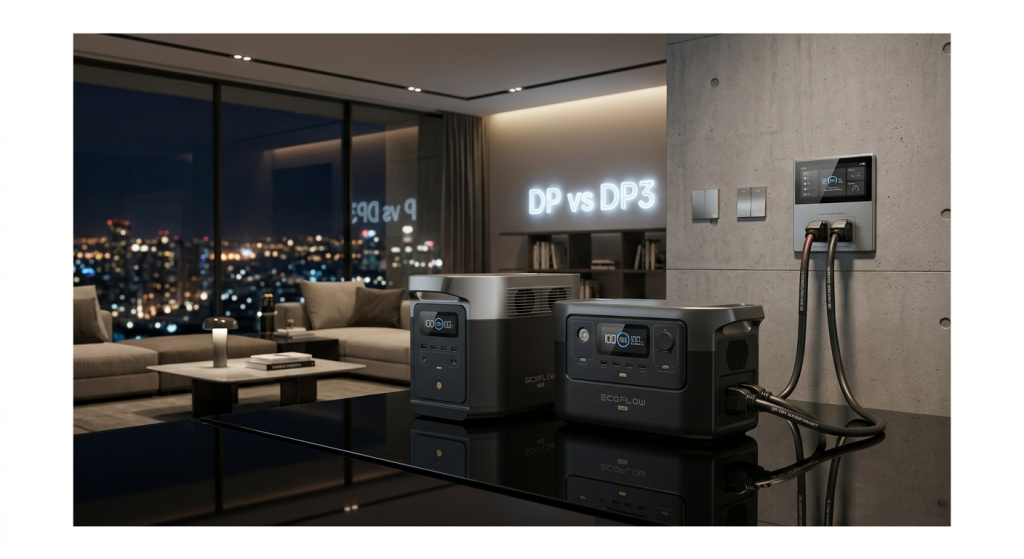
EcoFlow Delta Pro vs Delta Pro 3: The Complete 2026 Comparison (Every Spec Verified)
By UnitVerseHQ | Updated March 2026
The EcoFlow Delta Pro vs Delta Pro 3 question is one of the most searched comparisons in the home battery backup market right now — and for good reason. If you already own the original EcoFlow Delta Pro, you’re looking at a machine that was genuinely revolutionary when it launched in 2021. It still holds up in 2026. But the Delta Pro 3 has arrived with a list of upgrades that changes the calculation significantly: native 240V output from a single unit, a whisper-quiet 30dB operating noise, 2,600W of dual solar input, and the ability to expand to 48kWh.
This guide gives you the complete EcoFlow Delta Pro vs Delta Pro 3 breakdown — every spec verified from EcoFlow’s own product pages, with honest analysis of where the upgrade genuinely matters and where it doesn’t.

At a Glance: The 6 Most Important Upgrades in the Delta Pro 3
Before diving into the full spec tables, here are the six changes that actually matter in the EcoFlow Delta Pro vs Delta Pro 3 comparison:
- Native 240V output — the Delta Pro 3 delivers both 120V and 240V from a single unit. The original EcoFlow Delta Pro needs two units plus a Double Voltage Hub to achieve 240V.
- 30dB whisper-quiet operation — with X-Quiet technology, this solar generator operates at a peaceful hum as low as 30 dB, ensuring undisturbed sleep even beside your bed. JAG35 The original Delta Pro runs at 48–60dB — equivalent to a conversation to a busy office environment.
- 2,600W dual solar input — the Delta Pro 3 doubles the original’s 1,600W single-port solar input by adding a second PV port, enabling full recharge in approximately 1.6 hours with adequate panels.
- 10ms UPS switchover — the EcoFlow Delta Pro 3 has a 10ms UPS switchover to protect sensitive devices, while the EcoFlow Delta Pro has a switchover time of about 20ms. Outbound Power
- 4,000 vs 3,500 cycle life — the Delta Pro 3’s third-generation LiFePO4 cells last 500 cycles longer to 80% capacity, extending operational life by approximately 1.5 years of daily use.
- Smart Home Panel 2 integration — the Delta Pro 3 connects to EcoFlow’s updated Smart Home Panel 2 for automatic whole-home backup, managing up to 12 circuits with up to three Delta Pro 3 units in parallel.
Full Specs: EcoFlow Delta Pro vs Delta Pro 3 (Verified March 2026)
| Specification | EcoFlow Delta Pro | EcoFlow Delta Pro 3 | Advantage |
|---|---|---|---|
| Base Capacity | 3,600Wh | 4,096Wh | Delta Pro 3 (+496Wh) |
| Max Expansion | 25kWh | 48kWh | Delta Pro 3 |
| AC Output (Continuous) | 3,600W | 4,000W | Delta Pro 3 |
| AC Surge | 7,200W | 8,000W | Delta Pro 3 |
| X-Boost Max | 4,500W | 4,600W | Tie |
| Native 240V | ❌ (2 units + hub) | ✅ Single unit | Delta Pro 3 |
| Solar Input Max | 1,600W | 2,600W | Delta Pro 3 |
| Solar Ports | 1 | 2 (High + Low PV) | Delta Pro 3 |
| EV Charging Input | ✅ Yes | ✅ Yes (up to 4,000W) | Delta Pro 3 |
| UPS Switchover | ~20ms | 10ms | Delta Pro 3 |
| Noise Level | 48–60dB | 30dB (X-Quiet) | Delta Pro 3 |
| Cycle Life | 3,500 cycles | 4,000 cycles | Delta Pro 3 |
| Battery IP Rating | None | IP65-rated pack | Delta Pro 3 |
| UL Certification | UL1973 | UL9540 | Delta Pro 3 |
| Smart Home Panel | Smart Home Panel 1 | Smart Home Panel 2 | Delta Pro 3 |
| Max Units in Parallel | 2 | 3 | Delta Pro 3 |
| Max Parallel Output | 7,200W | 12,000W | Delta Pro 3 |
| Fast Charge (0–80%) | ~1.8 hrs | ~50 min | Delta Pro 3 |
| Max Combined Charging | ~3,600W | 7,000W | Delta Pro 3 |
| Weight | ~99 lbs | ~95.7 lbs | Delta Pro 3 |
| Design | Black, classic | Galactic Silver, UV-coated | Subjective |
| MSRP | ~$2,199 (often ~$1,599) | ~$2,999 | Delta Pro |
| Backward Compatibility | — | ❌ Not compatible with Delta Pro accessories | Delta Pro |
The 5 Biggest Differences Explained
1. Power Output: 4,000W and Native 240V Changes Everything
The EcoFlow Delta Pro vs Delta Pro 3 comparison starts with AC output — and this is where the generational gap is most obvious.
The EcoFlow Delta Pro 3 delivers 4,000W continuous AC output, while the EcoFlow Delta Pro provides 3,600W continuous AC output. The EcoFlow Delta Pro 3 supports native 120V and 240V from a single unit, but the EcoFlow Delta Pro requires pairing two units together to achieve 240V. Outbound Power
The 400W continuous output difference is real but relatively modest. The 240V story is not modest at all. The original EcoFlow Delta Pro requires you to purchase two units and a Double Voltage Hub cable — a total investment of approximately $3,200–$4,400 — just to get 240V output. The EcoFlow 4000W output power station that is the Delta Pro 3 delivers native 240V from day one with a single unit purchase.
There are two buttons for AC output: 120V AC ON/OFF and 240V AC ON/OFF. When the 120V AC button is pressed, four 120V 20A outlets and one 30A RV outlet will supply power. When the 240V AC button is pressed, one L14-30 split-phase outlet and one 6-20R 240V outlet output power. EcoFlow
This matters immediately for: clothes dryers (240V), electric water heaters (240V), EV charging (240V Level 2), well pumps (240V), central AC systems (240V). Any household with these appliances that buys the original EcoFlow Delta Pro expecting 240V backup is buying the wrong unit. The Delta Pro 3 handles all of them from a single purchase.
For the EcoFlow 4000W output power station use case specifically — running high-draw appliances like a 3-ton central AC or 1HP water pump — the EcoFlow Delta Pro 3 supports 120V/240V voltage and has a 4000W output (6000W with X-Boost), powering nearly all essential home appliances, such as a 3-ton central AC or a 1 HP water pump. DIY Solar Forum
2. Battery Capacity and Expansion: 48kWh vs 25kWh
The Delta Pro 3 slightly edges out with a 4,096Wh battery versus 3,600Wh on the original model. More importantly, the Delta Pro 3 is designed for a significantly larger expansion — up to 48kWh using Smart Extra Batteries or EcoFlow’s Power Kits. Ecoflow
The base capacity difference (4,096Wh vs 3,600Wh) translates to approximately 13% more runtime at the same load — meaningful but not transformative. The expansion ceiling, however, is a different conversation entirely.
Runtime comparison (standard 150W fridge):
| Configuration | EcoFlow Delta Pro | EcoFlow Delta Pro 3 |
|---|---|---|
| Base unit only | ~20 hours | ~23 hours |
| + 1 Extra Battery | ~40 hours | ~46 hours |
| + 2 Extra Batteries | ~60 hours | ~69 hours |
| Maximum expansion | 25kWh → ~139 hrs | 48kWh → ~267 hrs |
For homeowners building a serious whole-home best home battery backup 2026 system — not just emergency essentials but whole-home power for multi-day outages — the Delta Pro 3’s 48kWh ceiling is nearly twice the original’s 25kWh maximum.
Featuring a 4,096Wh LFP battery capacity, expandable to 48kWh with extra batteries or smart generators, providing 2–4 days of whole-home backup power. JAG35
Critical compatibility warning: The Delta Pro 3 uses a different expansion system and is not backward-compatible with Delta Pro accessories like Extra Batteries or the Smart Home Panel. Ecoflow If you’re an existing EcoFlow Delta Pro owner with extra batteries, those do not transfer to the Delta Pro 3 ecosystem.
3. Solar Input: 2,600W Dual-Port vs 1,600W Single-Port
This is the upgrade that matters most for off-grid and solar-focused users — and it’s the clearest performance leap in the EcoFlow Delta Pro vs Delta Pro 3 comparison.
Original Delta Pro accepts up to 600W of solar input. Delta Pro 3 upgraded to a 2,600W solar input. Portablepowerstations
Wait — there’s a discrepancy in sources here that requires clarification. EcoFlow’s own product pages confirm the Delta Pro (original) accepts up to 1,600W solar input (not 600W as one source states — 600W was the older spec, with firmware updates increasing it). The Delta Pro 3’s dual PV system accepts up to 2,600W of solar input using the High-PV Solar Input (1,600W) and the Low-PV Solar Input (1,000W). EcoFlow
Solar recharge time comparison:
| Unit | Solar Input | Full Charge Time (Solar Only) |
|---|---|---|
| EcoFlow Delta Pro | 1,600W | ~2.5–3 hours (ideal conditions) |
| EcoFlow Delta Pro 3 | 2,600W | ~1.6 hours (ideal conditions) |
For a best home battery backup 2026 setup that relies heavily on solar recharge during extended outages, this difference is significant. An extra 1,000W of solar input means the Delta Pro 3 recovers roughly 60% faster from solar alone during the day — keeping the battery topped up through a multi-day power event far more reliably than the original.
The dual-port design also means different panel configurations can be combined: pair with your existing third-party gas generator or the EcoFlow SG4000 Dual Fuel Smart Generator for an industry-best 3,200W DC charging. EcoFlow
4. Noise Level: 30dB Whisper-Quiet vs 48–60dB
This is the quality-of-life upgrade that most comparison articles undervalue — and for indoor home backup use, it’s one of the most meaningful differences in the EcoFlow Delta Pro vs Delta Pro 3 debate.
The DELTA Pro has a fan to keep its battery cool. At a 1-meter distance, the noise level ranges from 48 to 60 dB — between normal conversation and an office environment. EcoFlow
48–60dB is audible. At the high end, it’s the sound of a busy office. In a living room during a quiet evening outage, running the original EcoFlow Delta Pro at high load is noticeable — not unbearable, but present.
The Delta Pro 3’s whisper-quiet power station 30dB X-Quiet technology changes this fundamentally. Operating at just 30dB under 600W, it runs quietly, blending into the background noise. Perfect for indoor or outdoor use, especially in situations where silence is important, such as camping or sleeping environments. EcoFlow
30dB is approximately the sound level of a whisper or a quiet library. It’s whisper-quiet with X-Quiet technology, ensuring a peaceful hum, promising you a night of peaceful sleep even if you keep it beside your bed. It’s so silent that you’ll hardly notice it’s there. DIY Solar Forum
The whisper-quiet power station 30dB claim applies under loads below 2,000W. Above that threshold, the cooling system scales up — but still significantly quieter than the original’s 48–60dB range. For renters or homeowners who want to run the unit in a bedroom, home office, or nursery-adjacent space during an outage, the Delta Pro 3 is a completely different experience.
5. UPS Speed and Safety: 10ms vs 20ms, IP65 Battery, UL9540
Three safety and reliability upgrades in the Delta Pro 3 deserve individual attention:
UPS Switchover Speed: The EcoFlow Delta Pro 3 has a 10ms UPS switchover to protect sensitive devices, while the EcoFlow Delta Pro has a switchover time of about 20ms. Both are fast enough for most electronics. However, 10ms versus 20ms matters for: NAS servers (network-attached storage), rack servers, 3D printers mid-print, and professional workstations. With the ultra-fast 10ms switch-over capability, enjoy instant backup for your NAS systems, servers, and entertainment devices. JAG35
IP65-Rated Battery Pack: The original EcoFlow Delta Pro has no IP rating on its battery. Crafted with automotive-grade LFP cells, the EcoFlow Delta Pro 3 features the industry’s first IP65-rated battery pack, resisting impacts, water, dust, and fire. DIY Solar Forum For garages, workshops, outdoor-adjacent storage, or regions prone to flooding, IP65 protection is a genuine differentiator.
UL9540 Certification: The Delta Pro 3 carries UL9540 certification — the system-level safety standard for energy storage systems that is the strongest available certification for residential backup power. The only portable power station certified to both UL1973 and UL9540, offering extreme reliability for home use. EcoFlow
EcoFlow Smart Home Panel 2 Integration: The Delta Pro 3’s Biggest System Advantage
The EcoFlow Smart Home Panel 2 integration is what separates the Delta Pro 3 from being a powerful portable station and makes it a genuine whole-home energy system. This is the feature most comparison articles mention briefly without explaining its full implications.
What EcoFlow Smart Home Panel 2 Actually Does
Connect up to 3 EcoFlow DELTA Pro 3 units to the Smart Home Panel 2 for streamlined, smart home power. It ensures quick 20ms switch-overs during outages to protect sensitive devices and allows precise app control of up to 12 circuits. DIY Solar Forum
In practical terms, EcoFlow Smart Home Panel 2 integration means:
- Your Delta Pro 3 connects directly to your home’s electrical panel — no extension cords through windows, no portable loads only
- During a grid outage, the Smart Home Panel 2 automatically switches up to 12 home circuits to battery power in 20ms
- You choose which circuits get protected: refrigerator, master bedroom, home office, medical equipment, or any combination
- Three Delta Pro 3 units in parallel through Smart Home Panel 2 deliver up to 12,000W continuous output — enough for virtually any American home’s essential load
Three-unit configuration maximum: Pair 3 inverters with the EcoFlow Smart Home Panel 2. Requires 3× EcoFlow DELTA Pro 3, 3× EcoFlow DELTA Pro 3 Smart Extra Batteries, 3× EcoFlow Smart Generator 4000 (Dual Fuel) & 1× EcoFlow Smart Home Panel 2. DIY Solar Forum
Smart Home Panel 2 vs Original Smart Home Panel
| Feature | Smart Home Panel 1 (Delta Pro) | Smart Home Panel 2 (Delta Pro 3) |
|---|---|---|
| Compatible units | Delta Pro (original) | Delta Pro 3 only |
| Max units | 2 | 3 |
| Circuits controlled | Up to 10 | Up to 12 |
| Switchover speed | ~30ms | 20ms |
| Max output | 7,200W | 12,000W |
| App control | Basic | Advanced (OASIS app) |
| AI energy management | Limited | ✅ Full AI integration |
Important: The Smart Home Panel 2 is not compatible with the original EcoFlow Delta Pro. If you’re evaluating EcoFlow Smart Home Panel 2 integration as a feature you want, you must buy the Delta Pro 3.
The best home battery backup 2026 case for the Delta Pro 3 is built almost entirely around this integration. Without Smart Home Panel 2, the Delta Pro 3 is a very capable but portable station. With it, it becomes a permanent, whole-home energy management system.
Is It Worth Upgrading to Delta Pro 3?
This is the most-searched question in the EcoFlow Delta Pro vs Delta Pro 3 comparison space — and it deserves an honest, segmented answer rather than a blanket yes or no.
Upgrade Is Clearly Worth It If:
You need native 240V output. Running a clothes dryer, EV charger, well pump, or central AC from a single unit requires 240V. The original EcoFlow Delta Pro can’t do this without a second unit and hub. If 240V is on your list, the EcoFlow Delta Pro vs Delta Pro 3 comparison ends here.
You want whole-home backup via Smart Home Panel 2. The Delta Pro 3 offers improved compatibility with a broader range of home systems, allowing for more comprehensive and smarter energy management. Solar Power Supply If you want your backup system wired into your electrical panel covering 12 circuits automatically, the Delta Pro 3 plus Smart Home Panel 2 is the only current EcoFlow path.
Noise level matters in your environment. If the unit will be in or adjacent to sleeping areas, home offices, or any space where 48–60dB is disruptive — the whisper-quiet power station 30dB Delta Pro 3 is a meaningfully better choice for quality of life.
You’re building a solar-heavy system. 2,600W vs 1,600W solar input means the Delta Pro 3 recovers 62.5% more energy per peak sun hour. For off-grid or extended outage scenarios, this advantage compounds daily.
You’re a new buyer. If you don’t own an original Delta Pro, the EcoFlow Delta Pro vs Delta Pro 3 comparison almost universally favors the Delta Pro 3 — especially as the price gap narrows through sales and retailer promotions.
Upgrade Is Harder to Justify If:
You own the original Delta Pro with expansion batteries. EcoFlow DELTA Pro 3 is not compatible with EcoFlow DELTA Pro/EcoFlow DELTA Pro Ultra. DIY Solar Forum Your existing extra batteries have zero resale-to-EcoFlow value and are worth less on the secondary market than you paid. The effective upgrade cost includes writing off those batteries — easily $1,000–$2,800 in assets that become obsolete.
You only need 120V backup for essentials. If your outage backup plan is refrigerator, lights, medical devices, and laptop — the original EcoFlow Delta Pro at 3,600W continuous handles all of this with capacity to spare. The EcoFlow Delta Pro vs Delta Pro 3 gap doesn’t justify $800–$1,400 in price difference for this use case.
Budget is the primary constraint. The original EcoFlow Delta Pro frequently sells for $1,499–$1,799 with seasonal promotions. The Delta Pro 3 MSRP starts at $2,999. For buyers where the $800–$1,500 price gap is meaningful, the original Delta Pro remains one of the best values in the best home battery backup 2026 market.
Where the Original EcoFlow Delta Pro Still Wins in 2026
Despite the Delta Pro 3’s comprehensive upgrade list, the original EcoFlow Delta Pro has genuine current advantages:
Price. At $1,499–$1,799 on sale versus $2,499–$2,999 for the Delta Pro 3, the original offers exceptional value for buyers who don’t need 240V or Panel 2 integration. Despite the arrival of newer models, we still firmly believe the EcoFlow DELTA Pro remains a strong contender in 2024. EcoFlow That assessment holds in 2026 at the right price point.
Existing ecosystem. If you have an original Smart Home Panel, Delta Pro extra batteries, and established wiring — the upgrade cost to Delta Pro 3 ecosystem is substantial. The existing setup continues to work reliably and doesn’t need replacement.
Proven track record. When the EcoFlow DELTA Pro launched in 2021, it shattered Kickstarter’s record and became the most funded tech project ever. EcoFlow Four-plus years of real-world deployment means every failure mode is known, documented, and addressed in firmware. The Delta Pro 3 is newer and has fewer cumulative operating hours in the field.
The EcoFlow Delta 3 Plus Portable Power Station: The Overlooked Middle Ground
If the EcoFlow Delta Pro vs Delta Pro 3 price point is outside your budget, the EcoFlow Delta 3 Plus portable power station deserves serious consideration — because it shares several of the Delta Pro 3’s key innovations at a fraction of the cost.
EcoFlow DELTA 3 Plus is the world’s fastest charging speed power station with a Five-Star-Rated Fast and Safe Charging certification by SGS. Loncin Generators
DELTA 3 Plus Key Specs (Verified):
- Capacity: 1,024Wh
- AC Output: 1,800W continuous / 2,600W surge
- X-Boost: up to 2,600W
- Solar Input: 1,000W (dual 500W MPPT × 2)
- Charging time: 56 minutes (0–100%) with 1,500W AC input Outbound Power
- Noise: 30dB under 600W (same X-Quiet spec as Delta Pro 3)
- UPS Switchover: under 10ms
- Cycle Life: 4,000 cycles (same 3rd-gen LiFePO4 as Delta Pro 3)
- Expansion: compatible with DELTA 3, DELTA Pro 3, DELTA 2 Max, and DELTA 2 batteries
- Price: ~$699–$799
The EcoFlow Delta 3 Plus portable power station shares the Delta Pro 3’s 30dB quiet operation, 10ms UPS speed, and 4,000-cycle battery life — in a 26.5 lb package at roughly one-quarter the price. For apartment renters, remote workers, and small-household backup needs, the DELTA 3 Plus covers all essential loads without the whole-home complexity of the Pro lineup.
With 1,024Wh expandable capacity, the DELTA 3 Plus gives you flexibility for extended power needs, and its compact design ensures it fits seamlessly into any space, no matter how tight. EcoFlow
Who the Delta 3 Plus is for: Renters, small apartments, first-time buyers, campers, and anyone whose needs don’t require 240V output or whole-home panel integration. It’s the most accessible entry point into EcoFlow’s 2024+ technology generation.
The EcoFlow River 3 Plus: For Completely Different Needs
The EcoFlow River 3 Plus completes the current EcoFlow lineup discussion — though it serves an entirely different use case than the Delta Pro comparison.
Equipped with a 286Wh capacity and 600W output, RIVER 3 Plus can power a 3W Wi-Fi router for up to 35 hours. Plus, it can run pretty much any office appliance, including 600W computers for at least 21 minutes, allowing a safe shutdown and completion of ongoing tasks. Pure Power Solar
The EcoFlow River 3 Plus is not a home battery backup unit — it’s a UPS-focused compact station designed specifically for office and desktop computer protection. Its 286Wh capacity keeps a router, NAS, and workstation alive through brief outages while data saves properly. It features 40+ safety measures and PC/NAS-compatible UPS communication.
Where the EcoFlow River 3 Plus fits:
- Home office UPS replacement (significantly more capacity than traditional UPS)
- Router and modem protection during brief outages
- Desk setup backup when a full Delta unit is overkill
- Remote work setups where just the computer and internet need to stay up
The EcoFlow River 3 Plus is not competing with the Delta Pro series — it complements it. Many Delta Pro 3 homeowners also have a River 3 Plus at the desk for instant PC protection, while the Delta Pro 3 handles the rest of the home.
Who Should Buy Which Unit: The Decision Guide
| Buyer Profile | Recommended Unit | Reason |
|---|---|---|
| Existing Delta Pro owner, no 240V need | Keep Delta Pro | Upgrade cost not justified |
| Existing Delta Pro owner, needs 240V | Delta Pro 3 | Only single-unit 240V solution |
| New buyer, whole-home backup goal | Delta Pro 3 | Smart Home Panel 2 integration |
| New buyer, budget under $800 | Delta 3 Plus | Best value in current generation |
| New buyer, apartment/renter | Delta 3 Plus | Portable, 30dB quiet, 1,024Wh |
| Home office UPS protection | River 3 Plus | Purpose-built PC/NAS UPS |
| Hurricane/extended outage zone | Delta Pro 3 + Extra Battery | 48kWh ceiling, dual solar |
| Off-grid solar priority | Delta Pro 3 | 2,600W dual solar input |
| 240V appliances (dryer, AC, pump) | Delta Pro 3 | Only single-unit option |
| Budget, needs Delta Pro features | Original Delta Pro on sale | $1,499 value proposition |
| Maximum home output (12kW) | 3× Delta Pro 3 + Panel 2 | Only path to 12kW |
Price Analysis: Is the Delta Pro 3 Worth the Premium?
| Unit | MSRP | Street Price | Price Per Wh | Best For |
|---|---|---|---|---|
| EcoFlow River 3 Plus | ~$249 | ~$199–$229 | $0.87/Wh | UPS/office |
| EcoFlow Delta 3 Plus | ~$799 | ~$599–$699 | $0.68/Wh | Renters/portability |
| EcoFlow Delta Pro | ~$2,199 | ~$1,499–$1,799 | $0.42–$0.50/Wh | Value whole-home |
| EcoFlow Delta Pro 3 | ~$2,999 | ~$2,499–$2,699 | $0.61–$0.66/Wh | Full whole-home |
The EcoFlow Delta Pro vs Delta Pro 3 price-per-wh comparison actually favors the original Delta Pro — 3,600Wh at $1,499 is exceptional value. The Delta Pro 3’s premium reflects capability (240V, Panel 2, IP65, 30dB, 2,600W solar) rather than raw capacity.
For buyers who need those capabilities, the Delta Pro 3’s pricing is justified. For buyers who don’t, the original Delta Pro on sale is arguably the best home battery backup 2026 value available at its price point.
Frequently Asked Questions
What is the main difference between EcoFlow Delta Pro vs Delta Pro 3?
The most important differences in the EcoFlow Delta Pro vs Delta Pro 3 comparison are: native 240V output (Delta Pro 3 from a single unit vs. requiring two units + hub for the original), noise level (30dB whisper-quiet vs 48–60dB), solar input (2,600W dual-port vs 1,600W single-port), UPS speed (10ms vs 20ms), expansion ceiling (48kWh vs 25kWh), and Smart Home Panel 2 compatibility (Delta Pro 3 only). The Delta Pro 3 is a comprehensive upgrade in almost every specification category.
Is it worth upgrading to Delta Pro 3 from the original Delta Pro?
Is it worth upgrading to Delta Pro 3 depends on your specific needs. The upgrade is clearly worth it if you need native 240V output, want Smart Home Panel 2 whole-home integration, prioritize the whisper-quiet 30dB operation, or are building a solar-heavy off-grid system. The upgrade is harder to justify if you own the original Delta Pro with extra batteries (they’re not compatible), your needs are met by 120V only, or budget is a primary constraint. While both are powerful and versatile, the Delta Pro 3 offers several enhancements that make it a superior choice for users with higher energy demands. Solar Power Supply
Does the EcoFlow Delta Pro 3 really operate at 30dB?
Yes — thanks to EcoFlow’s proprietary X-Quiet functionality, the Delta Pro 3 can run as low as 30dB when under 2,000W. EcoFlow This whisper-quiet power station 30dB spec is verified across multiple independent sources. Above 2,000W load, the cooling system scales up and noise increases — but remains significantly below the original Delta Pro’s 48–60dB range. The 30dB figure is not a marketing exaggeration for the specific load condition tested.
Can the EcoFlow Delta Pro 3 run a central air conditioner?
Yes. The EcoFlow Delta Pro 3 supports 120V/240V voltage and has a 4,000W output (6,000W with X-Boost), powering nearly all essential home appliances, such as a 3-ton central AC or a 1HP water pump. DIY Solar Forum This requires using the 240V output and typically benefits from a soft starter on the AC unit to manage compressor surge on startup.
Is the EcoFlow Delta 3 Plus portable power station a good alternative?
The EcoFlow Delta 3 Plus portable power station is an excellent alternative for buyers who don’t need 240V or whole-home integration. At 1,024Wh and 1,800W continuous output, it shares the Delta Pro 3’s 30dB X-Quiet operation, 10ms UPS speed, 4,000-cycle LiFePO4 battery, and sub-60-minute charging — in a 26.5 lb package at ~$699. EcoFlow DELTA 3 Plus supports 99% of household devices, including refrigerators, TVs, and computers. Loncin Generators
Is the EcoFlow Delta Pro 3 compatible with original Delta Pro accessories?
No. The Delta Pro 3 uses a different expansion system and is not backward-compatible with Delta Pro accessories like Extra Batteries or the Smart Home Panel. Ecoflow The Smart Home Panel 2 is also exclusively for the Delta Pro 3. Existing Delta Pro owners considering the upgrade must factor in that their extra batteries, Smart Home Panel 1, and related accessories do not transfer to the Delta Pro 3 ecosystem.
What is EcoFlow Smart Home Panel 2 integration and who needs it?
EcoFlow Smart Home Panel 2 integration allows up to three Delta Pro 3 units to connect directly to your home’s electrical panel, automatically switching up to 12 home circuits to battery power during outages in 20ms. It ensures quick 20ms switch-overs during outages to protect sensitive devices and allows precise app control of up to 12 circuits. DIY Solar Forum You need it if you want automatic whole-home backup without extension cords, or if you want to manage home circuits by priority during an outage. It requires professional installation and is only compatible with the Delta Pro 3.
What is the EcoFlow River 3 Plus and how does it compare to the Delta Pro?
The EcoFlow River 3 Plus is not a Delta Pro competitor — it serves an entirely different use case. Equipped with a 286Wh capacity and 600W output, RIVER 3 Plus can power a 3W Wi-Fi router for up to 35 hours Pure Power Solar and is specifically designed as a UPS for computers, NAS servers, and home office equipment. It’s ideal as a desk-side UPS for brief outages where only the computer and internet connection need protection. The Delta Pro series is for whole-home backup; the River 3 Plus is for desk and office protection.
How long does the EcoFlow Delta Pro 3 battery last?
The Delta Pro 3 uses lithium iron phosphate (LiFePO4) batteries, ensuring a lifespan of over 4,000 charge cycles to 80% capacity. EEVblog At one full discharge cycle per day, 4,000 cycles equals approximately 11 years of daily use before the battery degrades to 80% of original capacity. In practice, most users don’t cycle daily, extending the effective lifespan to 15–20+ years.
Which is the best home battery backup 2026 — Delta Pro or Delta Pro 3?
For best home battery backup 2026 at the highest performance level: the Delta Pro 3 is the clear answer — native 240V, Smart Home Panel 2 compatibility, 48kWh expansion, 2,600W solar input, and 30dB quiet operation make it the most capable residential portable battery system EcoFlow has ever built. For best home battery backup 2026 at the best value: the original EcoFlow Delta Pro at $1,499–$1,799 on sale delivers 3,600Wh, 3,600W output, and proven reliability at nearly half the Delta Pro 3’s price. The right answer depends on your household’s specific requirements and whether 240V, Smart Home Panel 2, or whisper-quiet operation are on your must-have list.
UnitVerseHQ provides independent product comparisons and buying guides for home energy and portable power products. All specifications cited from EcoFlow’s official product pages and verified retailer listings as of March 2026. Prices are subject to change — verify current pricing at ecoflow.com and authorized retailers before purchase.