
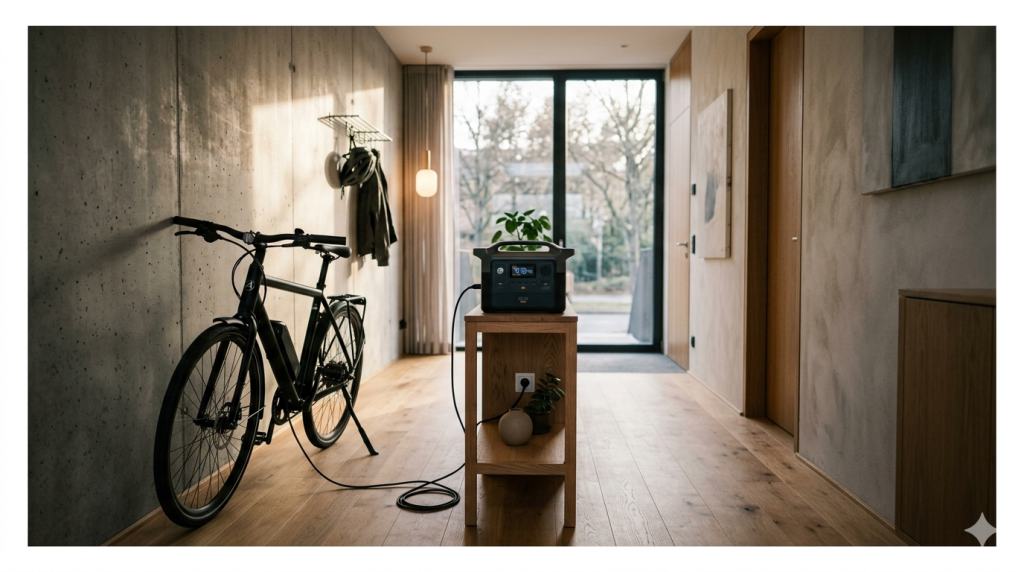
How to Charge an Ebike With a Portable Power Station: The 2026 Complete Guide
By UnitVerseHQ | Updated February 2026
If you own an e-bike and live in an apartment, you already know the problem. Building garages rarely have dedicated charging infrastructure. Hauling your e-bike upstairs every night isn’t always practical. And the question every urban rider eventually asks — How to Charge an Ebike With a Portable Power Station? — has a clear, simple answer: yes, completely, and here’s exactly how to do it right.
This guide covers everything: the watt math, the safest way of charging ebike battery in apartment buildings, which portable power station to buy, how to use a portable power station as ebike battery backup on the road, and a complete breakdown of e-bike types and their charging requirements. Whether you ride a class 1 e bike, a class 2 e bike, a cycrown e bike, an RTR e bike, or a fat-tire e bike chopper, the power station strategy is the same and it works.
How to Charge My Electric Bike With a Power Station?
Yes. The answer to “how to charge my electric bike with a power station” is straightforward: plug your e-bike’s original charger into the power station’s AC outlet, exactly as you would plug into a wall socket. The portable power station converts stored battery energy into standard AC power through its inverter, your e bike charger sees clean AC current, and your e-bike battery charges normally.
There is no special adapter needed. There is no modification required. There is no compatibility issue between your e bike charger and a quality portable power station — as long as two conditions are met:
Condition 1: The power station has a pure sine wave inverter. This produces clean AC power identical to the grid. Avoid modified sine wave units, which can cause voltage irregularities that damage sensitive charger electronics over time. Every unit recommended in this guide uses pure sine wave output.
Condition 2: The power station’s continuous AC output wattage exceeds your e-bike charger’s draw. Most standard e bike charger units pull 100W–250W. Any portable power station with 300W+ continuous output handles this comfortably.
That’s it. If you’ve been hesitating to charge ebike with portable power station due to uncertainty about compatibility — stop hesitating. It works exactly as described.
E-Bike Battery Basics: What You Need to Know Before Running the Numbers
Before calculating how many times you can charge ebike with portable power station capacity, you need to understand your e-bike’s battery specification. This is simpler than most guides make it.
Voltage × Amp-Hours = Watt-Hours
Every e-bike battery has two key numbers stamped on its casing or listed in the manual: voltage (V) and amp-hours (Ah). Multiply them together to get watt-hours (Wh) — the number you need for all power station calculations.
| E-Bike Battery Type | Voltage | Amp-Hours | Watt-Hours |
|---|---|---|---|
| Small commuter (entry level) | 24V | 10Ah | 240Wh |
| Mid-size city/commuter | 36V | 10Ah | 360Wh |
| Standard urban e-bike | 36V | 14Ah | 504Wh |
| Performance urban / class 2 e bike | 48V | 13Ah | 624Wh |
| Full-size class 1 e bike / trail | 48V | 15Ah | 720Wh |
| High-capacity touring / cargo | 52V | 20Ah | 1,040Wh |
| Premium long-range / e bike chopper style | 72V | 20Ah | 1,440Wh |
Finding your battery’s Wh number takes 30 seconds — check the battery label, the manual, or search your model number plus “battery wh.” This is the single most important number for sizing your portable power station correctly.
Understanding Your Battery Gauge for E Bike
Your battery gauge for e bike is the most practical tool for managing a portable power station charging workflow. Most modern e-bikes display battery state of charge as a percentage or a segmented bar indicator. Understanding what your battery gauge for e bike actually means in watt-hours lets you make smarter decisions about when and how much to charge from a portable station.
If your 720Wh battery shows 40% remaining on the battery gauge, you have approximately 288Wh left — and need to replenish approximately 432Wh to reach full charge (accounting for charger efficiency losses, a 720Wh battery needs roughly 780–800Wh input to charge from empty).
This matters because you often don’t need a full charge from your power station — just enough to top up for tomorrow’s commute. A 500Wh station that can’t deliver a full charge from empty can still deliver two partial top-up charges of 200Wh each, which may be all your battery gauge for e bike workflow requires.
How Many Times Can a 1000Wh Power Station Charge an Ebike?
This is the most-searched question in the charge ebike with portable power station category — and the answer depends entirely on your e-bike’s battery size.
The calculation is:
Charges = Station Capacity (Wh) × 0.85 ÷ E-Bike Battery (Wh)
The 0.85 factor accounts for inverter efficiency and charger conversion losses. Using a 1,000Wh station as the baseline:
| E-Bike Battery Size | Usable Station Energy | Full Charges | Practical Use |
|---|---|---|---|
| 240Wh (24V 10Ah) | 850Wh | 3.5 full charges | 4 days of commuting |
| 360Wh (36V 10Ah) | 850Wh | 2.4 full charges | 2–3 commute days |
| 504Wh (36V 14Ah) | 850Wh | 1.7 full charges | 1–2 commute days |
| 624Wh (48V 13Ah) | 850Wh | 1.4 full charges | 1 full + partial charge |
| 720Wh (48V 15Ah) | 850Wh | 1.2 full charges | 1 full charge + small buffer |
| 1,040Wh (52V 20Ah) | 850Wh | 0.8 full charges | ~80% charge only |
The honest answer to “how many times can a 1000wh power station charge an ebike”: For the most common urban e-bike batteries (36V 10–14Ah / 360–504Wh), a 1,000Wh station delivers 1.7–2.4 full charges per station cycle. For high-capacity batteries (720Wh+), budget for one full charge per station cycle plus wall top-up as needed.
Scaling Up: 2000Wh Station Doubles Everything
| E-Bike Battery Size | Full Charges from 2,000Wh Station |
|---|---|
| 360Wh | 4.7 full charges |
| 504Wh | 3.4 full charges |
| 720Wh | 2.4 full charges |
| 1,040Wh | 1.6 full charges |
A 2,000Wh station paired with a 200W balcony solar panel adds 600–900Wh of daily recharge — meaning for most standard e-bike batteries, you can maintain a continuous charge ebike with portable power station workflow indefinitely without ever touching a wall outlet.
Best Portable Power Station for Ebike Charging 2026
Not every portable power station is equally suited for e-bike charging. Here’s the complete 2026 comparison for the best portable power station for ebike charging 2026:
Master Comparison Table
| Unit | Capacity | AC Output | Surge | Battery | Solar In | Weight | Price | E-Bike Verdict |
|---|---|---|---|---|---|---|---|---|
| EcoFlow RIVER 2 Pro | 768Wh | 800W | 1,600W | LiFePO4 | 220W | 17.6 lbs | ~$449 | ✅ Best for 360–504Wh batteries |
| EcoFlow DELTA 2 | 1,024Wh | 1,800W | 2,700W | LiFePO4 | 500W | 27 lbs | ~$799 | ✅ Best overall for 720Wh batteries |
| Bluetti EB70S | 716Wh | 800W | 1,400W | LiFePO4 | 200W | 21.4 lbs | ~$449 | ✅ Budget pick, 1 full charge of 504Wh |
| Bluetti AC180 | 1,152Wh | 1,800W | 2,700W | LiFePO4 | 500W | 35 lbs | ~$799 | ✅ Quietest option, 1.5× 720Wh charges |
| Jackery Explorer 1000 Pro | 1,002Wh | 1,000W | 2,000W | NMC | 400W | 25.4 lbs | ~$749 | ✅ Best portability for van/travel riders |
| EcoFlow DELTA 2 Max | 2,048Wh | 2,400W | 5,000W | LiFePO4 | 1,000W | 50 lbs | ~$1,399 | ✅ Best for 1,040Wh+ cargo/touring bikes |
| Anker SOLIX C1000 | 1,056Wh | 1,800W | 2,400W | LiFePO4 | 600W | 27.3 lbs | ~$799 | ✅ Best app monitoring for charging workflow |
Top Pick: EcoFlow DELTA 2 for Most Riders
For the majority of urban apartment renters looking to charge ebike with portable power station equipment, the EcoFlow DELTA 2 is the clear recommendation for the best portable power station for ebike charging 2026:
- 1,024Wh capacity — delivers 1.2 full charges of a 720Wh battery or 2.4 full charges of a 360Wh battery
- 1,800W continuous AC output — handles any standard e bike charger including fast chargers pulling 250W+
- LiFePO4 chemistry — 3,000+ cycle life means the station outlasts your e-bike by years
- 500W solar input — pair with a 220W balcony panel for daily solar-assisted recharge
- 50-minute fast charge — recharges to 80% faster than most e-bike rides
Budget Pick: Bluetti EB70S for Smaller Batteries
For riders with 36V 10–14Ah batteries (360–504Wh range) — common on cycrown e bike, ridestar e bikes, and similar mid-market brands — the Bluetti EB70S at ~$449 is the best portable power station for ebike charging 2026 on a budget. LiFePO4 chemistry, 716Wh capacity, and 800W output handle standard e-bike chargers without issue.
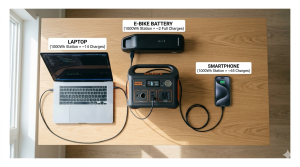
Charging Ebike Battery in Apartment Safely
Charging ebike battery in apartment buildings is a topic that has gotten serious regulatory attention since 2022–2023, when a wave of e-bike battery fires in New York City and other dense urban markets caused significant property damage and fatalities. Those fires were almost exclusively caused by cheap, uncertified lithium-ion batteries in budget e-bikes — not by quality charging setups.
Here’s what you need to know to charge ebike battery in apartment environments safely and responsibly.
The Real Risk: Cheap NMC Batteries, Not Proper Charging
The fires that prompted New York City’s Local Law 39 (2023) and similar ordinances in Chicago, Boston, and LA were concentrated in one specific failure mode: thermal runaway in substandard NMC lithium cells in uncertified e-bikes. Brands like those using generic unbranded cells with no battery management system caused essentially all the incidents.
If your e-bike is from a reputable manufacturer — class 1 e bike or class 2 e bike models from brands like Trek, Specialized, Rad Power, Aventon, or established direct-to-consumer brands — and uses a quality e bike charger from that manufacturer, your charging ebike battery in apartment risk profile is genuinely low.
The portable power station adds zero additional risk to this equation. You’re still using your original e bike charger — the power station is simply replacing the wall outlet.
Safety Rules for Charging Ebike Battery in Apartment
Rule 1: Always use your original e bike charger. Never substitute third-party chargers that weren’t designed for your specific battery. The BMS (Battery Management System) in your e-bike battery communicates with the original charger. Third-party chargers bypass this communication and are responsible for the majority of charging-related incidents.
Rule 2: Charge on hard, non-flammable surfaces. Never charge your e-bike battery on carpet, upholstered furniture, or bedding. Charge on tile, concrete, or hardwood — same rule applies when using a portable power station as the power source.
Rule 3: Don’t charge overnight unattended if avoidable. Most quality e-bike chargers have auto-shutoff. Still, the safest practice for charging ebike battery in apartment environments is to charge during waking hours when you can respond to any anomaly.
Rule 4: Keep the charging area ventilated. Don’t charge in a closed closet or under a bed. Normal room ventilation is sufficient — just don’t seal the space.
Rule 5: Check your lease and local ordinances. Some buildings have added specific e-bike charging language since 2023. Using a portable power station to charge in your apartment rather than the garage may actually be the compliant solution — verify your building’s specific rules.
Charging Ebike Battery in Apartment: The Portable Power Station Advantage
Here’s something most guides don’t address: using a portable power station as ebike battery backup actually has a specific safety advantage over garage charging in many apartment buildings.
Uncertified building wiring, overloaded circuits, and shared garage electrical panels are all risk factors that disappear when you charge ebike with portable power station equipment in your own apartment on a dedicated circuit. You control the environment. You’re using your original e bike charger. You’re monitoring the process. That’s a safer setup than plugging into an unknown garage outlet that may be on the same circuit as ten other devices.
E-Bike Types and Their Power Station Requirements
Different e-bike categories have meaningfully different battery sizes and therefore different portable power station requirements. Here’s the breakdown by type:
Class 1 E Bike
A class 1 e bike is pedal-assist only, with motor assistance cutting off at 20 mph. These are the most common urban commuter bikes and are legal on virtually all US bike paths and trails. Typical battery sizes: 36V 10–14Ah (360–504Wh).
Power station recommendation for class 1 e bike charging: EcoFlow RIVER 2 Pro (768Wh) — delivers 1.5–2 full charges per station cycle. Lightweight at 17.6 lbs, easy to store in a studio apartment.
Class 2 E Bike
A class 2 e bike adds a throttle, allowing motor operation without pedaling, still limited to 20 mph. Popular for cargo hauling, commuters who want more flexibility, and riders recovering from injuries. Battery sizes typically: 48V 13–15Ah (624–720Wh).
Power station recommendation for class 2 e bike charging: EcoFlow DELTA 2 (1,024Wh) — delivers 1.2–1.4 full charges per cycle. The 2,700W surge handles any 48V fast charger without hesitation.
Cycrown E Bike
Cycrown e bike models are popular mid-market fat-tire e-bikes with strong Amazon presence and competitive pricing. Most Cycrown models use 48V 15–20Ah batteries (720–960Wh). For cycrown e bike owners specifically, the EcoFlow DELTA 2 delivers approximately one full charge per station cycle — plan on daily wall recharge of the station to maintain a continuous workflow.
RTR E Bike
The RTR e bike category refers to high-performance ready-to-ride e-bikes built for aggressive trail use and performance riding. RTR e bike models typically use higher-voltage systems (52V or 72V) with large 20Ah+ batteries (1,040–1,440Wh). For RTR e bike owners, the standard 1,024Wh station is insufficient for a full charge. The EcoFlow DELTA 2 Max (2,048Wh) is the minimum recommendation, delivering approximately 1.3 full charges of a 1,040Wh RTR e bike battery per cycle.
E Dash Bike
The e dash bike — compact, folding-friendly urban commuters designed for multimodal transit — typically has the smallest batteries in the e-bike market: 24V–36V systems at 6–10Ah (144–360Wh). For e dash bike owners, even a modest 500Wh station delivers 1–3 full charges. The Bluetti EB70S (716Wh) handles three full charges of a standard e dash bike battery per station cycle.
E Bike Chopper
The e bike chopper style — wide handlebars, low-slung frame, oversized e bike tires, and a distinctly retro aesthetic — has become one of the fastest-growing e-bike segments in the US market. E bike chopper models from brands like Electra, Revi Bikes, and several Chinese direct-to-consumer manufacturers typically use 48V–52V systems with 15–20Ah batteries (720–1,040Wh).
For e bike chopper owners: EcoFlow DELTA 2 handles the 720Wh end of the range (1.2 full charges). For 1,040Wh chopper batteries, step up to the DELTA 2 Max for a complete charge in one station cycle.
Ridestar E Bikes
Ridestar e bikes occupy the budget-to-mid-range urban commuter segment with 36V 10–13Ah batteries (360–468Wh). For ridestar e bikes owners, the EcoFlow RIVER 2 Pro (768Wh) is the right-sized, right-priced power station — delivering 1.6–2.1 full charges per station cycle at the most compact and affordable form factor in the recommended lineup.
Portable Power Station as Ebike Battery Backup: Beyond the Apartment
Using a portable power station as ebike battery backup extends far beyond apartment charging. Here are the use cases that make a power station genuinely valuable for e-bike riders:
Range Extension on Long Rides
The most underrated use of a portable power station as ebike battery backup is range extension during long-distance rides or tours. Load the power station into a cargo basket, trailer, or rear rack bag, and you carry a full additional charge’s worth of power with you.
For a rider on a standard 36V 14Ah bike with 50-mile range, a 1,024Wh power station provides effectively another 50 miles of range — turning a single-day ride into a multi-day tour without grid dependence.
Trail Parking Lot Charging
Trailhead parking lots rarely have charging infrastructure. A power station in the car trunk means your class 1 e bike or class 2 e bike charges while you’re on the trail — arrive with a depleted battery, leave with a full one, no outlet required.
Camping and Bikepacking
Bikepacking with an e-bike creates a specific challenge: how do you recharge in the backcountry? A portable power station as ebike battery backup paired with a 100W foldable solar panel on top of your gear creates a genuinely self-sufficient charging ecosystem. Charge the station during the day via solar while you ride; charge the e-bike from the station at camp.
For bikepacking specifically, act best e bike touring models with 52V 20Ah batteries (1,040Wh) require large stations — the EcoFlow DELTA 2 Max (2,048Wh) is the minimum practical choice for two full charges per camp stop.
Emergency Backup at Home
Even riders who normally charge from the wall should consider a portable power station as ebike battery backup for outage scenarios. If your morning commute depends on your e-bike and a storm knocks out the grid overnight, a charged power station is the difference between making it to work and being stranded.
E-Bike Accessories and the Power Station Ecosystem
A portable power station doesn’t just charge ebike batteries — it powers the full ecosystem of e-bike accessories and charging needs:
E Bike Lighting
E bike lighting systems range from simple USB-rechargeable LED lights to integrated systems powered directly from the main battery. USB-rechargeable e bike lighting — front and rear lights, helmet lights, bar-end indicators — charges directly from your power station’s USB-A or USB-C ports at negligible power cost (10–20Wh per full set of lights). Never ride without lights, and never let a dead power bank be the reason your e bike lighting fails on a night commute.
E Bike Tires and Pumps
Electric tire pumps for maintaining e bike tires pressure draw 60–100W and typically run for 2–5 minutes per tire — consuming under 15Wh total. Any portable power station handles this effortlessly. Keeping correct e bike tires pressure (typically 20–30 PSI for fat tires, 50–80 PSI for road-style tires) is one of the most impactful range-maintenance habits an e-bike owner can develop, and a portable power station makes it possible anywhere.
E Bike Seat and Accessory Charging
Heated e bike seat systems, GPS trackers, phone mounts with wireless charging, and action cameras all draw USB power. Your portable power station handles all of these simultaneously through its USB-A and USB-C ports while your main e bike charger draws from the AC outlet — true multi-device simultaneous charging from a single station.
E Bike Brake Pads and Maintenance Tools
Electric multi-tools and torque wrenches used for e bike brake pads adjustment and general maintenance draw 100–200W — well within any portable power station’s AC output capacity. Keeping a charged power station in your garage or storage space means maintenance tools are always powered, regardless of outlet availability.
E Bike Frame Protection and Detailing
Detailing tools, polishers, and UV protection applicators for e bike frame maintenance draw modest power (100–200W) and benefit from a power station in spaces without convenient outlets — storage units, covered parking, outdoor maintenance areas.
The Charging Workflow: Day-by-Day Real-World Scenarios
Scenario 1: The Daily Urban Commuter (Chicago, IL)
Bike: Cycrown e bike, 48V 15Ah (720Wh battery) Commute: 12 miles round trip, using ~200Wh per day Power station: EcoFlow DELTA 2 (1,024Wh)
Workflow:
- Monday morning: station fully charged (1,024Wh available)
- Monday–Wednesday commutes: 200Wh × 3 = 600Wh consumed
- Wednesday evening: charge ebike with portable power station — delivers 200Wh top-up, station at ~370Wh remaining
- Wednesday night: plug station into wall for overnight recharge
- Thursday–Friday: station fully charged, cycle repeats
This rider never needs to touch a wall outlet with their e bike charger — the portable station handles mid-week top-ups, wall charging handles station recharge overnight.
Scenario 2: The Apartment Renter Without Garage Access (Brooklyn, NY)
Bike: Class 2 e bike, 48V 13Ah (624Wh) Building: No e-bike charging in garage (banned post-2023 ordinance on uncertified bikes) Power station: EcoFlow DELTA 2 (1,024Wh)
Workflow:
- Rides e-bike upstairs to apartment 3× per week
- Charging ebike battery in apartment on hard kitchen floor using original charger through power station AC outlet
- Station recharges from apartment wall outlet in 50 minutes
- Never violates lease (power station is a consumer appliance)
- Battery gauge for e bike stays consistently above 60%
This is the most practical urban solution to the apartment e-bike charging problem — and it’s entirely legal, entirely safe with a certified LiFePO4 station and original charger.
Scenario 3: The Weekend Trail Rider (Denver, CO)
Bike: RTR e bike, 52V 20Ah (1,040Wh) Use case: Weekend trail rides, 30–40 miles per session Power station: EcoFlow DELTA 2 Max (2,048Wh) + 220W panel
Workflow:
- Friday night: charge station from wall to 100%
- Saturday: drive to trailhead, 220W panel charges station in car during drive (gains ~100Wh)
- Post-ride: fully depleted RTR e bike battery charges from station in parking lot (~2 hours)
- Sunday: second ride, same workflow
- Station recharges fully from 220W panel in ~8 sun-hours
True two-day trail riding independence — no outlet needed from Friday evening to Sunday night.
Brand Recommendations for E-Bike Charging Use
EcoFlow — Best Overall for E-Bike Apartment Charging
The fastest recharge (50-minute to 80%), strongest app monitoring for tracking charging cycles, and the widest capacity range (RIVER 2 Pro through DELTA 2 Max) makes EcoFlow the top ecosystem for riders who charge ebike with portable power station equipment daily.
Bluetti — Best for Quiet Overnight Charging
If you charge your e dash bike or ridestar e bikes overnight while sleeping, Bluetti’s quieter fan operation makes the AC180 and EB70S the better choice. At moderate AC loads (standard e bike charger pulling 150–200W), Bluetti units run near-silently.
Jackery — Best for Trail and Van Riders
Jackery’s Explorer 1000 Pro at 25.4 lbs is the most genuinely portable 1,000Wh option. For trail riders who load the station into a vehicle and bring it to trailheads, the weight advantage matters. The SolarSaga panel ecosystem is the most outdoor-friendly solar integration available.
📎 For the complete portable power station comparison including EcoFlow vs Jackery 2026, LiFePO4 safety guide, and apartment renter’s buying matrix, see our Comprehensive Manual → Article #5
E-Bike Charging Decision Matrix
| E-Bike Type / Battery Size | Recommended Station | Full Charges Per Cycle | Notes |
|---|---|---|---|
| E dash bike (144–240Wh) | Bluetti EB70S (716Wh) | 3–4 full charges | Most affordable pairing |
| Class 1 e bike (360–504Wh) | EcoFlow RIVER 2 Pro (768Wh) | 1.7–2 full charges | Best size/price for commuters |
| Class 2 e bike (624Wh) | EcoFlow DELTA 2 (1,024Wh) | 1.4 full charges | Recommended minimum |
| Cycrown e bike (720Wh) | EcoFlow DELTA 2 (1,024Wh) | 1.2 full charges | Standard pick for this brand |
| Ridestar e bikes (360–468Wh) | EcoFlow RIVER 2 Pro (768Wh) | 1.6–2 full charges | Right-sized, best value |
| E bike chopper (720–1,040Wh) | EcoFlow DELTA 2 / DELTA 2 Max | 0.8–1.2 full charges | Step up to Max for 1,040Wh |
| RTR e bike (1,040–1,440Wh) | EcoFlow DELTA 2 Max (2,048Wh) | 1.3–1.7 full charges | Max is minimum for RTR |
| Cargo / touring (1,040Wh+) | EcoFlow DELTA 2 Max (2,048Wh) | 1.3+ full charges | Solar pairing essential |
Frequently Asked Questions
Can I charge my electric bike with a power station?
Yes — completely and safely. To charge ebike with portable power station equipment, plug your original e bike charger into the power station’s AC outlet exactly as you would into a wall socket. Use a pure sine wave power station (all major brands: EcoFlow, Bluetti, Jackery) and ensure the continuous wattage exceeds your charger’s draw (typically 100–250W). No modifications, no special adapters, no compatibility issues.
How many times can a 1000Wh power station charge an ebike?
For a standard 36V 10Ah battery (360Wh): approximately 2.4 full charges. For a 48V 15Ah battery (720Wh): approximately 1.2 full charges. The formula is: station capacity × 0.85 ÷ battery Wh. The 0.85 factor accounts for inverter and charger conversion losses. For most urban commuter e-bikes, one 1,000Wh station provides 1–2 full charges per station cycle.
What is the best portable power station for ebike charging in 2026?
The EcoFlow DELTA 2 (1,024Wh) is the best portable power station for ebike charging 2026 for most riders. It handles all standard e bike charger loads (up to 1,800W continuous), uses LiFePO4 chemistry for safe apartment use, recharges to 80% in 50 minutes, and accepts up to 500W of solar input. Budget pick: Bluetti EB70S (~$449) for bikes with batteries under 504Wh.
Is charging ebike battery in apartment safe?
Yes, with the right equipment and habits. Use your original e bike charger (never third-party substitutes), charge on hard non-flammable surfaces, keep the area ventilated, and avoid charging unattended overnight when possible. Using a certified LiFePO4 portable power station as ebike battery backup source adds no additional risk — you’re still using the same original charger, just with the power station replacing the wall outlet.
What’s the difference between a class 1 e bike and class 2 e bike for charging purposes?
A class 1 e bike is pedal-assist only (motor cuts off at 20 mph) and typically uses smaller 36V batteries (360–504Wh). A class 2 e bike adds throttle control and commonly uses larger 48V batteries (624–720Wh). For power station sizing: class 1 e bike owners can use a 768Wh station comfortably; class 2 e bike owners should step up to 1,024Wh minimum for a full charge per cycle.
Can I use a portable power station as ebike battery backup on a trail ride?
Absolutely. A portable power station as ebike battery backup in a vehicle trunk or cargo trailer provides range extension beyond your battery’s native capacity. For trailhead charging, place the station in the parking lot (shaded if possible), plug in your e bike charger, and charge during rest or meal breaks — most 720Wh batteries reach full charge in 4–6 hours from a 150W charger.
What power station do I need for an RTR e bike?
RTR e bike batteries typically run 52V–72V at 20Ah+ (1,040–1,440Wh). A standard 1,024Wh station cannot deliver a full charge. The EcoFlow DELTA 2 Max (2,048Wh) is the minimum practical recommendation, delivering 1.2–1.7 full charges per station cycle depending on specific RTR e bike battery configuration.
Does the e dash bike need a different charging approach?
No — the process to charge ebike with portable power station is identical regardless of e-bike type. The difference is scale: an e dash bike with a 240Wh battery charges 3–4 times from a single 716Wh Bluetti EB70S station cycle, making even budget power stations highly practical for e dash bike owners.
Can I charge my cycrown e bike from a power station in my apartment?
Yes. Cycrown e bike models with 48V 15–20Ah batteries (720–960Wh) charge normally from any power station with 800W+ AC output and 1,024Wh+ capacity. The EcoFlow DELTA 2 is the recommended pairing — one full charge per station cycle, with the station rechargeable from your apartment wall outlet in under 50 minutes via GaN adapter.
How do I monitor my charging session?
Use your battery gauge for e bike to track the e-bike’s state of charge, and your power station’s app (EcoFlow, Bluetti, and Anker all have capable mobile apps) to monitor real-time wattage draw, estimated session duration, and remaining station capacity simultaneously. This two-app monitoring approach gives you complete visibility into every charge ebike with portable power station session.
UnitVerseHQ covers portable power, e-bike technology, and apartment energy solutions for American riders and renters. All specifications reflect market data as of February 2026. Prices are approximate and subject to change. Always verify compatibility with your specific e-bike manufacturer before modifying charging workflows.