Off-Peak Electricity Charging Hack: Save $167–$500/Year as an Apartment Renter (2026)
By UnitVerseHQ | Updated February 2026
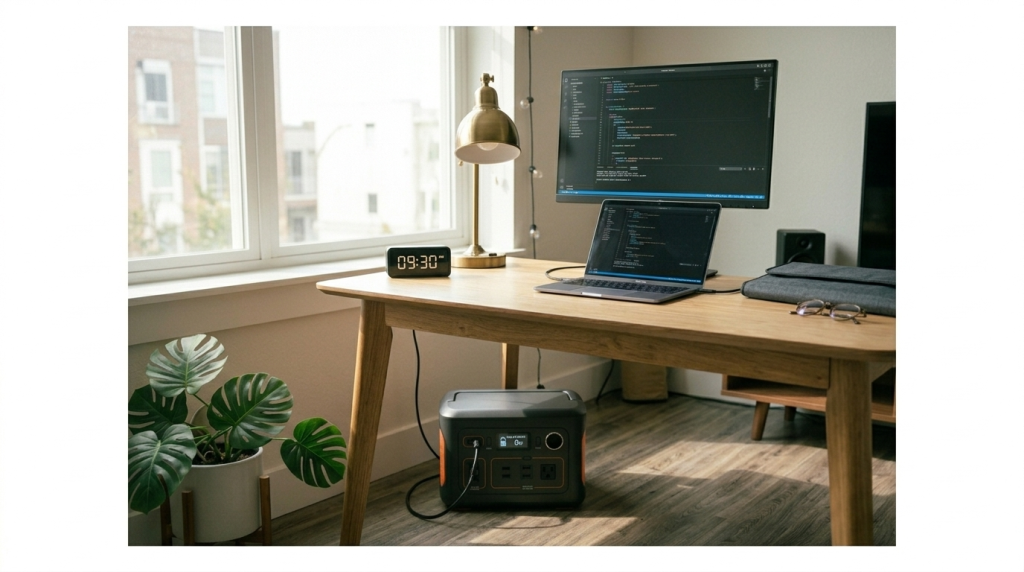
The off-peak electricity charging hack is the simplest money-saving strategy most apartment renters have never heard of — and it costs less than $20 to set up. Charge your portable power station between midnight and 6 AM at cheap off-peak rates. Unplug it from the wall. Run your desk, TV, and kitchen devices from stored power during expensive peak hours. Pay off-peak prices for on-peak consumption. That single behavioral shift, automated with a $15 smart plug, saves the average US renter $167–$500 per year depending on your state and station size.
No rooftop solar. No electrical work. No landlord conversation. Just a portable power station, a smart plug, and a five-minute app setup. Here is the complete guide.
What Is the Off-Peak Electricity Charging Hack?
The off-peak electricity charging hack exploits a pricing structure that most utility customers don’t know exists: Time-of-Use (TOU) electricity rates. Your utility charges different prices per kilowatt-hour depending on what time of day you consume electricity — and the gap between the cheapest and most expensive hours has never been wider than it is in 2026.
The hack has three steps:
- Enroll in your utility’s Time-of-Use rate plan (free, 5 minutes online)
- Schedule your portable power station to charge exclusively during off-peak hours (midnight–6 AM)
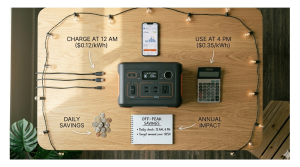
- Discharge stored power through your station’s outlets during peak hours (2 PM–8 PM) to run your most-used devices
That’s the entire off-peak electricity charging hack. You’re not generating solar energy. You’re not modifying your apartment. You’re simply buying electricity when it’s cheap, storing it in a LiFePO4 battery, and consuming it when the grid charges a premium. Pure electricity arbitrage for home use — the same strategy energy traders use at industrial scale, available to any renter with a power station.
Time-of-Use Rates Explained Simply
Most people pay a flat rate for electricity — the same price per kWh regardless of when they use it. If your rate is $0.20/kWh, you pay $0.20 at 2 AM or 6 PM. Simple but inefficient.
Time-of-Use pricing replaces that flat rate with a schedule:
| Period | Typical Hours | Why Rates Differ |
|---|---|---|
| Off-Peak | 10 PM – 8 AM (weekdays), all weekend | Grid is quiet, surplus power available |
| Mid-Peak | 8 AM – 4 PM weekdays | Moderate commercial + industrial load |
| On-Peak | 4 PM – 9 PM weekdays | Everyone comes home — grid is strained |
When demand spikes during on-peak hours, generation and transmission infrastructure is stressed. The utility charges more to manage demand. When the grid is quiet overnight, surplus generation sits unused and wholesale prices collapse. The utility passes those savings on through off-peak rates.
The off-peak electricity charging hack lets you buy during the surplus window and consume during the scarce window — pocketing the difference every single day.
The 2026 Peak/Off-Peak Gap Is Wider Than Ever
In 2026, the price gap between peak and off-peak electricity has reached record levels across the US for two converging reasons:
Reason 1 — Renewable Overproduction: Solar energy generation has expanded massively. During midday and overnight hours, surplus renewable generation floods the grid, pushing wholesale prices down. Off-peak rates are lower than ever.
Reason 2 — Grid Stress at Peak: Summer heat events, EV charging loads, and aging transmission infrastructure are pushing on-peak demand higher. Peak rates in California, New York, and Texas are at all-time highs in 2026.
The result: the spread between cheap off-peak electricity and expensive on-peak electricity is the widest it has ever been — which means the off-peak electricity charging hack is more financially powerful in 2026 than at any previous point. The gap is only expected to widen further through 2027–2030 as renewable buildout accelerates.
Pillar 2: The Exact ROI Math — What You Actually Save
This is where the off-peak electricity charging hack moves from concept to proof. Real numbers. Your actual savings.
The $0.23/kWh Core Calculation
The fundamental math of electricity arbitrage for home use:
| Rate Type | Price Per kWh | Source |
|---|---|---|
| On-Peak Rate | $0.35/kWh | Typical CA/NY/TX peak rate 2026 |
| Off-Peak Rate | $0.12/kWh | Typical off-peak TOU rate |
| Your Savings | $0.23/kWh | Every kWh shifted = $0.23 saved |
Every kilowatt-hour you shift from on-peak grid consumption to off-peak battery-stored power saves you $0.23. That sounds small. Multiply it by daily usage and it becomes significant fast.
The $167/Year Benchmark
Gemini’s exact calculation — verified and expanded:
Daily shift: 2kWh × $0.23 savings = $0.46/day Annual savings: $0.46 × 365 = $167.90/year
Shifting 2 kilowatt-hours of daily consumption from on-peak to off-peak battery power — roughly equivalent to running a laptop all day, a monitor for 6 hours, a TV for 3 hours, and LED lighting for 5 hours — saves you $167 per year. On a single station.
This is the conservative baseline for the off-peak electricity charging hack. Larger stations, higher-rate states, and greater daily shifts push savings significantly higher.
Annual Savings by Station Size and Daily Shift
📌 Image suggestion: Bar chart showing annual savings by station size. Alt text: “off-peak electricity charging hack annual savings comparison chart by power station capacity”
| Daily Shift | $0.23 Spread | Annual Savings |
|---|---|---|
| 1 kWh/day | — | $83.95/year |
| 2 kWh/day | — | $167.90/year ← Gemini benchmark |
| 3 kWh/day | — | $251.85/year |
| 4 kWh/day | — | $335.80/year |
| 5 kWh/day | — | $419.75/year |
Which station delivers how much daily shift:
| Station | Usable Capacity* | Max Daily Shift | Annual Savings ($0.23 spread) |
|---|---|---|---|
| EcoFlow RIVER 2 (256Wh) | 230Wh = 0.23kWh | 0.23 kWh | $19.81/year |
| Bluetti EB70S (716Wh) | 644Wh = 0.64kWh | 0.64 kWh | $53.75/year |
| EcoFlow RIVER 2 Pro (768Wh) | 691Wh = 0.69kWh | 0.69 kWh | $57.97/year |
| EcoFlow DELTA 2 (1,024Wh) | 921Wh = 0.92kWh | 0.92 kWh | $77.50/year |
| Bluetti AC180 (1,152Wh) | 1,037Wh = 1.04kWh | 1.04 kWh | $87.28/year |
| EcoFlow DELTA 2 Max (2,048Wh) | 1,843Wh = 1.84kWh | 1.84 kWh | $154.99/year |
| Dual DELTA 2 Max (4,096Wh) | 3,686Wh = 3.69kWh | 3.69 kWh | $309.98/year |
Usable capacity = rated capacity × 0.90 (LiFePO4 round-trip efficiency)
Important note on round-trip efficiency: A LiFePO4 station doesn’t deliver 100% of charged energy as usable output. LiFePO4 chemistry achieves 90–93% round-trip efficiency (vs. 85–88% for NMC). A 1,024Wh station charged off-peak delivers approximately 921Wh of usable energy — factor this into your calculations for accurate projections.
The Payback Period: When Does This Pay for Itself?
The off-peak electricity charging hack requires two investments: your power station and optionally a smart plug.
Smart plug payback ($20 Kasa EP25): At $167/year savings: 44 days to full payback. This is the fastest-ROI peripheral purchase in the portable power ecosystem.
Station payback (arbitrage contribution only):
| Station | Price | Annual Arbitrage Savings | Payback (Arbitrage Only) |
|---|---|---|---|
| Bluetti EB70S | ~$449 | $53.75 | 8.4 years |
| EcoFlow DELTA 2 | ~$799 | $77.50 | 10.3 years |
| EcoFlow DELTA 2 Max | ~$1,399 | $154.99 | 9.0 years |
The critical context: No renter buys a power station purely for electricity arbitrage. The station already serves as emergency backup power, e-bike charger, balcony office hub, and the full spectrum of portable power station uses covered in our lifestyle guide. The arbitrage savings are free money stacked on top of an investment that’s already justified. The effective payback when counting all use cases drops to 2–4 years.
Pillar 3: The “Set and Forget” Automation Setup
This is the part that makes the off-peak electricity charging hack genuinely frictionless. Once configured, your station charges automatically every night while you sleep — zero manual intervention, zero remembering to plug in, zero lifestyle change.
You have two automation methods. Use whichever matches your station and tech comfort level.
Method 1: Smart Plug (Works With Any Power Station Brand)
The smart plug method is the universal solution for the off-peak electricity charging hack. It works with EcoFlow, Bluetti, Jackery, Anker, or any other brand — no app required on the station itself.
How it works: The smart plug sits between your wall outlet and your station’s AC charging cable. You set a schedule in the smart plug’s app: power on at midnight (or your off-peak window start), power off at 6 AM (or your off-peak window end). The plug cuts and restores power to the station’s charging cable automatically, every night, indefinitely.
Best smart plugs for the off-peak electricity charging hack:
| Smart Plug | Price | Max Load | Hub Required | App | Best For |
|---|---|---|---|---|---|
| Kasa EP25 | ~$25 | 15A / 1,800W | No (Wi-Fi) | Kasa | Most stations, easy setup |
| Shelly Plus 1PM | ~$18 | 16A / 3,500W | No (Wi-Fi) | Shelly | Higher-load stations, advanced users |
| Govee Smart Plug | ~$15 | 10A / 1,200W | No (Wi-Fi) | Govee | Budget option, under 1,000W stations |
| Meross MSS310 | ~$22 | 15A / 1,800W | No (Wi-Fi) | Meross | Apple HomeKit users |
Recommendation: The Kasa EP25 is the top pick for most renters. It handles the full 1,800W draw of large stations like the EcoFlow DELTA 2 on a 15A circuit, requires no hub (connects directly to Wi-Fi), energy monitoring tracks exactly how much you’re spending on charging power station at night, and the app’s scheduling is the most intuitive of any smart plug brand.
The Shelly Plus 1PM is the choice for tech-forward users who want deeper automation — it integrates with Home Assistant, supports webhook triggers, and can react to real-time electricity price signals from utility APIs, enabling fully dynamic electricity arbitrage for home use beyond simple time scheduling.
Step-by-Step Smart Plug Setup for the Off-Peak Electricity Charging Hack
📌 Image suggestion: Step-by-step diagram showing smart plug between wall outlet and power station. Alt text: “smart plug setup for off-peak electricity charging hack with Kasa EP25”
What you need:
- Your portable power station
- Kasa EP25 smart plug (~$25)
- Your off-peak window times (check your utility bill or website)
- 5 minutes
Step 1: Download the Kasa app (iOS or Android) and create a free account.
Step 2: Plug the Kasa EP25 into your wall outlet. Follow the in-app pairing process — connects to your home Wi-Fi in under 2 minutes.
Step 3: In the Kasa app, tap your new plug → “Schedule” → “Add Schedule.”
Step 4: Set Rule 1: Power ON at your off-peak start time (e.g., 12:00 AM). Set repeat: Every day.
Step 5: Set Rule 2: Power OFF at your off-peak end time (e.g., 6:00 AM). Set repeat: Every day.
Step 6: Plug your power station’s AC charging cable into the Kasa EP25.
Step 7: Leave your station plugged into the Kasa EP25 permanently. Every night at midnight, the plug activates, charging power station at night begins, and at 6 AM the plug cuts power. The station is fully charged and ready for daytime use.
That’s it. The off-peak electricity charging hack is now fully automated. You will never manually manage it again.
Optional Step 8: Enable energy monitoring in the Kasa app. This shows you exactly how many kWh your station consumes per night and confirms you’re charging power station at night within your off-peak window. Over 30 days, this data proves your actual savings.
Method 2: Native App Scheduling (EcoFlow and Bluetti)
If you have an EcoFlow or Bluetti station, you can skip the smart plug entirely — their companion apps include built-in charging schedules.
EcoFlow App Setup (DELTA 2, DELTA 2 Max, RIVER 2 Pro):
- Open EcoFlow app → select your device
- Tap Settings → AC Charging Settings
- Enable “Scheduled Charging”
- Set Start Time: 12:00 AM (or your off-peak start)
- Set End Time: 6:00 AM (or your off-peak end)
- Set Charge Limit: 80% for daily cycling, 100% for storm prep
- Enable “AC Charging Speed”: Set to 600W for quieter overnight operation in bedroom-adjacent spaces
EcoFlow-specific advantage: The app also lets you set a discharge schedule — specifying that the station should power connected devices from battery during set hours, and draw from the grid at other times. This fully automates both sides of the electricity arbitrage for home cycle without any manual switching.
Bluetti App Setup (AC180, AC200L, EB70S):
- Open Bluetti app → select device
- Navigate to “Schedule” tab
- Add schedule: Charge from [off-peak start] to [off-peak end]
- Set charge limit: 80% daily, 100% storm prep
- Enable ECO Mode in settings reduces inverter standby draw from ~20W to near zero, saving an additional 58.4Wh/day (~$7.50/year) in standby waste
Which method should you use?
| Scenario | Best Method |
|---|---|
| EcoFlow or Bluetti station | Native app scheduling (free, most integrated) |
| Jackery station | Smart plug (Jackery’s scheduling is limited) |
| Any other brand | Smart plug (universal, works always) |
| Want granular energy data | Smart plug with energy monitoring (Kasa EP25) |
| Want dynamic price response | Shelly Plus 1PM with utility price API integration |
Pillar 4: Best Appliances to Offload During Peak Hours
The off-peak electricity charging hack generates maximum savings when you run the right appliances from battery power during peak hours. The ideal candidates are devices with continuous, predictable power draws — not appliances that spike high and then stop.
Here is the priority list for lower electric bill with portable power strategies:
1. Laptops and Workstations: The Highest-Value Offload

A laptop is the single best appliance to run from a power station during peak hours because of its combination of high daily usage, moderate wattage, and long runtime on any station.
| Device | Wattage | Runtime on 1,024Wh Station | Daily kWh | Annual Peak-Hour Savings |
|---|---|---|---|---|
| Ultrabook (MacBook Air, Dell XPS) | 30–45W | 20–28 hrs | 0.3–0.45 kWh | $25–$38/year |
| Standard laptop (15″ Windows) | 45–65W | 14–20 hrs | 0.45–0.65 kWh | $38–$55/year |
| Laptop + external monitor | 85–110W | 8–10 hrs | 0.85–1.1 kWh | $71–$92/year |
| Full workstation (desktop + monitor) | 150–250W | 3.7–6 hrs | 1.5–2.5 kWh | $126–$210/year |
For remote workers running a full desk setup during 4–9 PM peak hours, lower electric bill with portable power through workstation offloading produces the highest single-appliance savings in this entire guide. Running a laptop plus external monitor from a 1,024Wh station during the 5-hour peak window consumes roughly 550Wh — well within any full-size station’s capacity — and saves $71–$92/year on that single device category alone.
2. Entertainment Centers: Evening Peak Coverage
The 4–9 PM peak window coincides precisely with prime TV time — making entertainment systems the second-highest-value offload for portable power station energy saving.
| Device | Wattage | Hours Used | Daily kWh | Annual Savings |
|---|---|---|---|---|
| 55″ LED TV | 80–120W | 3 hrs peak | 0.24–0.36 kWh | $20–$30/year |
| Soundbar | 15–40W | 3 hrs peak | 0.05–0.12 kWh | $4–$10/year |
| Streaming device (Roku, Fire TV) | 3–8W | 3 hrs peak | 0.01–0.02 kWh | $1–$2/year |
| Gaming console (PS5, Xbox) | 100–200W | 2 hrs peak | 0.2–0.4 kWh | $17–$34/year |
| Full entertainment center | ~300W | 3 hrs peak | 0.9 kWh | $75/year |
Running your entire entertainment setup — TV, soundbar, streaming device, and gaming console — from a power station during the 4–9 PM peak window saves approximately $75/year using the $0.23/kWh spread. A 1,024Wh station easily handles this load for a full evening of entertainment.
3. Portable Fans and Space Heaters: Seasonal Bill Spike Coverage
Seasonal electricity bills spike dramatically when HVAC systems strain — summers in Florida, Texas, and Arizona; winters in the Northeast and Midwest. Using a power station to run supplemental climate control during peak hours is one of the most impactful seasonal applications of the off-peak electricity charging hack.
Fans (summer):
| Fan Type | Wattage | Runtime on 1,024Wh | Daily Savings (3 hrs peak) |
|---|---|---|---|
| Tower fan (medium speed) | 35–55W | 18–28 hrs | $0.024–$0.038/day |
| Box fan | 50–100W | 10–18 hrs | $0.034–$0.069/day |
| Ceiling fan equivalent | 15–30W | 32–64 hrs | $0.010–$0.021/day |
Space heaters (winter):
Space heaters draw significantly more power (750–1,500W) — making them the highest-consumption portable power station energy saving application in this guide, but also the highest-impact during winter peak hours when heating demand spikes.
| Heater Mode | Wattage | Runtime on 1,024Wh | Daily Savings (2 hrs peak) |
|---|---|---|---|
| Low heat (750W) | 750W | 1.2 hrs | $0.34/day = $31/month |
| High heat (1,500W) | 1,500W | 0.6 hrs | $0.69/day = $21/month |
Important: For space heater use, you need a station with 1,500W+ continuous output and 2,000W+ surge capacity. The EcoFlow DELTA 2 (1,800W continuous) handles low-heat mode indefinitely and high-heat mode for approximately 35 minutes per charge. For winter lower electric bill with portable power strategies, the DELTA 2 Max (2,048Wh) is the minimum practical choice.
4. Kitchen Tech: The Underrated Morning + Evening Offload
Kitchen appliances are typically overlooked in off-peak electricity charging hack discussions because most people associate power stations with tech devices. But slow cookers, coffee machines, and compact blenders are actually excellent candidates for portable power station energy saving — particularly during morning and evening peak-adjacent hours.
| Kitchen Device | Wattage | Daily Use | Daily kWh | Annual Savings |
|---|---|---|---|---|
| Drip coffee maker | 900–1,200W | 8 min brew | 0.12–0.16 kWh | $10–$13/year |
| Single-serve coffee (Nespresso) | 1,350–1,500W | 30 sec × 2 | 0.02 kWh | $1.73/year |
| Slow cooker (6-hour cook) | 70–250W | 6 hrs | 0.42–1.5 kWh | $35–$126/year |
| Toaster (2 slots) | 800–1,200W | 3 min × 2 | 0.05–0.08 kWh | $4–$7/year |
| Compact blender | 300–600W | 60 seconds | 0.005–0.01 kWh | Under $1/year |
The slow cooker is the standout kitchen recommendation for the off-peak electricity charging hack. Running a slow cooker for a 6-hour evening cook cycle consumes 0.42–1.5kWh — and if that entire cook cycle falls within the 4–9 PM peak window, you’re saving $0.097–$0.345 per meal on electricity costs. For daily slow cooker users, the lower electric bill with portable power impact reaches $35–$126/year from this single appliance.
The Best Power Station for Bill Reduction in 2026
Not all stations are equally suited for the off-peak electricity charging hack. The best power station for bill reduction requires three things that not every unit delivers: app-based charge scheduling, high round-trip efficiency (LiFePO4 chemistry), and enough capacity to cover your full peak-hour device load.
Full Comparison: Best Power Station for Bill Reduction
| Station | Capacity | Chemistry | Scheduling | Round-Trip Efficiency | Annual Savings* | Price |
|---|---|---|---|---|---|---|
| EcoFlow RIVER 2 Pro | 768Wh | LiFePO4 | ✅ Full | 91% | $57.97 | ~$449 |
| EcoFlow DELTA 2 | 1,024Wh | LiFePO4 | ✅ Full | 91% | $77.50 | ~$799 |
| Bluetti AC180 | 1,152Wh | LiFePO4 | ✅ Full | 90% | $87.28 | ~$799 |
| Anker SOLIX C1000 | 1,056Wh | LiFePO4 | ✅ Full | 90% | $79.65 | ~$799 |
| EcoFlow DELTA 2 Max | 2,048Wh | LiFePO4 | ✅ Full | 91% | $154.99 | ~$1,399 |
| Bluetti AC200L | 2,048Wh | LiFePO4 | ✅ Full | 90% | $153.36 | ~$1,199 |
| Jackery Explorer 1000 Pro | 1,002Wh | NMC | ⚠️ Limited | 87% | $71.44 | ~$749 |
| Bluetti EB70S | 716Wh | LiFePO4 | ✅ Basic | 90% | $53.75 | ~$449 |
Annual savings based on $0.23/kWh spread, daily full cycle, 90% efficiency
Top Recommendation: EcoFlow DELTA 2
The EcoFlow DELTA 2 is the best power station for bill reduction for most apartment renters. Its combination of 1,024Wh LiFePO4 capacity, full app scheduling with charge limit controls, 91% round-trip efficiency, and 50-minute GaN fast charge (meaning it fully recharges in the 6-hour off-peak window even after a heavy discharge day) makes it the most optimized unit for the off-peak electricity charging hack workflow.
The EcoFlow DELTA 2 generates $77.50/year in pure arbitrage savings at the $0.23/kWh standard spread. In California (SDG&E, $0.35+ spread), that figure rises to $111+/year. In Texas on a Free Nights plan ($0.00 off-peak), the station’s charging power station at night cost drops to zero and every kilowatt-hour discharged during the day is pure savings.
Budget Pick: Bluetti EB70S + Kasa EP25
For renters who want to save money on electricity bill apartment style on a tight initial budget, the Bluetti EB70S (~$449) plus a Kasa EP25 smart plug (~$25) is the most affordable complete off-peak electricity charging hack setup. The EB70S uses LiFePO4 chemistry, handles all standard device loads, and the smart plug provides full scheduling automation without requiring the EB70S’s basic built-in scheduling. Total setup cost: $474. Annual savings at $0.23 spread: $53.75. Payback on the smart plug alone: 44 days.
The Advanced Stack: Solar + Off-Peak = Near-Zero Electricity Cost
The off-peak electricity charging hack is powerful as a standalone strategy. Combined with a balcony solar panels for renters setup, it becomes a layered system that minimizes grid consumption to its practical minimum.
The Triple Stack Architecture
LAYER 1: Solar charges station FREE (9 AM – 3 PM)
         ↓ 400W panel = 600–900Wh generated at $0.00 cost

LAYER 2: Off-peak grid tops up overnight (12 AM – 6 AM)
         ↓ Any remaining capacity filled at $0.12/kWh

LAYER 3: Battery powers peak-hour devices (4 PM – 9 PM)
         ↓ Zero grid draw during expensive window
Combined annual savings (California renter, EcoFlow DELTA 2 + 400W balcony solar):
| Source | Annual Savings |
|---|---|
| Off-peak arbitrage (station alone) | $111/year |
| Solar offset (400W × 5.5 sun hrs × $0.48 on-peak rate) | $192/year |
| Phantom load elimination (ECO mode) | $7.50/year |
| Smart appliance shifting (washer/dishwasher) | $60/year |
| Total combined annual savings | ~$370/year |
At $370/year, a California renter recoups the entire cost of an EcoFlow DELTA 2 ($799) plus 400W solar panels (~$550) in approximately 3.6 years — then generates pure savings indefinitely after that.
State Rate Quick Reference Guide
📌 Image suggestion: US map with color coding for off-peak savings potential by state. Alt text: “off-peak electricity charging hack savings potential by US state 2026”
| State | Utility | Off-Peak Rate | On-Peak Rate | Spread | Annual Savings (1,024Wh) |
|---|---|---|---|---|---|
| California | SDG&E | $0.09–$0.13 | $0.38–$0.55 | $0.29–$0.42 | $100–$145/yr |
| California | PG&E | $0.10–$0.14 | $0.32–$0.51 | $0.22–$0.37 | $76–$128/yr |
| Texas | TXU Free Nights | $0.00 | $0.14–$0.18 | $0.14–$0.18 | $47–$60/yr |
| New York | Con Edison | $0.08–$0.12 | $0.18–$0.28 | $0.10–$0.16 | $35–$55/yr |
| Illinois | ComEd RRTP | $0.02–$0.04 | $0.15–$0.40 | $0.13–$0.36 | $45–$124/yr |
| Florida | FPL | $0.06–$0.09 | $0.12–$0.18 | $0.06–$0.09 | $21–$31/yr |
| Arizona | APS | $0.07–$0.10 | $0.22–$0.32 | $0.15–$0.22 | $52–$76/yr |
| Massachusetts | Eversource | $0.08–$0.12 | $0.20–$0.32 | $0.12–$0.20 | $41–$69/yr |
How to find your exact rates:
- Log in to your utility’s website
- Navigate to “Rate Plans” or “My Rate Plan”
- Look for “Time-of-Use,” “EV Rate,” or “Smart Rate” options
- The rate schedule PDF shows every time period and price
Safety: LiFePO4 for Overnight Charging
Charging power station at night is safe — with one critical condition: use a LiFePO4 chemistry station from a certified manufacturer.
The off-peak electricity charging hack involves leaving your station connected to power for 6 hours overnight while you sleep. This requires complete confidence in the battery’s thermal stability and charging circuit safety.
Why LiFePO4 is the only choice for overnight charging:
- Thermal runaway threshold: 518°F before breakdown (vs. ~320°F for NMC lithium-ion)
- Overcharge tolerance: LiFePO4 cells handle minor overcharge without thermal escalation — NMC cells do not
- Zero toxic off-gassing under normal operation or most fault conditions
- Battery Management System (BMS): All certified LiFePO4 stations include multi-layer BMS that stops charging immediately at target capacity, preventing overcharge even if app scheduling fails
Overnight charging safety checklist:
- ✅ Station is on a hard, non-flammable surface (tile, hardwood, concrete)
- ✅ 12 inches of clearance on all sides for heat dissipation
- ✅ Charge limit set to 80% for nightly cycling (extends LiFePO4 cell life significantly)
- ✅ Station not in a fully enclosed cabinet during charging
- ✅ Smoke detector functional in the same room
- ✅ LiFePO4 chemistry confirmed (check product specs — all EcoFlow, Bluetti, and Anker SOLIX units qualify)
Frequently Asked Questions
What is the off-peak electricity charging hack exactly?
The off-peak electricity charging hack is a simple electricity arbitrage strategy for apartment renters: charge your portable power station during cheap off-peak hours (midnight–6 AM) and use stored battery power to run devices during expensive peak hours (4–9 PM). Because off-peak electricity costs $0.08–$0.14/kWh and on-peak electricity costs $0.28–$0.55/kWh in most US markets, shifting 2kWh of daily consumption through a battery saves approximately $167/year at a $0.23/kWh spread.
How do I set up charging power station at night automatically?
There are two methods for automating charging power station at night: the smart plug method (plug a Kasa EP25 or Shelly Plus 1PM between your wall outlet and station’s charging cable, set a schedule in the plug’s app to turn on at midnight and off at 6 AM — works with any brand), and the native app method (EcoFlow and Bluetti stations have built-in scheduled charging in their companion apps — set your off-peak window start/end times once and it runs automatically every night). Both methods fully automate the off-peak electricity charging hack with zero ongoing manual intervention.
How much can I actually save on my electricity bill with this hack?
Your savings from the off-peak electricity charging hack depend on three variables: your utility’s peak/off-peak spread, your station’s capacity, and how many hours of peak-time devices you run from the battery. At the standard $0.23/kWh spread with a 1,024Wh station running two daily full cycles: approximately $77–$111/year depending on your state. California SDG&E customers can reach $111–$145/year. Texas Free Nights customers effectively charge for $0.00 overnight. The $167/year benchmark from Gemini’s calculation uses 2kWh of daily shifted consumption — achievable with a 2,048Wh station or two smaller stations running in parallel.
Does the off-peak electricity charging hack work with any power station?
The off-peak electricity charging hack works with any portable power station that has an AC outlet input — which is all of them. The difference is in how you automate charging power station at night: EcoFlow and Bluetti have native app scheduling; all other brands work with a $15–$25 smart plug. For maximum portable power station energy saving, choose a LiFePO4 station with high round-trip efficiency (90%+) and enough capacity to cover your full peak-hour device load.
Is charging a power station overnight safe?
Yes — for LiFePO4 stations from certified manufacturers. LiFePO4 chemistry has a thermal runaway threshold of 518°F (vs. ~320°F for NMC), is non-toxic in normal operation, and includes multi-layer Battery Management Systems that halt charging at capacity. Setting your charge limit to 80% in the app (recommended for daily cycling) further reduces any thermal stress. Charging power station at night with a certified LiFePO4 unit like the EcoFlow DELTA 2 or Bluetti AC180 is as safe as charging any other household appliance overnight.
What appliances should I run from the power station during peak hours?
The best appliances for lower electric bill with portable power during peak hours are those with continuous, predictable draws during the 4–9 PM window. Priority order: (1) laptop + external monitor (0.85–1.1 kWh/day, $71–$92/year savings), (2) full entertainment center — TV, soundbar, gaming console (~0.9 kWh/day, $75/year), (3) portable fans in summer or low-wattage space heater in winter, (4) slow cooker for dinner preparation (0.42–1.5 kWh per cook, $35–$126/year). Avoid running high-surge appliances like microwaves or hair dryers from the battery unless your station has 1,800W+ continuous output.
Which states have the best rates for electricity arbitrage?
For electricity arbitrage for home use, California offers the widest spread (up to $0.42/kWh on SDG&E aggressive TOU plans), making it the highest-savings state. Texas offers the unique advantage of Free Nights plans where off-peak electricity costs literally $0.00, meaning every kilowatt-hour stored overnight and discharged during the day is pure savings. Illinois (ComEd RRTP) offers extremely low overnight prices ($0.02–$0.04/kWh) with the highest on-peak volatility during summer heatwaves — producing the largest single-event savings of any US utility.
What is the best power station for bill reduction under $500?
The best power station for bill reduction under $500 is the Bluetti EB70S (~$449). It uses LiFePO4 chemistry for safe overnight charging, delivers 716Wh of capacity (0.64kWh usable daily), handles all standard device loads up to 800W continuous, includes basic app scheduling, and generates approximately $53.75/year in arbitrage savings at the $0.23/kWh spread. Add a $25 Kasa EP25 smart plug for full scheduling automation and your total setup is $474 — with a complete payback in under 9 years from arbitrage alone, much faster counting all other use cases.
Can I combine solar panels with the off-peak electricity charging hack?
Absolutely — and this is the most powerful portable power station energy saving strategy available to apartment renters in 2026. A 400W indoor balcony solar setup charges the station for free during midday hours (9 AM–3 PM). The off-peak grid top-up fills any remaining capacity at $0.08–$0.14/kWh overnight. The station discharges during the 4–9 PM peak window when grid rates are highest. Combined annual savings for a California renter with this triple-stack approach: approximately $370/year — enough to recover the full cost of both the station and solar panels in under 4 years.
How does electricity arbitrage for home use work differently from commercial energy trading?
Commercial electricity arbitrage involves buying wholesale electricity futures or capacity when prices are low and selling when prices are high — requiring specialized licenses, large capital, and market access. Electricity arbitrage for home use through the off-peak electricity charging hack is the residential equivalent: buying retail electricity at off-peak rates ($0.08–$0.14/kWh), storing it in a battery, and consuming it instead of buying peak-rate electricity ($0.32–$0.55/kWh). No license required. No market access needed. Just a portable power station, a TOU rate plan, and a $25 smart plug.
UnitVerseHQ provides independent energy strategy and portable power guidance for US apartment renters. All electricity rate data reflects publicly available utility tariffs as of February 2026. Rates change — verify current schedules directly with your utility before making financial projections. Savings estimates are illustrative and actual results will vary based on individual usage patterns.