
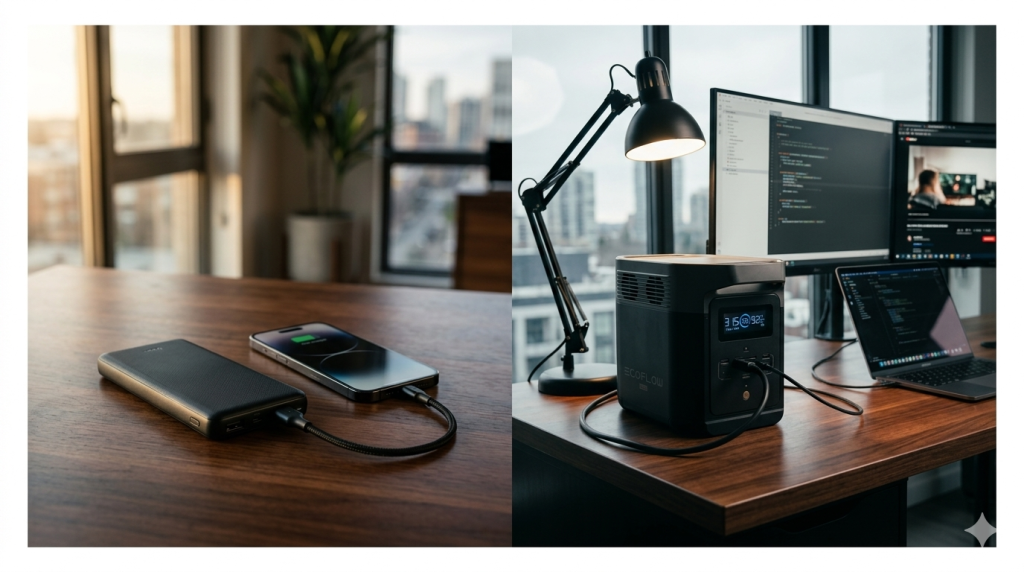
Portable Power Station vs Power Bank: The Complete 2026 Guide (Don’t Buy the Wrong One)
By UnitVerseHQ | Updated February 2026
Most people searching portable power station vs power bank already know they need backup power. What they don’t know is that buying the wrong category — a power bank when you need a power station, or vice versa — means buying the product twice.
This pillar guide ends that confusion permanently. By the time you finish reading, you’ll know exactly which category serves your needs, which specific products to consider, and why the portable power station vs power bank decision is more nuanced in 2026 than it’s ever been. The market has evolved. The lines have blurred. And one wrong click on Amazon costs you $200–$800.
Let’s get it right the first time.
What Exactly Is a Power Bank? (Your Power Bank Buying Guide Starts Here)
Before making any portable power station vs power bank decision, you need an accurate definition of each — not the marketing version. The accurate one.
A power bank is a portable battery pack designed primarily to charge USB-powered devices: smartphones, tablets, earbuds, smartwatches, and small accessories. It stores energy in lithium cells (usually NMC chemistry), outputs that energy through USB-A, USB-C, or Micro-USB ports, and is sized to fit in a pocket, purse, or backpack.
The core design philosophy of a power bank is portability above all else. Weight is measured in ounces. Capacity is measured in milliamp-hours (mAh). Output is measured in watts at the USB port level — typically 5W to 100W depending on the unit.
Power Bank Specifications That Actually Matter
Most power bank buying guide content online focuses on mAh numbers without explaining what they mean. Here’s the honest breakdown:
Capacity in mAh vs. real-world charging:
- 10,000 mAh power bank → approximately 1.8–2.2 full charges of a modern smartphone (accounting for conversion losses)
- 20,000 mAh power bank → approximately 3.5–4.5 full smartphone charges
- A question like “20000 mah how many charges” has a real answer: for a standard 4,500 mAh phone battery, expect 3.5–4 full charges from a quality 20,000 mAh unit — not 4.4, because 15–20% is lost to heat and conversion inefficiency
USB-C Power Delivery (PD) wattage: Entry-level power banks output 5–18W. A proper 100 watt power bank outputs 100W through USB-C PD — fast enough to charge a MacBook Pro at near-full speed. This is the upper end of what a power bank can deliver through any USB port.
Pass-through charging: A pass through charging bank charges your devices and itself simultaneously — useful when you have a single outlet and multiple things to charge. Not all units support this; it’s worth verifying before purchase.
Power bank with flashlight: Many compact power banks include an integrated LED torch — a genuine emergency utility. A power bank with flashlight adds meaningful value for outage preparedness without adding significant size or cost. Units from Anker, Ravpower, and several others include this feature under $40.
The Best Solar Power Banks
The best solar power banks add a small photovoltaic panel to the unit’s exterior for trickle charging in direct sunlight. Honest expectation-setting: a solar panel on a power bank is supplemental, not primary. The panel on even the best solar power banks is tiny — typically 0.5W–2W — meaning it adds 1–3% charge per hour in direct sunlight. It’s emergency resilience, not a genuine replacement for wall charging.
For real solar charging, that’s the territory of portable power stations with dedicated high-wattage solar input — a key distinction in the portable power station vs power bank debate.
What Exactly Is a Portable Power Station?
A portable power station is a large-format battery system with an AC inverter, multiple output types, and capacity measured in watt-hours (Wh) rather than milliamp-hours. It’s designed to power not just USB devices, but actual household appliances — refrigerators, CPAP machines, power tools, Starlink dishes, space heaters, and more.
The design philosophy of a portable power station is versatility and capacity above portability. Weight is measured in pounds, not ounces. Capacity typically ranges from 240Wh to 5,000Wh for consumer units. The AC inverter is the key component that separates every portable power station from every power bank — it’s what allows you to plug in a standard three-prong appliance cord.
What Makes a Portable Power Station Different From a Power Bank
The single most important distinction in any portable power station vs power bank comparison is the AC outlet. A portable power station has one (usually multiple). A power bank does not — with one notable exception we’ll cover shortly.
Additional differentiators:
- Capacity scale — a portable power station holds 10–100× more energy than a typical power bank
- Output power — a portable power station delivers 500W–3,000W of continuous AC power; a power bank delivers 5W–100W of DC power through USB
- Recharge options — portable power stations charge via wall outlet, car port, and solar panels simultaneously; most power banks charge only via USB or wall adapter
- Battery chemistry — the best LiFePO4 power stations use lithium iron phosphate cells for superior safety and longevity; most power banks still use NMC chemistry
- Size and weight — a portable power station weighs 10–60 lbs; a power bank weighs 0.5–2 lbs
The Portable AC Outlet Bank: Where the Lines Blur
Here’s where the portable power station vs power bank comparison gets genuinely complicated in 2026.
A category of products called the portable AC outlet bank sits directly between these two worlds. These are units — typically 150Wh–300Wh — that include both USB ports like a power bank AND a standard AC outlet like a portable power station, in a package small enough to carry in a shoulder bag.
Examples include:
- Anker SOLIX C300 (288Wh, 300W AC output, 6.6 lbs)
- EcoFlow RIVER 2 (256Wh, 300W AC output with X-Boost to 600W, 7.7 lbs)
- Bluetti EB3A (268Wh, 600W AC output, 10.1 lbs)
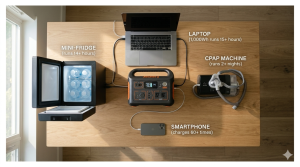
These units reframe the portable power station vs power bank question entirely. For a renter who needs to charge a laptop via AC, run a CPAP for one night, or keep a router alive through a brief outage — a portable ac outlet bank in this class handles all of it while still fitting in a backpack.
The honest caveat: at 256–300Wh, these units cannot run a full-size refrigerator for any meaningful duration, and they won’t power a space heater at all. For those use cases, you need a true portable power station at 1,000Wh+.
Head-to-Head: Portable Power Station vs Power Bank
The core portable power station vs power bank comparison, organized by every variable that matters:
Master Comparison Table
| Feature | Power Bank | Portable AC Outlet Bank | Portable Power Station |
|---|---|---|---|
| Typical capacity | 5,000–30,000mAh (18–111Wh) | 150–300Wh | 500–5,000Wh |
| AC outlet | ❌ None | ✅ 1–2 outlets | ✅ 2–4 outlets |
| USB-C output | ✅ Up to 100W | ✅ Up to 100W | ✅ Up to 140W |
| Runs refrigerator | ❌ | ❌ | ✅ (1,000Wh+) |
| Runs CPAP (1 night) | ❌ | ✅ (without humidifier) | ✅ |
| Runs space heater | ❌ | ❌ | ✅ (2,000Wh+) |
| Solar recharge | ⚠️ Trickle only | ✅ (limited) | ✅ Up to 1,200W |
| Weight | 0.5–2 lbs | 6–12 lbs | 17–65 lbs |
| Price range | $20–$150 | $200–$400 | $300–$2,500+ |
| Battery chemistry | NMC (most) | NMC or LiFePO4 | LiFePO4 (recommended) |
| Cycle life | 300–500 cycles | 500–3,000 cycles | 3,000–5,000 cycles |
| Pocket/bag portable | ✅ | ✅ (bag) | ❌ |
| Best for | Phones, tablets, earbuds | Laptop, CPAP, router | Fridge, appliances, full backup |
When a Power Bank Is the Right Answer
Stop reading the portable power station vs power bank debate and just get a power bank if your situation matches any of these:
You only need to charge phones and tablets. A quality 20,000mAh power bank provides 3–4 full smartphone charges and costs under $50. There is no reason to spend $500 on a portable power station for this use case.
You travel by air frequently. Airlines restrict lithium batteries over 100Wh in carry-on luggage. A 100 watt power bank (typically ~90–99Wh to stay under the limit) is the maximum practical portable power you can carry on a plane without special approval. No portable power station fits this requirement.
You need something truly pocketable. For hiking, cycling, theme parks, or anywhere that a 27 lb power station is absurd — a power bank is the answer. A power bank with flashlight adds emergency lighting for under $35.
Your budget is under $60. Entry-level portable power stations start at ~$150 (portable AC outlet bank category) and climb quickly. If budget is genuinely tight, a quality 20,000mAh power bank from Anker or Samsung provides real value and real reliability.
You want a jump start option. A jump start with power bank is possible with specific units that include dedicated jump-start terminals (NOCO Boost and similar products). No portable power station offers this function.
Choosing the Best Solar Power Banks
If solar supplemental charging matters to you and you’re firmly in power bank territory, the best solar power banks in 2026 are:
- Blavor Solar Power Bank — 10,000mAh with foldable solar panel, wireless charging, and a built-in flashlight; one of the most feature-complete units in the category
- Anker PowerCore Solar 20000 — larger capacity with USB-C 18W output and a more efficient solar panel than most competitors
- BigBlue 28W Solar Charger — technically a solar charger rather than a bank, but pairing it with a separate 20,000mAh bank creates the most practical solar power bank setup
The honest position on the best solar power banks category: they’re excellent emergency supplements. They are not a replacement for mains charging. Treat the solar panel as a bonus, not a feature you pay a premium for.
When a Portable Power Station Is the Right Answer
The portable power station vs power bank comparison decisively favors the power station side in any of these scenarios:
You need to run appliances with AC plugs. A refrigerator, CPAP machine, Starlink dish, power tool, or any device that uses a standard three-prong cord requires an AC inverter. Only a portable power station or portable ac outlet bank provides this.
You need more than 4 hours of device backup. Power banks run out. A 1,024Wh portable power station charging a phone (20W) runs for over 40 hours continuously. There’s no comparison at sustained loads.
You experience multi-hour power outages. If you’re in a region with frequent or extended grid failures, the portable power station vs power bank comparison ends here. A power bank cannot power your refrigerator, cannot run your CPAP through a full night with humidifier, and cannot keep your Starlink online for a workday. A proper portable power station does all three.
You want the best power stations for home backup. An apartment renter’s version of home backup means keeping the refrigerator, medical devices, communication equipment, and essential lighting running during a grid event. The best power stations for home backup start at 1,000Wh and ideally include solar recharge capability.
You camp with appliances. The best portable power stations for camping aren’t just charging stations — they run electric coolers, portable projectors, electric griddles, and lighting systems. A power bank handles none of these.
The Full Portable Power Station Buyer’s Guide
For readers who’ve confirmed they need a portable power station after the portable power station vs power bank analysis — here’s the complete purchase framework.
Capacity Tiers Explained
Under 500Wh — Entry Level Handles phone charging, laptop charging, and small device backup for 4–8 hours. Cannot reliably run a refrigerator or space heater. Right for renters who want a starter battery power station with room to upgrade.
- Best pick: EcoFlow RIVER 2 (256Wh) or Bluetti EB3A (268Wh)
500–1,000Wh — The Sweet Spot Handles everything in the entry tier plus: one full night of CPAP without humidifier, 6–10 hours of refrigerator backup, and continuous Starlink operation for 8–12 hours. This is the most popular tier for apartment renters.
- Best pick: EcoFlow RIVER 2 Pro (768Wh) or Jackery Explorer 1000 Pro (1,002Wh)
1,000–1,500Wh — The Best 1000Wh Power Station Tier The best 1000wh power station options in 2026 represent the best overall value for renters. The EcoFlow DELTA 2 (1,024Wh) and Bluetti AC180 (1,152Wh) both deliver 14–18 hours of refrigerator backup, 20+ hours of CPAP coverage, and the ability to run most household appliances short-term.
For renters comparing the best 1000wh power station options:
| Unit | Capacity | AC Output | Battery | Solar In | Weight | Price |
|---|---|---|---|---|---|---|
| EcoFlow DELTA 2 | 1,024Wh | 1,800W | LiFePO4 | 500W | 27 lbs | ~$799 |
| Bluetti AC180 | 1,152Wh | 1,800W | LiFePO4 | 500W | 35 lbs | ~$799 |
| Anker SOLIX C1000 | 1,056Wh | 1,800W | LiFePO4 | 600W | 27.3 lbs | ~$799 |
| Jackery Explorer 1000 Pro | 1,002Wh | 1,000W | NMC | 400W | 25.4 lbs | ~$749 |
| Goal Zero Yeti 1000X | 983Wh | 2,000W | NMC | 600W | 30 lbs | ~$999 |
2,000Wh+ — Full Backup and Heavier Loads At this tier, you can run a portable power station for space heater for 1–2 hours, maintain full refrigerator backup for 28–36 hours, and keep Starlink running for 24+ hours. This is the best home power station tier for serious outage preparedness.
- Best pick: EcoFlow DELTA 2 Max (2,048Wh) or Bluetti AC200L (2,048Wh)
The Best LiFePO4 Power Stations — Why Chemistry Matters
In any serious power bank buying guide or portable power station buying guide, battery chemistry must be addressed head-on. The best LiFePO4 power stations use lithium iron phosphate cells that offer:
- 3,000–5,000 charge cycles (vs. 300–800 for NMC power banks)
- Thermal runaway threshold at 518°F (vs. ~320°F for NMC)
- Zero toxic off-gassing in normal operation
- Safe for continuous indoor use — critical for apartment renters
The best LiFePO4 power stations for 2026 include the entire EcoFlow DELTA lineup, Bluetti AC180 and AC200L, and Anker SOLIX series. Jackery’s popular Explorer units use NMC — safe with proper ventilation, but not the preferred choice for enclosed apartment use.
Device-Specific Guidance: Portable Power Station vs Power Bank
Space Heaters
A portable power station for space heater application is the most demanding use case in the consumer market. Space heaters draw 750W–1,500W continuously — they drain even large stations fast.
Honest expectations:
- A 2,000Wh station runs a 750W space heater for approximately 2.2 hours
- A 2,000Wh station runs a 1,500W space heater for approximately 1.1 hours
- This makes a portable power station for space heater use a short-term emergency solution only — not a replacement for building heat
A power bank cannot run a space heater under any circumstances. This comparison decisively favors the portable power station — but even then, capacity requirements are extreme.
Starlink
The best portable power station for Starlink needs continuous output capacity, not surge capacity. Starlink Standard draws 50–75W continuously. A portable power station for Starlink backup at 1,024Wh provides 14+ hours of uninterrupted satellite internet. A power bank provides zero — Starlink requires AC power.
For work-from-home renters in semi-rural areas: the best portable power station for Starlink is the EcoFlow DELTA 2 Max paired with a 220W balcony solar panel. Daytime solar input offsets the Starlink draw almost entirely, extending runtime indefinitely during daylight outages.
Camping
The best portable power stations for camping serve a fundamentally different purpose than power banks at camp. While a power bank keeps phones charged on a day hike, the best portable power stations for camping run electric coolers (40–60W continuous), portable projectors (50–150W), camp lighting systems, and electric griddles (1,200–1,800W for short durations).
Top picks for the best portable power stations for camping in 2026:
- Jackery Explorer 1000 Pro — lightest 1,000Wh unit at 25.4 lbs; best in class for actual portability at camp; the best Jackery power station for outdoor use
- EcoFlow DELTA 2 — best charging speed (50-minute recharge) for campers who can plug in between sites
- Goal Zero Yeti 1000X — premium build quality with rugged design suited to rough outdoor conditions
The portable power station vs power bank comparison for camping comes down entirely to what you’re running at camp. Phone charging only? Power bank. Electric cooler, projector, or cooking appliances? Portable power station, no question.
Brand Deep Dive: Who Makes What in 2026
EcoFlow
The market leader in 2026 for charging speed, app ecosystem, and LiFePO4 adoption across its full lineup. GaN charging integration means the DELTA 2 hits 0–80% in 50 minutes. X-Boost technology runs appliances above the inverter’s rated wattage through intelligent power management. The best battery power station recommendation for most renters starts and ends here.
Bluetti
The quietest units in the market. Best solar input capacity at the 2,000Wh tier (1,200W on the AC200L). Strong value at the 1,000Wh level. The preferred choice when noise matters — bedroom CPAP setups, thin-wall apartments, and overnight operation.
Jackery
The best portable design and the strongest camping ecosystem. The best Jackery power station for most users remains the Explorer 1000 Pro — 25.4 lbs, excellent solar pairing, and the most user-friendly setup experience in the market. Uses NMC chemistry; store in ventilated locations.
Anker SOLIX
The best app experience and strongest third-party ecosystem integrations. Anker’s manufacturing quality (they dominate the power bank market globally) translates well to the portable power station category. Their best LiFePO4 power stations — the SOLIX C1000 and F3800 — are serious competitors.
Dark Energy Power Bank
The Dark Energy power bank brand deserves a specific mention in this guide because it represents the premium end of the pure power bank market — aircraft-grade aluminum construction, high-wattage USB-C PD output, and a distinctly premium aesthetic that separates it from commodity power banks. Not a portable power station by any definition, but the best answer if your use case is firmly in power bank territory and budget isn’t the primary constraint.
Power Bank Made in USA
Buyers specifically searching for a power bank made in USA face a genuinely limited market — the overwhelming majority of lithium battery products are manufactured in China or South Korea, regardless of where they’re branded or sold. Truly domestic manufacturing in the lithium battery space is rare. Goal Zero (owned by NRG Energy) assembles some products in the US, and a few specialty brands offer US-assembled options. For buyers where domestic manufacturing is a priority, verifying the specific assembly location (not just brand headquarters) with each manufacturer is essential.
Similarly, best US OEM/ODM supplier searches indicate buyers looking to source or white-label portable power products. The honest answer is that the major OEM/ODM suppliers for both power banks and portable power stations operate primarily from Shenzhen and surrounding regions — Shenzhen CATL suppliers, BYD battery suppliers, and Dongguan assembly specialists dominate global supply chains for both categories.
The Portable Power Station vs Power Bank Decision Matrix
Use this to end the portable power station vs power bank debate for your specific situation in under 60 seconds:
| Your Situation | Right Choice | Minimum Spec |
|---|---|---|
| Charging phones only | Power bank | 10,000mAh |
| Charging phones + laptop | Power bank (100W PD) or portable AC outlet bank | 100 watt power bank or 256Wh outlet bank |
| Flying with backup power | Power bank only | Under 100Wh for carry-on |
| One night CPAP (no humidifier) | Portable AC outlet bank or power station | 300Wh min |
| One night CPAP (with humidifier) | Portable power station | 768Wh min |
| Refrigerator backup (12 hrs) | Portable power station | 1,000Wh + 1,600W surge |
| Refrigerator backup (24+ hrs) | Portable power station + solar | 2,000Wh + 400W solar |
| Starlink backup (workday) | Portable power station | 1,024Wh min |
| Space heater emergency | Portable power station | 2,000Wh min |
| Camping (phones + lights) | Power bank | 20,000mAh |
| Camping (cooler + appliances) | Best portable power station for camping | 1,000Wh min |
| Apartment home backup | Best home power station | 1,000–2,000Wh |
| Moving between locations | Jackery Explorer 1000 Pro | 1,000Wh, 25 lbs |
| Budget under $50 | Power bank | 20,000mAh |
| Budget under $200 | Portable AC outlet bank | 256–300Wh |
| Budget $400–$500 | Budget LiFePO4 power station | 716–768Wh |
| Budget $700–$900 | Best 1000wh power station | 1,000–1,152Wh |
Frequently Asked Questions
What is the main difference between a portable power station and a power bank?
The core difference in any portable power station vs power bank comparison is the AC outlet and capacity scale. A portable power station has an AC inverter that powers standard household appliances — refrigerators, CPAP machines, laptops via standard charger, Starlink dishes. A power bank outputs only USB power (up to 100W on premium units) and can charge phones, tablets, and small electronics only. A portable ac outlet bank bridges this gap with small AC output in a compact package.
What is a 100 watt power bank and do I need one?
A 100 watt power bank outputs 100W through USB-C Power Delivery — fast enough to charge a MacBook Pro, iPad Pro, or high-end Windows laptop at near-full speed. You need one if you travel frequently by air (power stations exceed carry-on limits), work primarily on a laptop, and want the fastest possible portable USB charging. If you also need to run appliances via AC outlets, a portable ac outlet bank or full portable power station serves you better.
What does a power bank buying guide need to cover?
A complete power bank buying guide should address: capacity in mAh and what it realistically delivers in charges, USB output wattage (PD 100W vs. basic 18W matters enormously for laptop users), pass-through charging capability, solar supplemental input, whether a power bank with flashlight is included, battery chemistry and cycle life, physical size and weight, and airline carry-on compliance. This guide covers all of these — the portable power station vs power bank decision framework in this article functions as a complete power bank buying guide and portable power station guide simultaneously.
Can a power bank run a space heater?
No. A portable power station for space heater use requires a high-capacity AC inverter — minimum 1,500W continuous output — and a large battery (2,000Wh+ for any meaningful runtime). The highest-output 100 watt power bank delivers 100W through USB-C. Space heaters draw 750W–1,500W. There is no overlap. This is one of the clearest cases in the portable power station vs power bank comparison where only a power station answers the question.
What is the best 1000wh power station in 2026?
The best 1000wh power station in 2026 is the EcoFlow DELTA 2 for most users — LiFePO4 chemistry, 1,800W continuous output, 2,700W surge, 500W solar input, 50-minute fast charge, and the strongest app ecosystem in the class at ~$799. For buyers prioritizing quiet operation over charging speed, the Bluetti AC180 at the same price offers 1,152Wh and noticeably quieter fan operation. For buyers prioritizing portability, the Jackery Explorer 1000 Pro at 25.4 lbs is the lightest option — though it uses NMC chemistry.
Are the best portable power stations for camping different from apartment backup units?
The hardware is often identical — the best portable power stations for camping and the best home power station for apartment backup are frequently the same units. The difference is use-case prioritization. Camping buyers weight portability and solar integration more heavily. Apartment backup buyers weight capacity, surge rating (for refrigerators), and quiet operation. The EcoFlow DELTA 2 and Bluetti AC180 are top picks in both categories, which is why they dominate both best portable power stations for camping and best power stations for home backup search results.
Can I jump start a car with a power bank?
Yes — but only with a purpose-built jump start with power bank unit, not a standard power bank. Products like the NOCO Boost Plus GB40 are specifically designed for vehicle jump starting and include the necessary high-current output terminals. A standard 20,000mAh power bank cannot jump start a vehicle regardless of its mAh rating. A portable power station also cannot jump start a vehicle through standard outlets. Jump starting requires a dedicated product designed specifically for that function.
What is the best portable power station for home backup in an apartment?
The best home power station for apartment renters in 2026 is the EcoFlow DELTA 2 (1,024Wh) for moderate outage risk areas, and the EcoFlow DELTA 2 Max (2,048Wh) for hurricane zones, ice storm corridors, or renters with medical device dependencies. Both use LiFePO4 chemistry, accept solar input, and are certified for indoor use. In the portable power station vs power bank comparison for home backup specifically — there is no comparison. Only a portable power station serves this need.
UnitVerseHQ is an independent buyer’s guide and education platform for American renters and consumers navigating portable power decisions. All specifications reflect market data as of February 2026. Prices are approximate and subject to change. Always verify current certifications and specifications directly with manufacturers before purchasing.