Indoor Balcony Solar Setup: The Complete 2026 Renter’s Guide
By UnitVerseHQ | Updated February 2026
The average US apartment renter pays $1,200–$2,400 per year in electricity costs. Rooftop solar is unavailable to them. A whole-home battery system requires landlord approval they’ll never get. And yet the sun hits their balcony for six hours every single day — completely wasted.
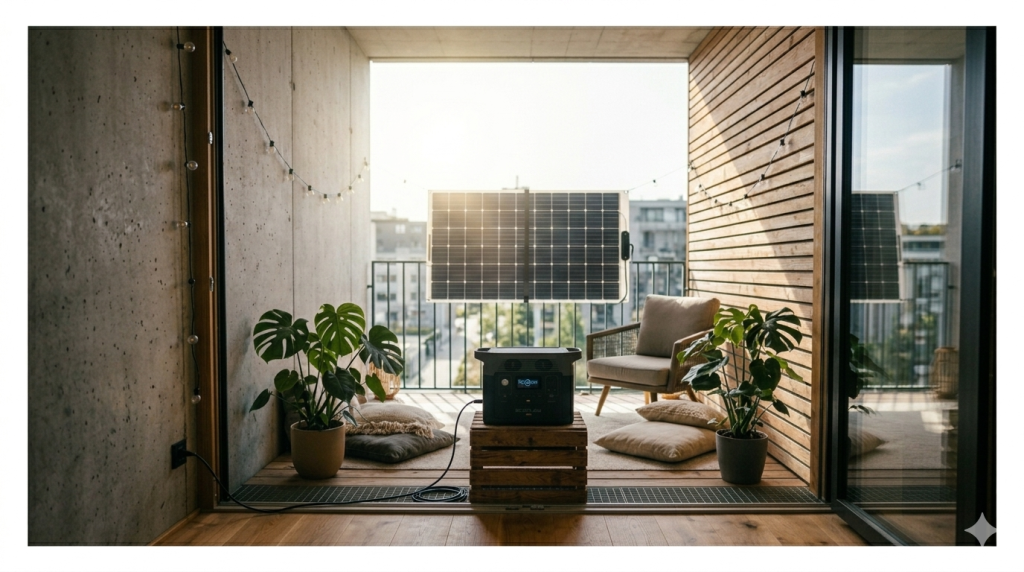
The indoor balcony solar setup changes that equation entirely. In 2026, a renter can legally, safely, and affordably build a balcony solar panels for renters system that generates 300–1,200Wh of electricity daily — enough to power a full work-from-home desk setup, offset daily device charging, and meaningfully reduce a monthly electricity bill, all without drilling a single hole or filing a single permit.
This is the most comprehensive guide to indoor balcony solar setup planning, installation, product selection, safety compliance, and state-level regulation available for US apartment renters. Whether you’re a first-time buyer researching a plug in solar kit for apartment use or a returning reader upgrading an existing setup, this guide has everything you need.
What Is an Indoor Balcony Solar Setup?
Before getting into specifics, it’s important to define what an indoor balcony solar setup actually is — because the term covers two meaningfully different system types that serve different needs.
Definition
An indoor balcony solar setup is a photovoltaic (solar panel) system installed on a residential balcony — typically mounted on railings, floor stands, or wall brackets — that converts sunlight into usable electricity without any permanent structural modification to the building.
The “indoor” element refers to where the electricity is used and stored: inside the apartment, either through a plug in solar kit for apartment grid connection or through a portable power station acting as the storage and distribution hub.
This category is growing rapidly in the US, driven largely by the success of Germany’s “Balkonkraftwerk” (balcony power plant) movement, which now has over 1.5 million registered plug-in solar units operating across the country. The US is approximately 3–4 years behind Europe in regulatory framework maturity — but 2026 marks the inflection point, with the arrival of the first dedicated US standard for this category.
Two Types of Indoor Balcony Solar Setup
Type 1 — Plug-In Grid-Tied System: Panels connect to a micro-inverter that converts DC solar power to grid-compatible AC, then feeds it directly into your apartment’s electrical system through a standard outlet. Your meter runs backward (or more accurately, you consume less from the grid). No battery storage required.
Type 2 — Power Station System: Panels connect directly to a portable power station via MC4 cables. The station stores the solar energy and dispatches it on demand through its outlets. This is the most popular indoor balcony solar setup for US renters in 2026 — no grid interaction, no utility approval needed, entirely self-contained.
Both approaches to solar power for apartment dwellers have distinct advantages. This guide covers both in full detail.
UL 3700: The New Safety Standard Changing Everything for Renter Solar in 2026
If you’re researching a plug in solar kit for apartment use and haven’t heard of UL 3700, this section is the most important thing you’ll read today.
What Is UL 3700?
UL 3700 is the first dedicated US safety standard specifically for plug-in solar energy systems — balcony solar kits, portable solar generators, and micro-inverter setups designed to connect directly to a standard household outlet. It was finalized and released for commercial certification in late 2025, with the first UL 3700 certified solar kit products reaching US retail channels in early 2026.
Before UL 3700 existed, there was no US standard specifically governing plug-in solar systems. Products were evaluated under partial references to UL 1703 (solar panels), UL 1741 (inverters), and NEC Article 705 (interconnected power production sources) — none of which were designed with the balcony renter use case in mind.
What UL 3700 Actually Tests
A UL 3700 certified solar kit has been evaluated for:
- Reverse current protection — prevents current from flowing back into the panels from the grid, which can cause overheating and fire in uncertified systems
- Anti-islanding protection — ensures the micro-inverter shuts down immediately when grid power is lost, protecting utility workers during outages
- Ground fault circuit interruption — detects and interrupts dangerous ground faults in the panel-to-inverter cable run
- Arc fault detection — identifies and disconnects dangerous arcing conditions in DC wiring
- Mechanical load rating — validates the mounting hardware’s wind and snow load capacity
- Weatherproofing — IP65 or IP67 rating for outdoor panel and inverter components
Why UL 3700 Matters for Renters Specifically
For solar power for apartment dwellers, UL 3700 does three critical things:
1. It creates a clear safety signal. Before this standard, a renter had no way to distinguish a genuinely safe plug in solar kit for apartment from a dangerous uncertified product. Now the UL 3700 mark provides that clarity.
2. It enables landlord conversations. A certified system with documented safety testing is orders of magnitude easier to discuss with a property manager than an uncertified one. UL 3700 documentation answers every safety objection a landlord might raise.
3. It’s accelerating utility acceptance. Several utilities — including Con Edison (NY) and LADWP (CA) — are actively referencing UL 3700 compliance in their emerging plug-in solar interconnection frameworks. A UL 3700 certified solar kit is the ticket to participating in net metering programs as they open to renters.
Bottom line: In 2026, for any indoor balcony solar setup that connects to the grid (Type 1), a UL 3700 certified solar kit is the only responsible choice. For power-station-based systems (Type 2), UL 3700 panel certification is still a strong quality signal worth prioritizing.
Type 1 Deep Dive: The Plug-In Grid-Tied Balcony Solar Setup
The grid-tied indoor balcony solar setup is the most financially efficient approach for renters who want to directly reduce their electricity bill — rather than simply powering a standalone power station.
How It Works
- Solar panels on the balcony produce DC electricity
- A micro-inverter converts DC to grid-compatible 120V AC
- A short cable runs from the micro-inverter through the balcony door gap to a standard wall outlet (called a “solar outlet” or “Schuko connection” in EU markets)
- The apartment’s circuit now has additional power generation — your devices draw from solar first, grid second
- Your electricity meter records less consumption from the grid
The Micro-Inverter: The Heart of a Plug-In Solar Kit for Apartment
The micro-inverter is what makes a plug in solar kit for apartment system function safely as a grid-tied installation. It performs DC-to-AC conversion at the panel level rather than centrally, which dramatically improves safety and efficiency.
Best micro-inverters for apartment balcony use in 2026:
| Micro-Inverter | Max Input | AC Output | UL 3700 | Weight | Price |
|---|---|---|---|---|---|
| APsystems EZ1-M | 800W DC | 600W AC | ✅ Certified | 3.9 lbs | ~$199 |
| Hoymiles HMS-600W | 600W DC | 600W AC | ✅ Certified | 4.2 lbs | ~$179 |
| Enphase IQ8MC | 460W DC | 380W AC | ✅ Certified | 2.0 lbs | ~$249 |
| Hoymiles HMT-2000 | 2,000W DC | 1,800W AC | ✅ Certified | 8.8 lbs | ~$349 |
The APsystems EZ1-M is the top recommendation for most renters building a plug in solar kit for apartment grid-tied system. Its 800W DC input handles two 400W panels in parallel, its UL 3700 certification is current, and its companion app provides real-time production monitoring.
Output Reality Check for Grid-Tied Systems
A 400W indoor balcony solar setup (two 200W panels + APsystems EZ1-M) generates in real-world US apartment conditions:
| City | Peak Sun Hours | Daily Output | Monthly Output | Monthly Bill Offset |
|---|---|---|---|---|
| Phoenix, AZ | 6.5 hrs | ~520Wh/day | ~15.6kWh | ~$3.90–$6.24 |
| Los Angeles, CA | 5.8 hrs | ~464Wh/day | ~13.9kWh | ~$4.17–$6.95 |
| Miami, FL | 5.5 hrs | ~440Wh/day | ~13.2kWh | ~$2.64–$4.62 |
| Austin, TX | 5.2 hrs | ~416Wh/day | ~12.5kWh | ~$1.87–$3.75 |
| New York, NY | 4.5 hrs | ~360Wh/day | ~10.8kWh | ~$3.24–$5.40 |
| Chicago, IL | 4.2 hrs | ~336Wh/day | ~10.1kWh | ~$1.51–$3.03 |
| Seattle, WA | 3.8 hrs | ~304Wh/day | ~9.1kWh | ~$1.00–$2.73 |
Annual savings from a 400W grid-tied indoor balcony solar setup range from $240–$840 depending on location and local electricity rates — with California and New York renters capturing the highest returns due to elevated electricity costs.
Type 2 Deep Dive: The Power Station Indoor Balcony Solar Setup
The power-station-based indoor balcony solar setup is the more popular choice for US renters in 2026 — primarily because it requires no utility interaction, no approval process, and no electrical knowledge beyond plugging in a cable.
How It Works
- Solar panels on the balcony produce DC electricity via MC4 output cables
- Cables route through the balcony door gap to the portable power station inside
- The power station stores energy in its LiFePO4 battery pack
- You draw power from the station’s outlets on demand — AC, USB-C, USB-A, DC
Why This Approach Dominates for Renters
The power-station indoor balcony solar setup wins for renters on three key dimensions:
Zero utility interaction. No net metering application, no utility approval, no notification requirements in any US state. You are simply charging a consumer appliance from a solar panel — legally and completely unrestricted.
Immediate ROI on power station investment. Most renters buying a power station already have one (or need one for backup). Adding balcony solar panels for renters to an existing station is a $200–$400 incremental investment that immediately starts offsetting daily electricity consumption.
Flexibility and portability. The entire indoor balcony solar setup can be disassembled, packed, and moved to your next apartment in under an hour. This is solar power for apartment dwellers that moves with you — unlike any permanent installation.
Solar Input Compatibility: Matching Panels to Power Stations
Before purchasing balcony solar panels for renters, verify these three specifications against your power station:
| Spec | Why It Matters | How to Check |
|---|---|---|
| Open Circuit Voltage (Voc) | Must be within station’s acceptable solar input range (typically 12–60V) | Check panel spec sheet |
| Maximum Power Voltage (Vmp) | Optimal operating voltage — should align with station’s MPPT range | Check panel spec sheet |
| Max Solar Input Wattage | Station limits maximum panel wattage it can accept | Check station manual |
Common compatibility pairings:
| Power Station | Max Solar Input | Compatible Panel Wattage |
|---|---|---|
| EcoFlow RIVER 2 Pro | 220W | 1× 200W panel |
| EcoFlow DELTA 2 | 500W | 2× 220W panels |
| EcoFlow DELTA 2 Max | 1,000W | 4× 220W or 2× 400W panels |
| Bluetti EB70S | 200W | 1× 200W panel |
| Bluetti AC180 | 500W | 2× 220W panels |
| Bluetti AC200L | 1,200W | 3× 400W panels |
| Jackery Explorer 1000 Pro | 400W | 2× 200W panels |
No Drill Solar Panel Mounting: 5 Methods for Renters
No drill solar panel mounting is the core practical challenge of any indoor balcony solar setup — and the most common reason renters hesitate to start. Here are all five proven methods, ordered from simplest to most robust.
Method 1: Railing Clamp Mounts
The most popular no drill solar panel mounting solution for standard balconies. Stainless steel clamps grip round or square railing tubing (most US apartment railings are 1.5″–2″ diameter) with zero drilling or adhesive.
Best for: Panels up to 220W on railings up to 3 floors high Wind rating: Up to 20 mph sustained (add secondary tether above 3rd floor) Cost: $15–$40 per panel mount set Setup time: 15–20 minutes per panel
Step-by-step:
- Select clamps sized for your railing diameter (measure before ordering)
- Attach clamp bracket to panel frame’s pre-drilled holes
- Position panel against railing at desired angle (15–30° from vertical for optimal output)
- Hand-tighten clamps, then snug with a wrench — do not overtorque aluminum
- Add a secondary stainless cable or heavy-duty bungee through the panel frame and around the railing post for wind security
Method 2: Weighted Floor Stands (Sandbag Ballast)
Freestanding A-frame panel stands with weighted base bags. The panel tilts at any angle (typically 30–45° for optimal southern-facing output) and the sandbag bases prevent tipping in moderate wind.
Best for: Larger panels (up to 400W), ground-floor or low-rise patios, maximum output angle optimization Wind rating: Varies by ballast weight — 20–30 lbs of ballast per stand handles winds to ~25 mph Cost: $30–$80 per stand system Setup time: 20–30 minutes
Critical note for high-rise renters: Weighted floor stands on upper-floor balconies must use heavier ballast (30+ lbs per stand) and should be positioned away from the railing edge. Never place unsecured floor-standing panels near the exterior edge of a high-rise balcony.
Method 3: Adhesive Wall Hooks + Panel Straps
For balconies with solid walls (rather than open railings), commercial-grade adhesive hooks rated for 25–50 lbs per hook can support lightweight foldable panels using webbing straps through the panel frame.
Best for: Lightweight foldable panels (under 15 lbs), solid wall balconies Wind rating: Low — suitable only for sheltered or low-floor balconies Cost: $10–$25 per panel Setup time: 10 minutes (plus 24-hour adhesive cure time) Important: Use 3M VHB or Command Heavy-Duty strips only — generic adhesive hooks are insufficient for outdoor wind loads.
Method 4: Over-Railing Hanging Brackets
Purpose-built brackets that hang over the top rail with gravity and weight distribution holding them in place — no drilling, no clamping, no adhesive. The panel hangs on the exterior face of the railing, angled at ~15° from vertical.
Best for: Standard apartment railings, quick daily deployment/removal Wind rating: Up to 15–20 mph (panels must be removed in high wind events) Cost: $25–$60 per panel mount Setup time: 5 minutes — the fastest deploy/remove solution
This is the preferred no drill solar panel mounting method for renters who want to bring panels inside during extreme weather without committing to a permanent-feel installation.
Method 5: Freestanding Portable Panel Stands
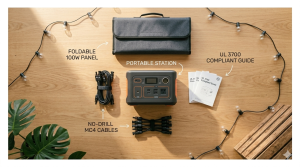
Many best portable solar panels 2026 products — particularly foldable units like the Jackery SolarSaga and EcoFlow portable panels — include integrated kickstands or freestanding frames. These require no mounting at all. Simply unfold, angle toward the sun, and connect.
Best for: Foldable panels, short-term or daily-deployment setups, renters who travel Wind rating: Low — foldable panels must be folded in winds above 20 mph Cost: $0 (included with panel) Setup time: Under 2 minutes
Best Portable Solar Panels 2026: Full Product Comparison
Choosing the right panels is the foundation of a productive indoor balcony solar setup. Here’s the complete best portable solar panels 2026 comparison for renters:
Master Panel Comparison Table
| Panel | Wattage | Type | Efficiency | Voc | Weight | Foldable | UL Listed | Price |
|---|---|---|---|---|---|---|---|---|
| EcoFlow 220W Bifacial | 220W | Bifacial mono | 22.4% | 24.2V | 16.1 lbs | No | ✅ | ~$299 |
| Jackery SolarSaga 200W | 200W | Monocrystalline | 24.3% | 21.6V | 14.3 lbs | ✅ Yes | ✅ | ~$299 |
| Bluetti PV200 | 200W | Monocrystalline | 23.4% | 24.6V | 13.7 lbs | ✅ Yes | ✅ | ~$249 |
| Anker SOLIX PS400 | 400W | Monocrystalline | 23.0% | 48.6V | 26.5 lbs | No | ✅ | ~$499 |
| EcoFlow 400W Rigid | 400W | Monocrystalline | 23.0% | 48.4V | 26.0 lbs | No | ✅ | ~$449 |
| Bluetti PV420 | 420W | Monocrystalline | 23.4% | 52.8V | 28.6 lbs | No | ✅ | ~$549 |
| Renogy 200W Portable | 200W | Monocrystalline | 21.0% | 24.3V | 19.8 lbs | ✅ Yes | ✅ | ~$199 |
Top Picks for Each Renter Profile
Best Overall for Balcony Solar Panels for Renters: EcoFlow 220W Bifacial
The bifacial design captures reflected light from your balcony floor and surrounding walls — a genuine advantage for vertical railing-mounted installations where the rear face still receives meaningful indirect light. At 22.4% efficiency and 220W output from a relatively compact frame, this panel punches above its weight on a small balcony. The EcoFlow 220W Bifacial is the top recommendation for any indoor balcony solar setup prioritizing output-per-square-foot.
Best Foldable for the Best Portable Solar Panels 2026: Jackery SolarSaga 200W
The SolarSaga 200W is the best foldable panel in the best portable solar panels 2026 comparison for one specific reason: its 24.3% monocrystalline cell efficiency is the highest in its class, meaning it extracts maximum energy from limited balcony sun exposure. At 14.3 lbs, it’s genuinely portable — fold it up at night, deploy it in the morning, and take it to the next apartment without a second thought. The integrated carrying handle makes the SolarSaga the most user-friendly panel in the balcony solar panels for renters market.
Best Budget: Bluetti PV200
The Bluetti PV200 at ~$249 offers 200W of monocrystalline output with 23.4% efficiency at the lowest price point among quality certified panels. For renters building their first indoor balcony solar setup on a tight budget, the PV200 provides everything necessary — and it’s compatible with all Bluetti stations out of the box, with an adapter available for EcoFlow stations.
Best for Maximum Output: Anker SOLIX PS400
Two SOLIX PS400 panels (800W total) paired with an EcoFlow DELTA 2 Max (1,000W max solar input) or Bluetti AC200L (1,200W max input) creates the most powerful residential indoor balcony solar setup available for renters without grid connection. On a south-facing Phoenix balcony with 6.5 peak sun hours, this system generates approximately 4,680Wh daily — nearly a full EcoFlow DELTA 2 Max charge per day.
Complete Plug-In Solar Kit for Apartment: Top Kits Reviewed
For renters who want a complete plug in solar kit for apartment system — panels, micro-inverter or power station, mounting hardware, and cables in one package — these are the best options in 2026:
Kit 1: APsystems EZ1-M Balcony Solar Kit (Grid-Tied)
Components: 2× 400W panels + APsystems EZ1-M micro-inverter + railing mount hardware + 10ft connection cable System Output: Up to 600W AC continuous UL 3700 Status: ✅ Certified Price: ~$799 complete kit Best for: Renters who want to directly offset their electricity bill through grid feed-in
This is the most complete UL 3700 certified solar kit available for US apartment renters in 2026. The APsystems EZ1-M micro-inverter handles the DC-to-AC conversion, the companion app monitors real-time production, and the railing mount hardware covers standard US balcony railing types. For a plug in solar kit for apartment use with grid interaction, this is the market-leading option.
Important: Check your state and utility’s plug-in solar policies before connecting to the grid. See the State Regulations section below.
Kit 2: EcoFlow DELTA 2 + 2× 220W Bifacial Panels (Power Station)
Components: EcoFlow DELTA 2 (1,024Wh) + 2× EcoFlow 220W Bifacial panels + railing mounts + MC4 parallel connector System Output: 440W solar input, 1,024Wh storage, 1,800W AC output UL 3700 Status: Panels UL listed; power station UL 9540 certified Price: ~$1,400 complete Best for: Renters who want both daily solar generation AND outage backup in one system
This is the most versatile indoor balcony solar setup package for apartment renters. The DELTA 2 stores solar energy during the day and dispatches it on demand — powering your work desk, charging devices, running a fridge during outages, and functioning as the hub for a full apartment solar kit USA ecosystem. The two bifacial panels on the railing generate 600–900Wh on a good sun day — nearly a full station recharge.
Kit 3: Bluetti EB70S + PV200 Starter Kit (Budget Power Station)
Components: Bluetti EB70S (716Wh) + Bluetti PV200 (200W) + kickstand mount System Output: 200W solar input, 716Wh storage, 800W AC output Price: ~$699 complete Best for: First-time buyers building a starter indoor balcony solar setup on a budget
The most affordable complete plug in solar kit for apartment power-station system with LiFePO4 chemistry. The PV200 generates 600–900Wh on a sunny day — enough to fully recharge the EB70S and leave surplus. For renters with 36V e-bike batteries, compact refrigerators, or primarily device-charging needs, this kit covers daily requirements without the premium price of larger systems.
Kit 4: Anker SOLIX Solarbank 2 Pro Kit (Smart Grid Integration)
Components: Anker SOLIX Solarbank 2 Pro + 2× SOLIX PS400 panels + smart home integration System Output: 800W solar input, 2,048Wh storage, smart load management UL 3700 Status: ✅ Panels UL listed; Solarbank 2 Pro pursuing UL 3700 Price: ~$1,799 complete Best for: Tech-forward renters who want AI-powered energy management and smart home integration
The Solarbank 2 Pro learns your consumption patterns and optimizes charging/discharging automatically — a genuine evolution in solar power for apartment dwellers that treats the balcony solar setup as an intelligent energy management system rather than a simple backup device.
Output Expectations: What Your Indoor Balcony Solar Setup Will Actually Generate
Honest output expectations are the most important service any indoor balcony solar setup guide can provide. Manufacturer wattage ratings are measured under Standard Test Conditions (STC) — direct noon-level irradiance, 77°F panel temperature, clear sky. Real-world balcony conditions differ significantly.
Real-World Efficiency Factors
Panel orientation derating:
| Balcony Direction | Relative Output vs. South-Facing |
|---|---|
| True South (optimal) | 100% |
| Southeast / Southwest | 85–92% |
| East-facing | 65–75% |
| West-facing | 60–70% |
| North-facing | 25–40% |
Mounting angle derating (vertical railing mount vs. optimal tilt):
- Vertical mounting (90°) on south-facing balcony: ~75–80% of optimal tilt output
- 30° tilt on south-facing floor stand: 95–100% of optimal
- Bifacial panels on vertical railing: recapture 5–10% from rear-face reflection, bringing effective output to ~85%
Shading derating: Partial shading from a neighboring building or overhang during any part of the day has a disproportionate impact. Even 20% shading of one panel can reduce whole-system output by 40–60% in series-wired systems. Use parallel wiring for balcony solar panels for renters whenever possible — shading one panel affects only that panel’s output, not the whole string.
Realistic Daily Output by System Size and City
| System Size | Phoenix | LA | Miami | NYC | Chicago | Seattle |
|---|---|---|---|---|---|---|
| 200W (1 panel) | 780Wh | 696Wh | 660Wh | 540Wh | 504Wh | 456Wh |
| 400W (2 panels) | 1,560Wh | 1,392Wh | 1,320Wh | 1,080Wh | 1,008Wh | 912Wh |
| 800W (4 panels) | 3,120Wh | 2,784Wh | 2,640Wh | 2,160Wh | 2,016Wh | 1,824Wh |
Based on real-world system performance ratio of 0.75 applied to rated wattage × peak sun hours.
State-Level Regulations for Plug-In Solar Kits
Solar power for apartment dwellers exists in a complex and rapidly evolving regulatory environment at the state level. Here’s the 2026 status by major state:
California
California’s NEM 3.0 (Net Energy Metering) program reduced export rates for rooftop solar in 2023, but a separate regulatory pathway for plug in solar kit for apartment systems under 1kW is being developed under AB 2143. Several California utilities — including LADWP and SCE — are running pilot programs that allow renters to connect UL 3700 certified solar kit systems to their meters. Status as of February 2026: pilot programs active, statewide renter solar rules expected by late 2026.
New York
Con Edison launched a plug-in solar pilot program in 2024 covering Manhattan, Brooklyn, and the Bronx. Renters with UL 3700 certified solar kit systems up to 600W can apply for a simplified interconnection agreement. The program has been oversubscribed in its first year — sign up early at Con Edison’s clean energy portal.
Texas
Texas’s deregulated electricity market creates a unique opportunity for indoor balcony solar setup renters. With retail electricity choice and competitive TOU rates, energy arbitrage (charging at off-peak rates, using stored solar during on-peak periods) is particularly valuable. Grid-tied plug-in solar is regulated at the utility level — check with your specific Texas utility for current interconnection rules.
Florida
Florida has abundant sun but specific concerns for indoor balcony solar setup systems: hurricane wind load ratings. Any panel or mounting hardware used on Florida balconies should be rated for wind loads consistent with local building codes — typically 130–175 mph wind zones depending on location. Foldable panels that can be quickly stored are particularly practical for Florida renters during hurricane season. The state has strong net metering protections for homeowners, with emerging renter-specific provisions under review.
General Guidance for All States
For solar power for apartment dwellers across all states:
- Systems under 1kW feeding into a standard outlet (not hardwired) are generally not subject to permit requirements in most US jurisdictions
- A UL 3700 certified solar kit is the strongest documentation for any utility or landlord discussion
- Always notify (but typically don’t need approval from) your utility if connecting to the grid
- Power-station-based systems with no grid connection require no notification or approval in any US state
The Complete Safety Checklist for Your Indoor Balcony Solar Setup
Before going live with any indoor balcony solar setup, run through this complete safety checklist:
Panel and Mounting Safety
- ✅ All railing clamps properly sized for your specific railing diameter
- ✅ Secondary tether (stainless cable or heavy-duty bungee) on every railing-mounted panel
- ✅ Floor-standing panels have minimum 25 lbs of ballast per stand
- ✅ No panel positioned at the unsupported exterior edge of the balcony
- ✅ Wind forecast checked — panels secured or removed when 25+ mph winds forecast
- ✅ Panels rated for outdoor use (IP65 minimum)
Cable and Connection Safety
- ✅ MC4 connectors fully seated and locked (audible click)
- ✅ Cable not pinched by door frame, window, or furniture
- ✅ No cable running across foot traffic areas without cable protection
- ✅ Cable length appropriate — no excess coiled directly against panel junction box
- ✅ Correct polarity confirmed before connecting to power station
Grid-Tied System Safety (Type 1 only)
- ✅ UL 3700 certified solar kit components verified
- ✅ Micro-inverter anti-islanding protection confirmed functional
- ✅ System connected to GFCI-protected outlet
- ✅ Utility notification submitted (if required by your utility)
- ✅ System output monitored via app for first 48 hours of operation
Power Station Safety (Type 2)
- ✅ Station on hard, non-flammable surface with 12″ clearance on all sides
- ✅ Solar input reading confirmed on station display within expected range
- ✅ LiFePO4 chemistry confirmed (check product page or spec sheet)
- ✅ Station not charging in direct sunlight (keep indoors)
- ✅ Charge ceiling set to 80% for daily cycling (extends LiFePO4 cell life)
Choosing Your Indoor Balcony Solar Setup: The Decision Framework
| Your Priority | Best System Type | Recommended Kit |
|---|---|---|
| Lowest cost to start | Power station, 1 panel | Bluetti EB70S + PV200 (~$699) |
| Maximum daily output | Power station, 4 panels | EcoFlow DELTA 2 Max + 4× 220W (~$2,200) |
| Direct bill reduction | Grid-tied plug-in | APsystems EZ1-M Kit (~$799) |
| Backup + solar combined | Power station, 2 panels | EcoFlow DELTA 2 + 2× 220W (~$1,400) |
| Foldable/portable setup | Foldable panels + station | Jackery 1000 Pro + 2× SolarSaga 200W (~$1,350) |
| Smart home integration | Smart power station | Anker SOLIX Solarbank 2 Pro Kit (~$1,799) |
| Budget grid-tied | Grid-tied micro-inverter | Hoymiles HMS-600W + 2× panels (~$600) |
Frequently Asked Questions
What is an indoor balcony solar setup?
An indoor balcony solar setup is a photovoltaic solar panel system installed on a residential apartment balcony — using railing mounts, floor stands, or hanging brackets — that generates electricity used inside the apartment. The two main types are grid-tied systems (feeding directly into your apartment’s electrical circuit via a micro-inverter) and power-station systems (charging a portable battery for on-demand use). Neither type requires drilling, structural modification, or building permits for systems under 1kW in most US jurisdictions.
Do I need landlord permission for balcony solar panels?
For power-station-based indoor balcony solar setup systems — which are the most common type for US renters — no landlord permission is typically required. The panels are not permanently attached to the building, and the power station is a consumer appliance equivalent to a television. For grid-tied systems feeding into your apartment’s electrical circuit, a brief notification to your landlord (not necessarily approval) is good practice. A UL 3700 certified solar kit with documented safety certifications makes this conversation significantly easier.
What is UL 3700 and why does it matter for apartment solar?
UL 3700 is the first dedicated US safety standard for plug-in solar energy systems, finalized in late 2025. A UL 3700 certified solar kit has been tested for reverse current protection, anti-islanding, arc fault detection, and mechanical wind/snow load ratings. For renters, UL 3700 certification is the clearest safety signal available when evaluating a plug in solar kit for apartment use, and it’s the documentation standard that utilities and landlords are beginning to reference in their own policies.
What are the best portable solar panels in 2026 for balcony use?
The best portable solar panels 2026 for balcony use are the Jackery SolarSaga 200W (best efficiency at 24.3%, lightest foldable in class), EcoFlow 220W Bifacial (best output per square foot for vertical railing mounts), and Bluetti PV200 (best budget option). For maximum output from a two-panel system, the Anker SOLIX PS400 at 400W per panel is the most powerful single panel in the consumer balcony solar panels for renters market.
How much electricity will a balcony solar setup actually generate?
Realistic output depends on your location, panel orientation, and system size. A 400W indoor balcony solar setup (two 200W panels) on a south-facing New York apartment generates approximately 1,080Wh/day in summer — enough to power a full work-from-home desk setup and charge all devices with energy to spare. The same system in Phoenix generates approximately 1,560Wh/day. For all cities and system sizes, see the output table in the article above.
Can I use balcony solar panels with any portable power station?
Almost any portable power station with a dedicated solar input port is compatible with standard balcony solar panels for renters. Before purchasing, verify that your panel’s Open Circuit Voltage (Voc) falls within your station’s acceptable solar input voltage range (typically 12–60V for most consumer stations), and that the panel’s wattage does not exceed the station’s maximum solar input rating. EcoFlow, Bluetti, and Jackery all publish these specifications clearly in their product documentation.
Is a no drill solar panel mounting system safe for high-rise balconies?
No drill solar panel mounting is safe for high-rise balconies with the right hardware and wind management practices. Above the 8th floor, railing clamp mounts should always include a secondary tether (stainless cable looped through the panel frame and around a railing post), and panels should be removed or secured flat when sustained winds above 25 mph are forecast. Foldable panels that can be stored in under two minutes are the most practical choice for high-rise indoor balcony solar setup installations.
What states have the best policies for apartment solar?
For solar power for apartment dwellers in 2026, New York (Con Edison plug-in solar pilot), California (emerging UL 3700 pathway under AB 2143), and Texas (deregulated market with strong TOU rate arbitrage opportunity) offer the most favorable current environments. Florida has excellent sun resources and strong homeowner net metering — renter-specific policies are in development. In all states, power-station-based indoor balcony solar setup systems with no grid connection require no regulatory interaction whatsoever.
How do I route solar cables from my balcony into my apartment without drilling?
The three main approaches for cable routing in a no drill solar panel mounting setup are: (1) flat MC4 extension cables routed through the bottom track gap of a sliding glass door (2–3mm profile, fits without damaging the door seal), (2) routing through a casement window’s bottom corner with adhesive foam weather strip sealing the gap, and (3) using a pre-existing cable pass-through knockout if your balcony door has one. All three methods are completely reversible and leave no permanent marks.
What is the payback period for a balcony solar setup?
For a power-station-based indoor balcony solar setup where the station serves both solar storage and backup power purposes: the solar panels ($200–$500 for one or two panels) pay back through electricity savings in 2–4 years in most US cities. In high-rate states like California and New York, payback is as fast as 18–24 months. For a dedicated grid-tied plug in solar kit for apartment system ($600–$800 complete), payback ranges from 2–5 years depending on local electricity rates and solar irradiance.
UnitVerseHQ provides independent solar and portable power education for American apartment renters. Regulatory information reflects publicly available policies as of February 2026 — always verify current utility and municipal rules in your specific jurisdiction before installing any grid-connected system. Product specifications subject to change; verify current certifications with manufacturers.