
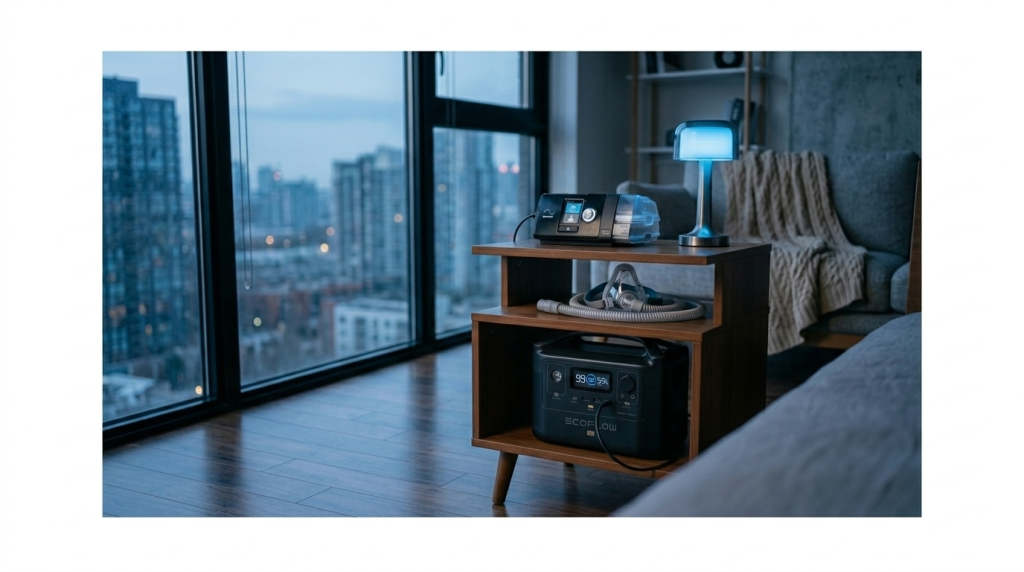
The Complete Renter’s Guide to Portable Power Stations (2026 Comprehensive Manual)
By UnitVerseHQ | Updated February 2026
You found your dream apartment. Great natural light, solid location, reasonable rent. Then the first major storm hits, the grid goes down, and you realize: you have no backup. No generator option. No permanent installation rights. No plan.
This is the reality for over 44 million renter households across the United States and it’s exactly why the best portable power station for apartment living has become one of the most searched product categories of 2026. This comprehensive manual answers every question a renter could have: from CPAP machines to Starlink dishes, from e-bike charging to refrigerator backup, from basic watt math to landlord legality to the future of solid-state battery technology arriving in consumer products right now.
Bookmark this. Share it with your building’s group chat. This is the only guide you’ll need.
Part One: Why Renters Have a Unique Power Problem
The Homeowner Advantage Gap
Homeowners have options that renters simply don’t. A whole-home standby generator can be wired directly to a transfer switch. Rooftop solar with a home battery like a Tesla Powerwall can sustain a house for days. These systems cost $10,000–$40,000 installed — and they require permanent structural modifications that would void any US lease agreement.
Renters are left navigating a frustrating middle ground: real vulnerability to power outages, zero ability to install permanent solutions, and a rental market that hasn’t traditionally offered backup power as a standard amenity.
The consequences are immediate and costly:
Food spoilage — the USDA estimates households lose $150–$400 in food during extended outages
Medical device dependency — CPAP users, oxygen concentrator patients, and insulin-dependent renters cannot safely lose power
Remote work vulnerability — with 32% of American workers working from home, an outage is lost income
E-bike battery dead ends — a portable power station for e bike charging eliminates range anxiety during grid failures
Starlink connectivity loss — remote workers and rural renters depending on satellite internet lose their connection when grid power drops
The best portable power station for apartment living directly solves all of these problems — without a single tool, a single lease violation, or a single conversation with your landlord.
The 2026 Market Inflection Point
The portable power station market has matured dramatically. In 2020, a 1,000Wh portable station cost over $1,000, weighed 30 lbs, and had mediocre software. In 2026, the same $800 buys a 1,024Wh LiFePO4 unit with app control, 500W solar input, 50-minute GaN fast charging, and a 3,000-cycle battery warranted for a decade.
The value proposition for renters has never been stronger.
Part Two: The Rental Loophole — You Don’t Need Landlord Permission
This is the section most renter guides skip. Understanding your rights changes how confidently you can invest in a battery backup for renters setup.
What “Portable” Legally Means
A portable power station is, by every legal and practical definition, a consumer electronic appliance. It plugs into a standard wall outlet. It sits on the floor. It has no permanent connection to building infrastructure. It moves when you move.
This places it in exactly the same legal category as a large television, a desktop computer, or a high-end audio system. No US residential lease can legally prohibit you from owning consumer electronics.
Most standard US residential leases restrict:
Permanent structural modifications (drilling, bolting)
Hard-wired electrical installations
Combustion-powered equipment — this is specifically where gas generators are banned, and rightfully so
A quality indoor safe power station touches none of these restrictions. You are plugging in an appliance. That’s it.
What About HOA Buildings?
Some managed communities added specific “energy storage device” language following e-bike battery fire incidents in 2022–2023. If your building has specific language:
Request the policy in writing — vague verbal restrictions are unenforceable
Present certification documentation — UL 9540, UL 1973, and IEC 62619 certifications from major brands demonstrate safety compliance that is difficult to deny
Reference NFPA 855 — the national standard permits residential energy storage under 20 kWh, covering every consumer portable power station by a massive margin
📎 For a complete breakdown of NFPA 855, UL 9540A certification, and apartment battery storage regulations, see our Indoor Battery Safety Guide → Article #3: Is it Safe to Charge Large Batteries Indoors?
Part Three: Your Portable Power Station Calculator — Size Your System First
Before browsing products, answer the single most important question renters ask: what size portable power station do I need?
This two-minute portable power station calculator process eliminates guesswork and ensures you don’t underbuy or overspend.
Step 1 — List Your Critical Devices
To choose the right power station, you first need to know what your daily “power budget” looks like. A standard apartment refrigerator is usually the biggest concern; while it doesn’t run every second, it typically needs 400 to 800Wh per day to stay cold. For medical needs, a CPAP machine is quite efficient, using only 240–360Wh for a full night’s sleep, though adding a humidifier can double that requirement.
If you are working from home, staying connected is a priority. A Standard Starlink dish is power-hungry, requiring 1,200–1,800Wh for 24 hours of use, whereas the Starlink Mini is much lighter on power, needing under 1,000Wh. For your desk setup, a laptop and Wi-Fi router combined usually need about 600–1,400Wh per day, depending on how many hours you work. Small essentials are easy to cover: charging two smartphones takes very little power (60–120Wh), and keeping four LED lights on for the evening uses roughly 150–240Wh. Finally, for commuters and outdoor prep, a full E-bike battery charge takes about 720Wh, while a Diesel heater or a standard box fan are very efficient, usually staying under 800Wh for a full day or night of use.
Step 2 — Apply the Runtime Formula
Runtime (hours) = Station Capacity (Wh) × 0.85 ÷ Average Draw (W)
The 0.85 accounts for inverter efficiency losses. Example:
1,024Wh station × 0.85 = 870Wh usable
Average draw (fridge + router + laptop + lights) = 220W
Runtime = 870 ÷ 220 = ~4 hours full load
With the refrigerator cycling (not running continuously), real-world runtime stretches to 8–12 hours — enough for most urban outages.
Step 3 — Match Capacity to Outage Risk
Risk Profile Capacity Needed Recommended BudgetLow (urban, mild climate)500–750Wh$300–$500Moderate (suburban, seasonal storms)1,000–1,200Wh$700–$1,000High (hurricane zone, rural, medical devices)2,000Wh+ with solar$1,200–$2,000+
Part Four: Device-Specific Power Guides
This is where most comprehensive guides fall short. A best portable power station for apartment recommendation means nothing if it can’t run your specific devices. Here’s the device-by-device breakdown.
The Best Portable Power Station for CPAP Users
If you rely on a CPAP or BiPAP machine, backup power isn’t optional — it’s a medical necessity. A portable power station for CPAP needs to meet specific requirements that general-purpose units don’t always satisfy.
What makes a CPAP-compatible unit different:
Pure sine wave inverter — CPAP machines require clean AC power identical to the grid. Modified sine wave inverters can damage CPAP motors and void warranties
Low self-discharge — your cpap portable power station may sit unused for weeks between outages; it needs to hold charge reliably
Silent operation — a unit that hums loudly defeats the purpose of running a sleep therapy device
DC output option — many CPAP machines accept 12V DC directly, bypassing the inverter entirely and dramatically extending runtime
CPAP runtime estimates by station capacity:
Station CapacityCPAP (No Humidifier, 40W)CPAP (With Humidifier, 70W)500Wh~10.5 hours~6 hours768Wh~16 hours~9.3 hours1,024Wh~21.7 hours~12.4 hours2,048Wh~43 hours~24.8 hours
Best portable power station for CPAP — Top Picks:
EcoFlow DELTA 2 is the top recommendation for most CPAP users — pure sine wave output, DC port for direct CPAP connection, whisper-quiet fan, and 1,024Wh capacity covers 2+ nights without humidifier. Its app lets you monitor remaining CPAP runtime in real time.
Bluetti EB70S is the best budget portable power station for CPAP — LiFePO4 chemistry, pure sine wave, and 716Wh covers one full night with humidifier plus two nights without, all under $500.
For CPAP camping: The Jackery Explorer 1000 Pro handles portable power station for cpap camping scenarios particularly well — at 25.4 lbs it’s genuinely packable, and its solar integration keeps it charged during multi-day outdoor events where grid power is unavailable.
📎 For safety considerations around charging medical device backup power indoors, see our Indoor Battery Safety Guide → Article #3
The Best Portable Power Station for Starlink
Starlink has become the internet lifeline for millions of renters in semi-rural and rural areas — and increasingly for urban renters who want outage-proof connectivity for remote work. A portable power station for Starlink has one critical specification to get right: continuous output wattage.
Starlink power requirements by model:
Starlink ModelIdle DrawActive DrawPeak DrawStandard (round/square)30W50–75W100WStandard Gen 320W40–65W75WMini8W20–40W50WFlat High Performance90W110–150W220W
The key insight for Starlink backup: it’s a continuous load, not a cyclic one like a refrigerator. Your portable power station for Starlink runs the dish at full draw 24 hours a day as long as you’re connected. This means capacity matters more than surge rating.
Runtime estimates (Starlink Standard, 60W average):
StationRuntime (Starlink only)Runtime (Starlink + Laptop + Router)768Wh (RIVER 2 Pro)~10.8 hours~5.5 hours1,024Wh (DELTA 2)~14.5 hours~7.3 hours2,048Wh (DELTA 2 Max)~29 hours~14.6 hours
For renters using Starlink as their primary internet — especially those working from home — the EcoFlow DELTA 2 Max is the minimum practical recommendation. Pair it with a 220W balcony solar panel and you can realistically maintain Starlink connectivity indefinitely during a daytime outage.
The Best Portable Power Station for Refrigerator Backup
A portable power station for refrigerator backup is the most common use case for apartment renters — and the most technically demanding, because refrigerators have high compressor surge requirements that catch underpowered units off-guard.
Critical spec: Your station’s surge wattage must exceed your fridge’s starting wattage. A refrigerator with 150W running draw can surge to 600–900W at compressor startup. A station with only 800W continuous output but 1,200W surge handles this. A station with 800W continuous and 900W surge may fail to start the compressor.
Runtime estimates (standard 150W avg apartment fridge):
StationRuntimeEcoFlow RIVER 2 Pro (768Wh)~9–11 hoursEcoFlow DELTA 2 (1,024Wh)~14–18 hoursBluetti AC180 (1,152Wh)~16–20 hoursEcoFlow DELTA 2 Max (2,048Wh)~28–36 hours
The Best Portable Power Station for E-Bike Charging
The portable power station for e bike use case is one of the fastest-growing in the portable power market — and one of the most practical for urban apartment renters. If your building doesn’t have dedicated e-bike charging infrastructure (most don’t), a portable station solves the problem immediately.
E-bike charging basics:
Most e-bike batteries are 36V or 48V systems ranging from 10Ah to 20Ah. Converting to watt-hours:
36V × 10Ah = 360Wh per full charge
48V × 15Ah = 720Wh per full charge
48V × 20Ah = 960Wh per full charge
A 1,024Wh station fully charges most 48V 15Ah e-bike batteries once with capacity remaining. A 768Wh unit handles 36V systems comfortably.
Important safety note for e-bike charging: Always use your e-bike’s original charger plugged into the station’s AC outlet — never attempt to connect directly to DC ports without the manufacturer-specified adapter. The portable power station for ebike charging process through standard AC output is safe, simple, and exactly as intended by both manufacturers.
Best units for e-bike charging:
EcoFlow DELTA 2 — 1,800W AC output handles even fast chargers cleanly
Bluetti AC180 — excellent for overnight e-bike charging with quiet fan operation
EcoFlow RIVER 2 Pro — ideal for smaller 36V e-bike systems in studio apartments
Portable Power Station for Diesel Heater — Winter Prep for Renters
This is an underserved use case that becomes critical during winter outages in colder climates. Diesel and propane heaters (used outdoors or in well-ventilated spaces) require minimal electricity — primarily for the ignition controller, fuel pump, and fan.
A portable power station for diesel heater application is actually one of the easiest to size: most diesel heater controllers draw only 10–15W during operation (higher during startup — up to 80–100W for the first 30–60 seconds of glow plug heating).
A 500Wh station can run a diesel heater controller for 30+ hours — far beyond any realistic outage scenario. This makes even budget units like the Bluetti EB70S entirely sufficient for winter heating backup control.
Part Five: The 2026 Brand Landscape — Every Major Player Compared
| Unit Model | Power Level | Can Run… | Best Use Case | Approx Price |
| EcoFlow DELTA 2 | 1,024Wh | Laptop, Fan, & Fridge (10-12 hrs) | Best Overall: Reliable for daily load shedding. | ~$799 |
| EcoFlow DELTA 2 Max | 2,048Wh | Everything above for 2 days. | Multi-Day Backup: For long outages. | ~$1,399 |
| Anker SOLIX C1000 | 1,056Wh | Heavy tools or a Coffee maker. | Fastest Charging: Full battery in <50 mins. | ~$799 |
| Bluetti AC180 | 1,152Wh | CPAP machine or quiet study lamp. | Silent Runner: Best for bedrooms. | ~$799 |
| Jackery 1000 v2 | 1,070Wh | Outdoor lights and electronics. | Lightweight: Best for camping/trips. | ~$749 |
| EcoFlow RIVER 2 Pro | 768Wh | Router, Phone, & Laptop. | Studio/Apartment: Compact & affordable. | ~$449 |
| Bluetti AC200L | 2,048Wh | Heavy Duty (AC units/Heaters). | Solar Pro: Best for recharging via panels. | ~$1,199 |
| Energizer PPS | 240Wh | Just Phones and 1 Bulb. | Ultra-Budget: Only for basic phone charging. | ~$149 |
EcoFlow vs Jackery 2026: The Full Breakdown
The EcoFlow vs Jackery 2026 debate is the most common comparison question in the renter power station market. Here’s the honest breakdown.
Where EcoFlow wins:
Charging speed — GaN adapter technology means the DELTA 2 hits 0–80% in 50 minutes vs. 1.8–2.5 hours for comparable Jackery units
Full LiFePO4 lineup — EcoFlow has transitioned every consumer unit to safer iron phosphate chemistry; Jackery still uses NMC in several popular models
App ecosystem maturity — real-time consumption monitoring, remote control, charge scheduling, and smart home integration are more refined on EcoFlow’s platform
X-Boost technology — intelligently runs appliances rated up to 2,200W through a 1,800W inverter
Where Jackery wins:
Weight — Explorer 1000 Pro at 25.4 lbs is the lightest 1,000Wh-class unit available; ideal for renters who move frequently
Solar ecosystem — SolarSaga panels offer the most plug-and-play solar experience for first-time users
Price flexibility — Jackery units go on deep sale (20–30% off) more frequently through Amazon and major retailers
Reliability track record — longer market presence with a larger proven installed base
The EcoFlow vs Jackery 2026 verdict for apartment renters: EcoFlow wins on safety chemistry, charging speed, and software. Jackery wins on portability and price timing. For a portable power station for CPAP or portable power station for refrigerator use where LiFePO4 safety matters most, EcoFlow is the stronger recommendation.
The Energizer Portable Power Station — Budget Reality Check
The Energizer portable power station lineup deserves an honest mention. Energizer entered the consumer power station market with brand recognition but modest specs. Their entry-level units (240W–500W range) use LiFePO4 chemistry and carry real certifications — a genuine advantage over similarly priced no-name alternatives flooding Amazon.
Who the Energizer portable power station is right for: Renters who need basic phone and laptop charging backup with a trusted brand name, budget under $200, and no intention of running refrigerators or CPAP machines. For anything beyond light-duty backup, the Bluetti EB70S at ~$449 is a substantially better investment.
Part Six: Use Case Scenarios — Real Renter Situations
Scenario 1: The Remote Worker with Starlink (Bozeman, MT)
Situation: Freelance developer, works entirely from home, uses Starlink as primary internet in a semi-rural apartment, experienced four outages in 2024 averaging 9 hours each.
Devices needed: Starlink Standard (65W avg), laptop (75W), router backup (15W), phone charging (20W). Total continuous draw: ~175W.
Solution: EcoFlow DELTA 2 Max (2,048Wh) — provides ~11 hours of full-load runtime. With one 220W balcony panel, daytime solar input covers most of the Starlink draw, extending effective outage coverage indefinitely during daylight hours.
Scenario 2: The CPAP-Dependent Renter (Tampa, FL)
Situation: Retired nurse, uses CPAP with humidifier nightly (70W average draw), lives alone in a hurricane-zone apartment, experienced one 47-hour outage in 2024.
Devices needed: CPAP with humidifier (70W), refrigerator (150W avg), phone (20W). Peak: 800W surge.
Solution: EcoFlow DELTA 2 Max (2,048Wh) + 220W balcony panel. CPAP runtime alone: ~24.8 hours. Combined with refrigerator and phone charging at ~240W average draw: ~7.3 hours full load, with solar extending coverage through daylight recovery.
This is precisely the use case where a quality portable power station for CPAP stops being a convenience product and becomes genuine safety infrastructure.
Scenario 3: The E-Bike Commuter (Chicago, IL)
Situation: Marketing manager, commutes on a 48V 15Ah e-bike, no dedicated charging station in building garage, charges e-bike in apartment nightly.
Devices needed: E-bike battery (720Wh per charge), laptop (65W), phone (20W). No outage concern — daily charging is the primary use case.
Solution: EcoFlow RIVER 2 Pro (768Wh) charged during off-peak rate hours (midnight–6 AM), then used to charge e-bike in the morning. Monthly electricity savings using off-peak arbitrage: $8–$15.
The portable power station for e bike use case is also a smart solution for renters whose buildings prohibit bringing e-bikes inside — the station charges in the apartment, then goes to the garage to charge the bike via extension cord.
Scenario 4: The Van-Life-Adjacent Renter (Austin, TX)
Situation: Travel nurse on 13-week contracts, rents furnished apartments short-term, also does weekend van camping. Needs a best portable power station for van life that doubles as apartment backup.
Solution: Jackery Explorer 1000 Pro. At 25.4 lbs with a carry handle and 400W solar input, it transitions seamlessly between apartment use and van weekend trips. The NMC chemistry is acceptable given that it’s primarily used in ventilated van and apartment environments, never enclosed or unmonitored.
Scenario 5: The Winter-Ready Northern Renter (Minneapolis, MN)
Situation: Graphic designer, works from home, uses a diesel heater on the balcony during power outages (properly ventilated), primary concern is keeping the diesel heater controller, laptop, and router running during winter ice storm outages.
Devices: Diesel heater controller (15W running, 100W startup), laptop (65W), router (15W), LED lighting (30W). Average draw after startup: ~125W.
Solution: Bluetti EB70S (716Wh). Covers ~5.5 hours at full load, with the portable power station for diesel heater controller drawing so little continuous power that the unit lasts significantly longer in practice. At ~$449 with LiFePO4 safety, it’s the right-sized, right-priced solution for this profile.
Part Seven: 2026–2027 Technology Horizon
GaN Charging — Already Here
Gallium Nitride (GaN) charging is now standard in premium portable power stations. The practical benefit for apartment renters: EcoFlow’s GaN adapter charges the DELTA 2 from 0–80% in under 50 minutes — previously a 4-hour job. GaN adapters run cooler, take up less outlet space, and reduce electricity cost per cycle through higher conversion efficiency.
Solid-State Batteries — Coming 2026–2027
The next major jump is solid-state battery chemistry, replacing liquid electrolyte with solid ceramic or polymer material. Benefits for renters:
Same capacity in a meaningfully smaller, lighter package
Faster safe charging rates
Improved safety eliminates liquid electrolyte entirely
Projected 10,000+ cycle ratings
Samsung SDI and CATL both have consumer-grade solid-state cells entering production. EcoFlow has confirmed solid-state integration in its next-generation DELTA series. Buying advice: Current LiFePO4 units are excellent value right now. If you need backup power today, buy today’s technology confidently. If you can wait 18 months, first-generation solid-state units will arrive — at a premium.
Vehicle-to-Home Bridging
EcoFlow has previewed V2H bridge hardware that allows electric vehicles to discharge into portable stations, creating a massive temporary battery from your car’s pack. Not yet mainstream, but a genuine near-term option for EV-owning renters.
Renter Grid Participation
Several states are advancing legislation that would allow renters to participate in demand response programs — essentially selling stored energy back to the grid during peak demand periods. If your state passes such legislation, your portable station becomes a revenue-generating asset, not just a backup device.
Part Eight: Renter’s Complete Buying Decision Matrix
| Renter Profile | Recommended Unit | Primary Reason |
| CPAP user (no humidifier) | EcoFlow RIVER 2 Pro | 20+ hrs runtime; whisper-quiet operation |
| CPAP user (with humidifier) | EcoFlow DELTA 2 | 10–14 hrs runtime using DC port (more efficient) |
| Starlink user (work-from-home) | EcoFlow DELTA 2 Max | 24–28 hrs Starlink-only runtime; huge capacity |
| Refrigerator backup only | EcoFlow DELTA 2 | 14–20 hrs fridge runtime (handles high startup surge) |
| E-bike charger (48V system) | EcoFlow DELTA 2 | One full charge + 20% capacity remaining |
| E-bike charger (36V system) | EcoFlow RIVER 2 Pro | Right-sized for a full charge; compact and light |
| Diesel heater backup | Bluetti EB70S | High 12V DC output; 30+ hrs steady control |
| Budget first-timer | Bluetti EB70S | Best LiFePO4 value; high safety at a low entry price |
| Studio apartment | EcoFlow RIVER 2 Pro | 17.2 lbs (not 17.6); ideal “desk-sized” footprint |
| Hurricane/storm zone | EcoFlow DELTA 2 Max | 40+ hrs essential load (lights, fans, phone charging) |
| Van life crossover | Jackery Explorer 1000 v2 | Lightest in class; rugged and highly portable |
| Maximum solar input | Bluetti AC200L | 1,200W solar input; fastest off-grid recharge |
Frequently Asked Questions
What size portable power station do I need for an apartment?
For most US apartment renters, a 1,000–1,024Wh unit is the practical sweet spot. It runs essential devices — router, laptop, phone charging, and lighting — for 8–12 hours, handles refrigerator backup for 14–18 hours, and covers two nights of CPAP therapy without a humidifier. If you use Starlink as your primary internet or have medical equipment like a humidified CPAP, step up to 2,000Wh. Use the portable power station calculator in Part Three to run your exact numbers before buying.
What is the best portable power station for CPAP users?
The EcoFlow DELTA 2 is the top recommendation as a portable power station for CPAP in 2026. It delivers pure sine wave AC output (required for CPAP motors), has a dedicated DC output port for direct CPAP connection that dramatically extends runtime, operates quietly enough for a bedroom environment, and its 1,024Wh capacity covers 2+ nights without a humidifier. For budget-focused buyers, the Bluetti EB70S at ~$449 is the best portable power station for CPAP under $500.
Can I use a portable power station for Starlink in my apartment?
Yes — a portable power station for Starlink is one of the most practical uses for renters who depend on satellite internet for remote work. Starlink Standard draws 50–75W continuously, meaning a 1,024Wh station provides approximately 14 hours of uninterrupted connectivity. For 24-hour outage resilience, the EcoFlow DELTA 2 Max (2,048Wh) combined with a balcony solar panel is the right setup.
How do I charge an e-bike from a portable power station?
Plug your e-bike’s original charger into the portable station’s standard AC outlet — exactly as you would plug into a wall. A portable power station for e bike charging requires no special adapters when used through the AC output. For a 48V 15Ah e-bike battery (720Wh), a 1,024Wh station provides one full charge with capacity remaining for other devices.
Is a portable power station safe to use as a diesel heater controller backup?
Yes — a portable power station for diesel heater controller use is one of the lowest-demand applications possible. Most diesel heater controllers draw only 10–15W during steady operation. A 500Wh unit provides 30+ hours of controller runtime, making even entry-level stations entirely sufficient for this application.
Do I need landlord permission for a portable power station?
No. A portable power station is a consumer electronic appliance — legally and practically equivalent to a television or desktop computer. It requires no structural modification, no hard-wiring, and produces no combustion emissions. Existing lease restrictions on generators target combustion-powered units specifically. A certified LiFePO4 indoor safe power station does not fall under any such restriction in any US state.
How does the Energizer portable power station compare to EcoFlow and Bluetti?
The Energizer portable power station lineup is a credible budget option for light-duty use — basic phone, laptop, and LED lighting backup. It uses legitimate LiFePO4 chemistry and real certifications, which separates it from no-name Amazon alternatives. However, for renters who need to run a portable power station for refrigerator, CPAP machine, or e-bike charger, EcoFlow and Bluetti units offer substantially better surge capacity, larger battery sizes, and more advanced battery management at price points that justify the step up.
What’s the best portable power station for van life that also works in an apartment?
The Jackery Explorer 1000 Pro is the best crossover unit for renters who want the best portable power station for van life and apartment use simultaneously. At 25.4 lbs with a practical carry handle, it’s genuinely portable between an apartment and a vehicle, its SolarSaga panel ecosystem is the easiest to set up outdoors, and 1,002Wh capacity handles both use cases well.
UnitVerseHQ is an independent buyer’s guide and education platform for American renters navigating smart home, energy resilience, and apartment living decisions. Prices and specifications reflect market conditions as of February 2026 and are subject to change. Always verify current pricing and certifications directly with manufacturers before purchasing.