
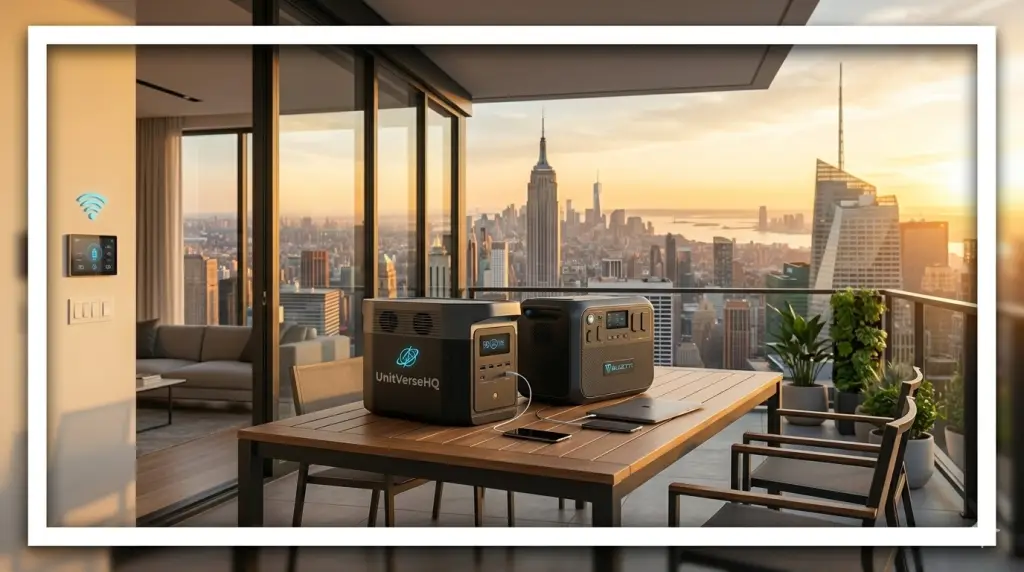
5 Best Portable Power Stations for USA Apartments (2026 Review)
By UnitVerseHQ | Updated February 2026
Living in a USA apartment means you can’t just fire up a gas generator when the power goes out. Your neighbors would complain, your landlord would panic, and carbon monoxide would turn your studio into a serious health hazard. That’s exactly why the portable power station for apartment living has exploded in popularity — and in 2026, the options are better than ever.
Whether you’re prepping for storm season, protecting your home office setup, or looking for the best solar generator for renters, this guide breaks down everything you need to know before you buy.
Why Apartments Need a Different Power Solution
Gas generators are completely off the table for most renters. They emit toxic fumes, make serious noise, and most leases explicitly ban them. But power outages don’t care about your lease agreement.
A quality indoor safe battery backup solves every one of those problems:
- Zero emissions — runs completely clean indoors
- Silent operation — most produce 0 dB at rest, under 50 dB under load
- Compact footprint — fits under a desk, in a closet, or beside a nightstand
- No landlord drama — looks like a large speaker or appliance
The shift to LiFePO4 (Lithium Iron Phosphate) battery chemistry has been the biggest game-changer for apartment users specifically. Here’s why that matters.
Why LiFePO4 Batteries Are the Gold Standard for Indoor Use
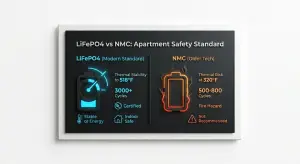
Not all portable power stations are created equal. Older units used NMC (Nickel Manganese Cobalt) lithium chemistry, which — while energy-dense — carries real thermal runaway risk. That means fire hazard. That means bad news in a small apartment.
LiFePO4 batteries offer:
- Thermal stability up to 518°F before breakdown (NMC fails around 320°F)
- 3,000–5,000 charge cycles vs. 500–800 for NMC units
- No toxic off-gassing during normal operation or even in fault conditions
- UL certification eligibility — the safety benchmark American consumers should look for
For a portable power station for apartment use, LiFePO4 isn’t a nice-to-have. It’s the minimum requirement.
What to Look for Before You Buy
Before we get to the top picks, here’s your quick apartment-specific checklist:
Capacity (Wh)
- Under 500Wh — lights, phone charging, small fans
- 500–1,000Wh — adds a CPAP, router, and small fridge
- 1,000Wh+ — powers a mini-fridge, laptop, TV, and medical devices simultaneously
Output (Watts)
Make sure the continuous watt output covers your highest-draw appliance. A 1,000W inverter won’t run a 1,200W microwave.
Size and Weight
Apartment living means limited storage. Units under 30 lbs are genuinely portable. Over 50 lbs, you’re mostly leaving it in one spot.
Solar Input
If you’re evaluating the best solar generator for renters, check the max solar input (watts) and whether the unit supports pass-through charging. Balcony solar panels are a growing trend for renters who want energy independence without rooftop installations.
Noise Level
Look for units with fanless modes or low-RPM cooling fans. The quietest units on this list operate at under 30 dB — quieter than a library.
The 5 Best Portable Power Stations for Apartments in 2026
1. EcoFlow DELTA 2 — Best Overall for Apartment Use
Capacity: 1,024Wh | Output: 1,800W (2,700W surge) | Battery: LiFePO4 | Weight: 27 lbs
The EcoFlow DELTA 2 is the top pick for renters who want serious power in a manageable package. It’s one of the most recommended units in any EcoFlow vs Bluetti for small spaces comparison — and for good reason.
Why it wins for apartments:
- Charges from 0–80% in just 50 minutes via AC
- LiFePO4 cells rated for 3,000+ cycles
- App control via Bluetooth and Wi-Fi
- Compact enough to slide under most desks
- Whisper-quiet fan that only spins up under heavy load
It’s the most balanced portable power station for apartment users who need enough capacity for a full outage without storing something the size of a mini-fridge.
Best for: Home office workers, CPAP users, renters who want whole-unit backup.
Off-Peak Electricity Charging Hack: Save $167–$500/Year as an Apartment Renter (2026)
2. Bluetti AC180 — Best for Silent Operation
Capacity: 1,152Wh | Output: 1,800W (2,700W surge) | Battery: LiFePO4 | Weight: 35 lbs
When comparing EcoFlow vs Bluetti for small spaces, Bluetti’s AC180 stands out for its near-silent cooling system. It runs noticeably quieter than most competitors under moderate loads — a real advantage in a thin-walled apartment building.
Why renters love it:
- Turbo charging mode hits full charge in under 45 minutes
- ECO mode drops standby power to almost nothing
- Robust build quality with a premium feel
- Excellent solar input: up to 500W
- Strong indoor safe battery backup credentials with UL-adjacent safety features
It’s slightly heavier than the EcoFlow DELTA 2, but the quieter operation makes it the top pick for light sleepers or anyone keeping their unit in a bedroom.
Best for: Renters in shared walls situations, bedroom setups, overnight medical device users.
3. Jackery Explorer 1000 Pro Best for Solar-Powered Renters
Capacity: 1,002Wh | Output: 1,000W (2,000W surge) | Battery: NMC (safe, with BMS protection) | Weight: 25.4 lbs
The Jackery Explorer 1000 Pro earns its spot as the best solar generator for renters thanks to its exceptional solar charging compatibility and lightweight build. Note that it uses NMC chemistry rather than LiFePO4 — but Jackery’s battery management system (BMS) is well-regarded, and its track record for indoor safety is strong.
Why it works for apartments:
- Pairs seamlessly with Jackery’s SolarSaga panels (great for balconies)
- Lightest unit in the 1,000Wh class on this list
- Quiet enough for indoor use
- Handle-forward design makes it easy to move between rooms
If you’re building a balcony solar setup as a renter, this ecosystem is the most plug-and-play of the bunch.
Best for: Balcony solar setups, frequent movers, renters who prioritize portability.
4. EcoFlow RIVER 2 Pro — Best Compact Option
Capacity: 768Wh | Output: 800W (1,600W surge) | Battery: LiFePO4 | Weight: 17.6 lbs
Not every apartment needs a 1,000Wh behemoth. The EcoFlow RIVER 2 Pro is the sweet spot for renters who want a genuinely compact, lightweight portable power station for apartment use without sacrificing LiFePO4 safety.
Why it earns a spot:
- Under 18 lbs — easy to grab and move
- LiFePO4 rated for 3,000+ cycles
- Charges to full in about 70 minutes
- Easily fits in a backpack or closet shelf
- Excellent indoor safe battery backup for essentials: router, phone, laptop, CPAP
In the EcoFlow vs Bluetti for small spaces conversation, the RIVER 2 Pro is EcoFlow’s answer to the “I just don’t have the room” renter.
Best for: Studio apartments, minimalist setups, renters who move frequently.
5. Bluetti EB70S — Best Budget Pick
Capacity: 716Wh | Output: 800W (1,400W surge) | Battery: LiFePO4 | Weight: 21.4 lbs
The Bluetti EB70S brings LiFePO4 chemistry to a price point under $500 (frequently on sale). If you’re exploring the best solar generator for renters on a budget, this is your entry point without compromising on indoor safety.
Why budget-conscious renters choose it:
- LiFePO4 battery in a sub-$500 unit — rare
- Supports up to 200W solar input
- Quiet operation under light-to-moderate loads
- Multiple AC outlets, USB-A, USB-C, and DC ports
- Solid indoor safe battery backup for outages lasting 12–24 hours
It’s not the fastest charger and won’t run a full apartment’s worth of appliances — but for essential backup, it does the job safely and affordably.
Best for: First-time buyers, renters on a budget, essential-only backup needs.
EcoFlow vs Bluetti for Small Spaces: Quick Comparison
This is one of the most Googled questions in the category, so let’s address it directly.
| Feature | EcoFlow DELTA 2 | Bluetti AC180 |
|---|---|---|
| Capacity | 1,024Wh | 1,152Wh |
| Weight | 27 lbs | 35 lbs |
| Charge Speed | ~50 min (0-80%) | ~45 min (full) |
| Noise Level | Low | Very Low |
| Solar Input | 500W | 500W |
| App Control | Yes | Yes |
| Price Range | $$$ | $$$ |
Bottom line on EcoFlow vs Bluetti for small spaces: EcoFlow wins on portability and speed. Bluetti wins on silence and slightly higher capacity. Both are excellent portable power station for apartment choices — it really comes down to whether you value lighter weight or quieter operation.
Gas Generator vs. Portable Power Station for Apartments
Let’s put this debate to rest permanently.
| Factor | Gas Generator | Portable Power Station |
|---|---|---|
| Indoor safe? | No CO poisoning risk | Yes zero emissions |
| Noise | 65-75 dB (very loud) | 0–45 dB (library quiet) |
| Apartment-legal? | Almost never | Always |
| Fuel required? | Yes — gasoline storage | No — charges from wall/solar |
| Maintenance | Oil changes, carb cleaning | None |
| Solar compatible? | No | Yes |
There is no scenario where a gas generator is the right answer for a renter in a USA apartment. A quality indoor safe battery backup beats it on every metric that matters for apartment living.
Tips for Getting the Most Out of Your Apartment Power Station
- Charge to 80% for storage — LiFePO4 cells last longer when not kept at 100% constantly
- Use ECO mode when running low-draw devices to extend battery life
- Keep it ventilated — even though these units are indoor-safe, don’t stuff them in an airtight cabinet under load
- Pair with a balcony solar panel — even a 100W panel can meaningfully extend runtime during a daytime outage
- Register your unit — all five brands offer warranty extensions for registered products
Frequently Asked Questions
Are portable power stations safe to use indoors in an apartment?
Yes — especially units with LiFePO4 batteries. Unlike gas generators, they produce zero carbon monoxide or combustion fumes. They’re designed specifically for indoor use and are safe to run in enclosed spaces. Always look for UL certification or equivalent safety testing when shopping for an indoor safe battery backup.
Can a portable power station power an entire apartment?
It depends on the capacity and your power needs. A 1,000Wh+ unit can realistically run essential devices — a router, phone chargers, a laptop, CPAP machine, and LED lights — for 12–24 hours. Running a full kitchen or central AC is beyond the scope of any portable unit in this class.
What’s the difference between EcoFlow and Bluetti for renters?
In most EcoFlow vs Bluetti for small spaces comparisons, EcoFlow units tend to be lighter and charge faster, while Bluetti units tend to be quieter and offer slightly more capacity at similar price points. Both brands offer excellent LiFePO4 options well-suited for apartment use.
Can I use solar panels with a portable power station in an apartment?
Absolutely. Many renters use compact solar panels on balconies or window sills to keep their unit topped up. This is especially relevant if you’re shopping for the best solar generator for renters — look for units with high solar input (300W+) and pass-through charging capability.
How long does a portable power station last?
LiFePO4 units are typically rated for 3,000–5,000 charge cycles before dropping to 80% capacity. At one full cycle per week, that’s over 50 years of use. NMC units typically last 500–800 cycles. For long-term apartment use, LiFePO4 is clearly the better investment.
Do portable power stations make noise?
Most modern units have cooling fans that only engage under heavy load. In standby or light use, many operate at near-0 dB. Under moderate load, expect 30–45 dB — roughly the sound of a quiet conversation. This makes them well-suited for bedroom or home office use in a portable power station for apartment setup.
Is it worth buying a portable power station as a renter?
Yes, particularly if you live in an area prone to outages, rely on medical equipment, or work from home. Since you can’t install a whole-home backup system as a renter, a portable unit is the most practical and cost-effective solution available to you.