

EcoFlow Alternator Charger & X-Stream Guide: Charge Your Delta at 800W While Driving (2026)
By UnitVerseHQ | Updated March 2026
Every van-lifer, overlander, and road tripper eventually hits the same wall: a power station that’s dead by morning, and a campsite with no outlet in sight. The conventional wisdom is to charge via the 12V cigarette lighter in your vehicle. That’s fine for topping up a phone. It’s completely useless for restoring a 1,024Wh power station — at 10W of charge speed, you’d need 102 hours of driving to fill a DELTA 2 from empty.
The EcoFlow Alternator Charger kills this problem permanently. With the EcoFlow 800W Alternator Charger, charge 8 times faster than with traditional vehicle auxiliary power outlets simply by using excess energy generated by your vehicle. DIY Solar Forum At 800W of 800W car charging power, you restore 1kWh of capacity in a 75-minute drive — turning every commute, every interstate run, and every trip between campsites into a charging session.
This guide covers everything: the complete EcoFlow Alternator Charger specs, how EcoFlow X-Stream charging actually works and how it differs from alternator charging, the step-by-step installation, the critical smart alternator warning most van-lifers miss, the real charging math, and how the EcoFlow Delta 2 Extra Battery transforms the entire system into a genuinely never-empty mobile power setup.
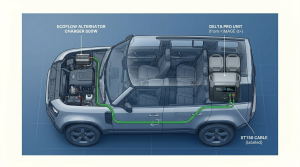
What Is the EcoFlow Alternator Charger?
The EcoFlow Alternator Charger is a DC-to-DC converter that taps into your vehicle’s alternator — the generator driven by your engine that keeps your car battery charged while driving — and routes that surplus electrical energy into your portable power station at high speed.
The EcoFlow Alternator Charger converts driving time into charging time, delivering 500W or 800W to your portable power station. This makes it up to eight times faster than a regular 12V car outlet. Instead of waiting hours at camp, you arrive with your power station fully charged and ready to run your essentials, tools, and outdoor appliances. EcoFlow
This is the fundamental insight behind the EcoFlow Alternator Charger: your vehicle’s alternator produces substantially more electrical power than your car needs while driving. That surplus energy — which would otherwise generate heat in the charging regulator — can be captured and redirected. The EcoFlow DC-to-DC charger converts your vehicle battery’s 12V or 24V DC output into the 40–60V DC range that EcoFlow power stations accept through their charging ports.
Why Not Just Use the 12V Cigarette Outlet?
This is the question the EcoFlow Alternator Charger answers definitively:
| Charging Method | Power Output | Time to Fill 1kWh | 8-Hour Drive Charges |
|---|---|---|---|
| 12V cigarette lighter | 8–12W | ~100 hours | ~0.08kWh |
| EcoFlow Alternator Charger 800W | 800W | ~1.3 hours | ~5.5kWh |
| EcoFlow Alternator Charger 500W | 500W | ~2.3 hours | ~3.5kWh |
| Solar (200W, ideal conditions) | 200W | ~5.5 hours | ~1.4kWh |
The cigarette lighter charges at the same speed as a single LED bulb. The EcoFlow Alternator Charger at 800W charges at the equivalent of a high-speed wall outlet — while you drive, automatically, with zero manual intervention.
EcoFlow X-Stream vs Alternator Charger: Two Different Systems You Need to Understand
One of the most persistent points of confusion in EcoFlow Alternator Charger research is the relationship between the alternator charger and EcoFlow X-Stream charging. They are completely different technologies that serve complementary — not competing — purposes.
What EcoFlow X-Stream Actually Is
X-Stream tech means you can charge from 0–80% in 50 mins, that’s faster than you’ll pack your trunk for the next road trip. To iterate just how fast that is — it’s 7× faster than other power stations on the market. DIY Solar Forum
EcoFlow X-Stream is EcoFlow’s proprietary AC wall-outlet fast-charging technology. It allows compatible power stations to accept significantly higher AC input wattage than standard stations:
| Station | X-Stream AC Input | 0-80% Time |
|---|---|---|
| DELTA 2 | 1,200W AC | 50 minutes |
| DELTA 2 Max | 1,500W AC | ~65 minutes |
| DELTA Pro 3 | Up to 3,600W AC | ~50 minutes |
X-Stream enables the EcoFlow DELTA 2 to reach 80% charge in just 50 minutes. The Smart Battery Management system fully optimizes how your station stores and provides power. EcoFlow Europe
EcoFlow X-Stream only works when you have AC wall power available — at home, at a campsite with shore power, or at a commercial charging location.
The EcoFlow EV X-Stream Adapter: A Third System
There is also an EcoFlow EV X-Stream adapter — a separate product entirely — that allows certain DELTA stations to charge at Level 2 EV charging stations:
The EcoFlow EV X-Stream Adapter allows you to charge your Delta Pro at any of the thousands of level 2 AC EV Charging stations worldwide. Fast charging at 3,400 Watts at home or on the road lets you bring your Delta Pro PowerStation to a full charge in 1.7 hours. Outbound Power
This is distinct from both the wall-outlet EcoFlow X-Stream and the EcoFlow Alternator Charger.
The Three-System Summary
| System | Power Source | Speed | Best For |
|---|---|---|---|
| EcoFlow Alternator Charger | Vehicle alternator (DC) | 500–800W | Driving, van life, overlanding |
| EcoFlow X-Stream (AC) | Wall outlet (AC) | 1,200–1,500W | Home, campsite shore power |
| EcoFlow EV X-Stream Adapter | Level 2 EV station (AC) | 3,400W | Road trips near EV chargers |
The EcoFlow Alternator Charger is the only system that works while driving. EcoFlow X-Stream is the fastest option when you have grid power. They stack perfectly — drive with the alternator charger running, then plug into X-Stream at your destination for a final top-up in under an hour.
Full Specs: EcoFlow Alternator Charger 500W vs 800W
The EcoFlow Alternator Charger comes in two robust variations: the 500W and 800W models. Both are engineered with precision to enhance your outdoor experiences or optimize your professional ventures. EcoFlow
Complete Verified Specs Comparison
| Specification | 500W Model | 800W Model |
|---|---|---|
| Max Output Power | 500W | 800W |
| Input (Vehicle Battery) | 11V–31V | 11V–31V, 76A max |
| Output (to Station) | Up to 40–60V, 500W | Up to 40–60V, 800W |
| Reverse Charge Output | 100W max | 100W max |
| Battery Maintenance | ✅ Yes | ✅ Yes |
| Jump Starter | ✅ Yes | ✅ Yes |
| GaN Technology | ✅ Yes | ✅ Yes |
| 12V/24V Vehicle Support | ✅ Both | ✅ Both |
| Vehicle Types | SUV, Pickup, RV, Boat | SUV, Pickup, RV, Boat |
| Included Cable | XT60 + XT150 | XT150 only |
| XT60 Cable | Included | Separate purchase |
| RIVER Series Support | ✅ Yes (XT60) | ⚠️ Needs XT60 (sold separately) |
| DELTA Series (full 800W) | 500W via XT60 | 800W via XT150 |
| DELTA Pro / Pro 3 | Needs adapter | Needs Smart Generator Adapter |
| DELTA Pro Ultra | ❌ Not compatible | ❌ Not compatible |
| CarPlay / Android Auto | ✅ Yes | ✅ Yes |
| EcoFlow App integration | ✅ Yes | ✅ Yes |
| Safety protections | 6 types | 6 types |
| Warranty | 2 years | 2 years |
| Price | ~$149–$179 | ~$249–$299 |
| Charges 1kWh in | ~2.3 hours | ~1.3 hours |
The Critical Cable Distinction
The 800W and 500W models both charge at 500W when using the XT60 output cable. To unlock the 800W model’s full 800W potential, you must use the XT150 or Custom Fit (4+8) output cable with a compatible EcoFlow DELTA series unit. DIY Solar Forum
This is the most important technical detail for anyone shopping the 800W EcoFlow Alternator Charger: the XT150 cable is the key to unlocking full 800W output. The 800W model ships with the XT150 cable for DELTA series units. If you want to use it with a RIVER series station or a third-party power station, you need to purchase a separate XT60 cable — at which point, both the 500W and 800W models perform identically (capped at 500W through the XT60 port).
Bottom line: The 800W model is only worth the premium if you own an EcoFlow DELTA series station and plan to use the included XT150 cable.
Third-Party Compatibility
EcoFlow Alternator Chargers are compatible with many third-party power stations (such as Jackery, BLUETTI, and Anker) via the XT60 output cable. This cable is included with 500W and 600W models but sold separately for the 800W. DIY Solar Forum
For Jackery, Bluetti, or Anker owners: the EcoFlow Alternator Charger works — but only at 500W maximum through the XT60 port. If your third-party station accepts solar input via XT60, the alternator charger connects through the same port.
How to Charge EcoFlow While Driving: Complete Installation Guide
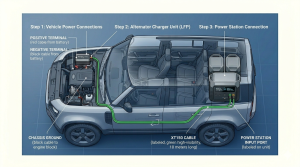
This is the step-by-step guide for how to charge EcoFlow while driving using the EcoFlow Alternator Charger. The installation is semi-permanent done once, then the charger works automatically every time you start the vehicle.
What You Need Before Starting
- EcoFlow 800W or 500W Alternator Charger
- Included fuse cable (with appropriate fuse — typically 80–100A for 800W)
- Included input cable (positive + negative leads)
- XT150 cable (included with 800W for DELTA series)
- Basic tools: wire stripper, wrench for battery terminal, cable routing tool
- 30–60 minutes of installation time
Step-by-Step Installation
Connect the Fuse Cable — 1. Connect the fuse cable to the input cable on one end. 2. Connect the fuse cable to the vehicle battery on the other end. EEVblog
Step 1: Mount the alternator charger. Choose a location in your engine bay or accessible vehicle interior with adequate ventilation. The EcoFlow Alternator Charger produces heat during operation — avoid enclosed spaces. Many van-lifers mount it inside the van near the battery, with cables routed through the firewall.
Step 2: Connect the fuse cable. Connect the fuse cable to the input cable on one end. Connect the fuse cable to the vehicle battery on the other end. EEVblog The fuse must be installed within 18 inches of the battery positive terminal — this is the protection point for your vehicle’s electrical system.
Step 3: Connect the input cable. Connect the black cable to the chassis terminal. Thread the other end of the input cable through the car body towards the charger. If the input cable is bulky or difficult to pull through, disconnect the cable ends before threading. Plug the other side of the input cable into the EcoFlow Alternator Charger. DIY Solar Forum
Step 4: Connect the output cable to your power station. Plug the XT150 cable (for DELTA series) or XT60 cable (for RIVER series) from the EcoFlow Alternator Charger‘s output port into your power station’s solar/DC input port.
Step 5: Verify and test. Start your vehicle. The EcoFlow app should immediately show DC input power on your station’s dashboard. Confirm input wattage is within expected range (typically 400–800W depending on alternator load and vehicle speed). A reading of 200–600W is normal at idle; full 800W is typically achieved at driving RPM.
Step 6: Route the output cable. Route the XT150 cable from the engine bay through a grommet in the firewall into the vehicle interior where your power station lives. Use cable clips to secure it away from heat sources and moving parts.
Step 7: Monitor the first drive. On your first drive with the EcoFlow Alternator Charger installed, watch the EcoFlow app (or the station’s display) for stable input readings. Confirm charging is active and the station’s battery percentage is increasing. If the reading drops to zero while driving, proceed to the Smart Alternator section below.
Smart Alternator Warning: The Problem Most Van-Lifers Don’t Know About
This section addresses the single most common issue people encounter with the EcoFlow Alternator Charger — and it’s one that neither EcoFlow’s marketing nor most review articles cover adequately.
What Is a Smart Alternator?
Modern vehicles — particularly post-2010 models from BMW, Mercedes-Benz, Ford (EcoBoost lineup), Volkswagen, Audi, and General Motors — use smart alternators (also called variable voltage alternators or intelligent energy management systems).
A smart alternator doesn’t run at constant output. Instead, it dynamically adjusts voltage based on battery state of charge, driving conditions, and vehicle electrical load. When your vehicle battery is fully charged, the smart alternator reduces its output to near zero — saving fuel by not spinning an unnecessarily loaded generator.
Why This Matters for the EcoFlow Alternator Charger
No, the 800W alternator charger’s charging logic does not rigidly apply 800 watts. Instead, it depends on the power surplus of the car’s alternator. It ensures the alternator is not overloaded, allowing up to a maximum of 800 watts without harming the car’s battery. EcoFlow
The EcoFlow DC-to-DC charger is designed to draw from alternator surplus. But on a smart alternator vehicle, if the ECU decides to reduce alternator output, the EcoFlow Alternator Charger sees less available power — and charging slows or stops.
Symptoms of a smart alternator problem:
- Input wattage on the EcoFlow app drops to zero while driving
- Charging only works for the first 20–30 minutes then stops
- Inconsistent charge rates — fluctuating between 0W and 400W unpredictably
- Charging works fine at high RPM but stops at highway cruising speed
Vehicles most likely to have smart alternator issues:
- BMW 3/5/7 Series (2008+)
- Mercedes-Benz C/E/S Class (2008+)
- Ford F-150 EcoBoost (2011+)
- VW Golf, Passat, Tiguan (2010+)
- Chevrolet Silverado, GMC Sierra (2014+)
Solutions:
The most effective solution for smart alternator battery charger compatibility is adding a DC-DC battery isolator between your vehicle battery and the EcoFlow Alternator Charger. This device draws from the vehicle’s auxiliary/leisure battery rather than directly from the smart alternator circuit — eliminating the ECU interference.
For vehicles with a dedicated house battery (most van conversions, RVs): connect the EcoFlow Alternator Charger to the house battery rather than the starter battery. The house battery maintains a more stable voltage and accepts charging more predictably.
Note: Alternator capacity varies by vehicle — please verify with your manual (or the alternator’s manual) that the alternator’s output supports the alternator charger’s maximum power draw for safe operation. DIY Solar Forum
This note in EcoFlow’s own documentation is the polite version of: check your vehicle first, because compatibility is not universal.
The Real-World Charging Math: What One Drive Actually Gives You
This is the evidence section — exact numbers for every common scenario.
Standard Charging Scenarios
Scenario A: DELTA 2 (1,024Wh) — Short Commute
| Drive Duration | Input Power (800W) | Energy Delivered (90% eff.) | DELTA 2 % Restored |
|---|---|---|---|
| 30 minutes | 800W | 360Wh | 35% |
| 60 minutes | 800W | 720Wh | 70% |
| 75 minutes | 800W | 900Wh | ~88% |
| 90 minutes | 800W | 1,080Wh | ~100% |
The 800W Alternator Charger replenishes 1kWh to a portable power station within a 75-minute drive. DIY Solar Forum
Scenario B: DELTA 2 + Extra Battery (2,048Wh) — Road Trip
| Drive Duration | Energy Delivered | System % Restored |
|---|---|---|
| 1 hour | 720Wh | 35% |
| 2 hours | 1,440Wh | 70% |
| 2.8 hours | 2,016Wh | ~98% |
| 3 hours | 2,160Wh | Full |
A 3-hour road trip fully recharges a 2,048Wh system. For most camping trips, the drive from home to campsite is sufficient to arrive with a full station.
Scenario C: 500W vs 800W Model — Comparative Speed
| Station | 500W Time to Full | 800W Time to Full | Time Saved |
|---|---|---|---|
| DELTA 2 (1,024Wh) | ~2.3 hours | ~1.3 hours | 60 minutes |
| DELTA 2 + Extra Battery (2,048Wh) | ~4.6 hours | ~2.8 hours | ~100 minutes |
| DELTA 2 Max (2,048Wh) | ~4.6 hours | ~2.8 hours | ~100 minutes |
The 800W model saves approximately 1–1.7 hours of drive time for a full system recharge. Whether that time saving justifies the ~$100 price premium depends on your usage pattern.
The “Never Empty” Daily Math
Here’s the reality check for van-lifers and daily users of the EcoFlow Alternator Charger:
- Average daily commute (US): 26 minutes each way = 52 minutes of alternator charging
- Energy restored in 52 minutes at 800W: ~623Wh
- Average daily home/van electricity consumption (lights, laptop, phone, router): ~400–600Wh
- Result: Daily commute alone covers daily consumption for most moderate users
This is the “never-ending power” promise in practice. A daily driver using the EcoFlow Alternator Charger as their primary charging method can realistically maintain a full power station without ever plugging into a wall outlet using only the energy their commute would have wasted anyway.
Stack Everything: Alternator + Solar + X-Stream Simultaneous Charging
The maximum charging speed comes from stacking all available sources simultaneously. The EcoFlow Alternator Charger is designed to work alongside solar and grid charging — not instead of them.
Multi-Source Charging on DELTA 2
| Source | Input | Scenario |
|---|---|---|
| 800W Alternator Charger | 800W | While driving |
| 220W Solar Panel (single) | 220W | Roof-mounted on vehicle |
| Combined driving | ~1,020W | Full in ~1 hour |
| Source | Input | Scenario |
|---|---|---|
| EcoFlow X-Stream (AC wall) | 1,200W | Arrived at campsite |
| 220W Solar (balcony/ground) | 220W | Simultaneously |
| Combined stationary | ~1,420W | Full in ~50 min |
The triple-stack strategy for serious off-grid users: charge via alternator during transit, switch to EcoFlow X-Stream plus solar when parked at a powered site, and use solar alone during remote off-grid days. The EcoFlow app manages all sources simultaneously and displays total combined input in real time.
EcoFlow App as Your Charging Dashboard
Monitor your power station and remaining charging time at a glance. Stay connected with real-time control through Apple iOS CarPlay & Android Auto support. Access the EcoFlow App directly via your vehicle’s infotainment system, turning your drive into a hub of intelligent energy management. Everything at your fingertips without constantly checking your phone, ensuring safer driving. DIY Solar Forum
The EcoFlow app integration with Apple CarPlay and Android Auto is the industry’s first infotainment-integrated energy management system. While driving with the EcoFlow Alternator Charger active, your car’s touchscreen displays:
- Current input wattage from alternator
- Battery percentage of connected power station
- Estimated time to full charge based on current input rate
- Temperature monitoring of the charging unit
- Alert notifications for any protection events
This makes monitoring the EcoFlow Alternator Charger as natural as checking your navigation glanceable, integrated, and completely hands-free.
EcoFlow Delta 2 Extra Battery + Alternator Charger: The “Never Empty” System
The EcoFlow Delta 2 Extra Battery is the capacity multiplier that makes the EcoFlow Alternator Charger genuinely transformative for extended off-grid use.
Expandable capacity — increase the capacity of DELTA 2 with an extra 1024Wh. Double power at up to 30% lower cost — 2kWh expandable capacity to fit your energy storage needs. And it’s up to 30% more affordable than a power station of the same capacity. EcoFlow
DELTA 2 Extra Battery Key Specs
This add-on seamlessly integrates with your DELTA 2, doubling your power capacity to an impressive 2,048Wh. The battery itself is equipped with advanced lithium iron phosphate (LiFePO4) technology, ensuring up to 3,000 cycles before reaching 80% capacity, providing a long-lasting and durable power source. It’s also designed with multiple safety features including overvoltage, overcurrent, and over-temperature protection. EcoFlow
| Spec | EcoFlow Delta 2 Extra Battery |
|---|---|
| Capacity | 1,024Wh |
| Chemistry | LFP (3,000+ cycles) |
| Combined with DELTA 2 | 2,048Wh |
| Charge time (0-80%) | 80 minutes |
| Charge time (0-100%) | 130 minutes |
| Setup | Plug-and-play, no configuration |
| App monitoring | ✅ Full via EcoFlow app |
| Warranty | 5 years |
| Price | ~$299–$349 |
Why DELTA 2 + Extra Battery + Alternator Charger Is the Van Life Trifecta
DELTA 2 and its Extra Battery charge and discharge in unison. Recharging from portable solar panels, AC outlets, or our Smart Generator is easy. Pure Power Solar
When the EcoFlow Delta 2 Extra Battery is attached, the EcoFlow Alternator Charger charges both the main DELTA 2 and the extra battery simultaneously — treating the combined 2,048Wh as a single system. This means:
Daily consumption budget at 2,048Wh:
| Load | Daily Draw | Covered? |
|---|---|---|
| Laptop + monitor (8 hrs) | ~880Wh | ✅ Yes |
| Wi-Fi router (24 hrs) | ~72Wh | ✅ Yes |
| Phone charging (×2) | ~60Wh | ✅ Yes |
| LED lighting (4 hrs) | ~40Wh | ✅ Yes |
| EcoFlow Wave 3 AC (3 hrs, Eco mode) | ~1,068Wh | ✅ Yes |
| Total heavy day | ~2,120Wh | ⚠️ Nearly covered |
| Total moderate day | ~1,052Wh | ✅ Fully covered by 90-min drive |
For a moderate daily energy user — working remotely, charging devices, running lights — a single 90-minute drive fully covers daily consumption. The system never goes empty as long as you drive daily.
Which Vehicles Work Best With the EcoFlow Alternator Charger?
Optimal Vehicle Profiles
Traditional alternators (best compatibility):
- Toyota Tacoma, 4Runner, Tundra (2005+)
- Ford F-150 (pre-2011), Ranger
- Jeep Wrangler, Gladiator
- Chevrolet Colorado, Canyon
- Honda Ridgeline, Pilot
- Subaru Outback, Forester (most years)
- Most diesel trucks and RVs
These vehicles use traditional fixed-output alternators that maintain stable voltage. The EcoFlow Alternator Charger performs at its rated capacity reliably in all of these.
Smart alternator vehicles (compatibility varies — verify first):
- BMW 3/5/7 Series (2008+)
- Mercedes C/E Class (2010+)
- Ford F-150 EcoBoost (2011+)
- VW/Audi/Porsche (2010+)
- GM trucks with Battery State Monitoring (2014+)
For these vehicles, EcoFlow recommends verifying alternator output in your owner’s manual. A workaround using a DC-DC battery isolator resolves most smart alternator compatibility issues.
12V vs 24V systems: The EcoFlow Alternator Charger supports both 12V and 24V vehicle systems, making it versatile enough for SUVs, pickups, RVs, and boats. EcoFlow Most passenger vehicles and light trucks use 12V systems. Larger trucks, commercial vehicles, and European diesel rigs often use 24V — both are supported natively by the EcoFlow Alternator Charger.
RV-Specific Setup: House Battery Integration
Conveniently adapts to 12V/24V RV house batteries. Connects to EcoFlow portable power stations and protects RV house batteries while expanding energy storage capacity by up to 7.2kWh. DIY Solar Forum
For RV users, the EcoFlow Alternator Charger connects to the RV’s house battery rather than the starting battery — the preferred configuration because:
- The house battery maintains stable voltage (no smart alternator interference)
- The alternator charges the house battery through the standard RV charging system
- The EcoFlow Alternator Charger then draws from the house battery to charge your power station
- The three-way reverse charge capability can top up the house battery from the power station when parked
Real-World Use Cases: Van Life, Overlanding, and Road Trips
Use Case 1: The Full-Time Van Lifer (Seattle, WA)
Setup: Custom Transit van, Toyota Tacoma-sourced 160A alternator, DELTA 2 + Extra Battery (2,048Wh), 200W roof solar, EcoFlow Alternator Charger 800W
Daily routine: Drives 45 minutes to coffee shop to work. EcoFlow Alternator Charger adds 540Wh during the drive. Solar adds 600–800Wh during the workday (overcast Pacific Northwest: ~300Wh on bad days). Daily consumption: ~1,100Wh.
Result: System stays above 50% permanently. Grid charging used only during extended stay in underground parking or multi-day storms. Annual grid electricity cost: under $30.
Use Case 2: The Weekend Overlander (Phoenix, AZ)
Setup: Jeep Wrangler, standard 180A alternator, DELTA 2 Max (2,048Wh), EcoFlow Alternator Charger 800W, 2× 220W roof panels
Friday drive (4 hours, Phoenix to Sedona): Alternator adds ~2,880Wh of charge. Departs with full 2,048Wh station plus overflow energy that ran camp lighting en route.
Weekend off-grid: 6.5 peak sun hours × 440W panels = ~2,860Wh/day solar. Daily consumption (cooler, lighting, devices, charging, occasional Wave 3 morning cooling): ~1,800Wh. System maintains near-100% charge throughout the weekend.
Sunday drive home (4 hours): Another ~2,880Wh from alternator. Arrives home fully charged, ready for the week.
Use Case 3: The Road Trip Family (Chicago to Denver)
Setup: Toyota Sienna hybrid, DELTA 2 (1,024Wh), EcoFlow Alternator Charger 500W (no 800W needed — existing solar charges slowly enough)
Note on hybrids: Hybrid vehicles’ complex alternator/generator systems can be problematic. The EcoFlow Alternator Charger works on most Toyota hybrids but verify compatibility with your specific model.
20-hour drive: 500W × 20hrs × 0.90 efficiency = 9,000Wh total delivered — almost 9 full DELTA 2 recharges over the trip. The family runs the DELTA 2 to power kids’ tablets, charge devices, and run a small fan — consuming ~400Wh/day — while the EcoFlow Alternator Charger continuously restores what they use.
Frequently Asked Questions
What is the EcoFlow Alternator Charger and how does it work?
The EcoFlow Alternator Charger is a DC-to-DC converter that connects to your vehicle’s battery terminals and converts the alternator’s surplus electrical output into high-voltage DC power compatible with EcoFlow power stations. It converts driving time into charging time, delivering 500W or 800W to your portable power station — up to eight times faster than a regular 12V car outlet. EcoFlow It connects via XT150 cable (DELTA series) or XT60 cable (RIVER series and third-party stations) and operates automatically whenever the vehicle is running.
How to charge EcoFlow while driving — which method is fastest?
The fastest method for how to charge EcoFlow while driving is the EcoFlow Alternator Charger 800W model paired with a DELTA series station via the included XT150 cable. The 800W Alternator Charger replenishes 1kWh to a portable power station within a 75-minute drive. DIY Solar Forum The 500W model takes approximately 2.3 hours for the same 1kWh. The 12V cigarette lighter outlet provides 8–12W and is not viable for meaningful charging of a full-size power station.
What is EcoFlow X-Stream and is it the same as the Alternator Charger?
No — EcoFlow X-Stream and the EcoFlow Alternator Charger are completely different systems. X-Stream tech means you can charge from 0–80% in 50 mins DIY Solar Forum — it is EcoFlow’s AC wall-outlet fast charging technology that works when you’re plugged into shore power. The EcoFlow Alternator Charger is a DC-to-DC charging system that works while your vehicle is running. They are complementary: use the alternator charger while driving, switch to X-Stream when you have AC power available.
Does the EcoFlow Alternator Charger work with smart alternators?
It works with many smart alternator vehicles, but not all. The charging logic does not rigidly apply 800 watts. Instead, it depends on the power surplus of the car’s alternator. It ensures the alternator is not overloaded. EcoFlow On vehicles with aggressive smart alternator systems (common on BMW, Mercedes, Ford EcoBoost, post-2014 GM trucks), the ECU may reduce alternator output when the vehicle battery is full, causing the EcoFlow Alternator Charger to slow or stop. The recommended solution is a DC-DC battery isolator between the vehicle and house battery, or connecting to an RV house battery rather than the starter battery.
What is the EcoFlow Delta 2 Extra Battery and how does it pair with the Alternator Charger?
The EcoFlow Delta 2 Extra Battery increases the capacity of DELTA 2 with an extra 1,024Wh, doubling power to 2,048Wh at up to 30% lower cost than a new power station of the same capacity. EcoFlow When the EcoFlow Delta 2 Extra Battery is attached, the EcoFlow Alternator Charger charges the entire combined 2,048Wh system as a single unit. DELTA 2 and its Extra Battery charge and discharge in unison. Pure Power Solar A 3-hour drive with the 800W EcoFlow Alternator Charger restores the full 2,048Wh combined system.
Can the EcoFlow Alternator Charger charge third-party power stations?
EcoFlow Alternator Chargers are compatible with many third-party power stations (such as Jackery, BLUETTI, and Anker) via the XT60 output cable. DIY Solar Forum However, the XT60 cable caps output at 500W regardless of which model you use. For the 800W model, the XT60 cable must be purchased separately. Additionally, reverse charging and battery maintenance modes are exclusive to EcoFlow DELTA series stations using the XT150 cable.
Is the 800W model worth $100 more than the 500W?
The 800W model is worth it if you own an EcoFlow DELTA series station and make drives of 1–2 hours between camping stops. The 800W model saves approximately 60 minutes per 1kWh restored compared to the 500W model. For van-lifers with short daily drives, the time saving compounds significantly over a season. For users with longer drives or who primarily use other charging methods, the 500W at ~$150 is better value. For RIVER series stations or third-party units where both models cap at 500W through the XT60 port, the 500W model is the right choice.
Can I use the EcoFlow Alternator Charger to jump-start my car?
800W turbo alternator — 8× faster than traditional in-vehicle auxiliary power outlets. A 3-in-1 fast charger, maintainer, and jump starter keeps your battery in mint condition. EEVblog Yes — the EcoFlow Alternator Charger includes jump-start capability through the reverse charging function, using your power station’s stored energy to restart a dead vehicle battery. This requires the XT150 cable and a compatible EcoFlow DELTA series station, and the power station must have sufficient charge to deliver the required current.
Does the EcoFlow Alternator Charger work with the DELTA Pro or Delta Pro 3?
A DELTA Pro to Smart Generator Adapter is required to connect the Alternator Charger with DELTA Pro and DELTA Pro 3. DIY Solar Forum The adapter is a separate purchase. The EcoFlow Alternator Charger is not compatible with the DELTA Pro Ultra in any configuration. For DELTA Pro and DELTA Pro 3 users, purchase the Smart Generator Adapter before ordering the alternator charger to ensure proper connectivity.
What is the 3-in-1 functionality of the EcoFlow Alternator Charger?
More than just a charger, this 3-in-1 device also acts as a maintainer and jump starter, providing comprehensive battery management. Use it to charge your power station, maintain your vehicle’s starter battery, or even jump-start in emergencies. EcoFlow The three modes are: (1) Charging mode — alternator charges your power station while driving; (2) Reverse charging mode — power station charges your vehicle’s dead starter battery or RV house battery; (3) Battery maintenance mode — uses a lower trickle current to extend your vehicle battery’s lifespan during long periods of inactivity (especially useful for RVs in storage).
UnitVerseHQ provides independent technical guides and product comparisons for the van life, overlanding, and portable power communities. All specifications cited from EcoFlow’s official US product pages, Amazon, Best Buy, SanTan Solar, and independent reviewer data as of March 2026. Smart alternator compatibility varies by vehicle model and year — verify your alternator specifications before purchase. Prices subject to change.