
EcoFlow Wave 3 + Glacier Classic 35L: The Ultimate 2026 Off-Grid Cooling Setup
By UnitVerseHQ | Updated March 2026
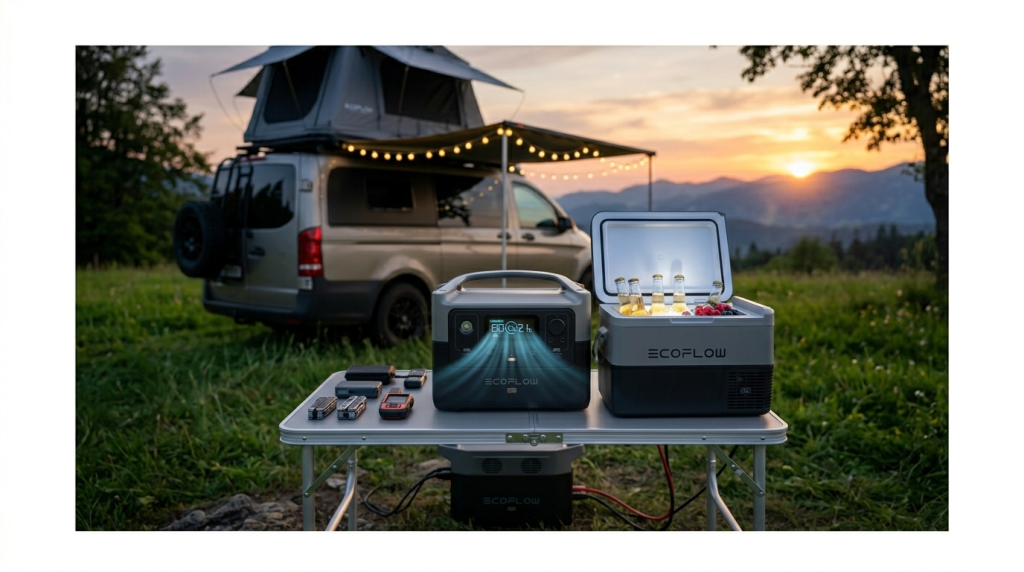
Off-grid comfort in 2026 means two things working together: keeping the air around you cool, and keeping your food and drinks cold. The EcoFlow Wave 3 handles the first problem with 6,100 BTU of portable cooling power and up to 8 hours of battery runtime. The EcoFlow Glacier Classic 35L handles the second — 43 hours of fridge runtime from a single 298Wh battery charge, in a footprint 40% smaller than standard electric coolers.
Together, they form the most capable portable AC for camping 2026 ecosystem available — and one that integrates seamlessly through the EcoFlow app, shared charging infrastructure, and compatible power stations. This guide covers the complete EcoFlow Wave 3 specs breakdown, a full EcoFlow Glacier Classic 35L review, the honest Wave 3 vs Wave 2 upgrade verdict, and exactly how to build the off-grid cooling setup that keeps you comfortable through even the most brutal summer weekend.

What Makes This the Ultimate Off-Grid Cooling Combo?
Most portable AC for camping 2026 guides treat the air conditioner and the cooler as separate purchases. They’re not — or at least, they shouldn’t be when you’re building a real off-grid system.
The EcoFlow Wave 3 and EcoFlow Glacier Classic 35L share three things that make them a genuine ecosystem rather than two separate products:
Shared app control. Both connect to the EcoFlow app via Wi-Fi and Bluetooth. You monitor battery levels, set temperatures, schedule shutdowns, and receive alerts from both devices on a single dashboard. Wake up at 3 AM worrying about your food? Check the Glacier’s temp without leaving your sleeping bag.
Shared charging infrastructure. Both units accept solar input. Both work with EcoFlow’s portable power station lineup. A single 400W solar panel can recharge the Wave 3 Add-On battery in 3 hours and the Glacier Classic’s 298Wh battery through a separate line. One solar setup, two appliances, zero grid dependency.
Complementary power profiles. The Wave 3 is the high-draw appliance (350–620W active). The Glacier Classic 35L is the ultra-low-draw appliance (~7W average in fridge mode). They don’t compete for power — the Glacier’s negligible draw barely registers alongside the Wave 3’s load. Run both from a single power station without meaningful compromise.
This is the framework for an EcoFlow Wave 3 specs + Glacier Classic 35L review that goes beyond individual products into genuine system design.
EcoFlow Wave 3 Specs: The Complete Verified Breakdown
Cooling and Heating Performance
Drop 15°F in just 15 minutes with 6,100 BTU power, setting an ideal environment for any scenario. Quickly warm up with 6,800 BTU heating, raising the temperature by 17°F in just 15 minutes, perfect for staying cozy during chilly outdoor activities like autumn camping. DIY Solar Forum
The EcoFlow Wave 3 specs for thermal performance represent a meaningful step up from the Wave 2:
| Performance Spec | Wave 3 | Wave 2 | Change |
|---|---|---|---|
| Cooling Power | 6,100 BTU (1,800W) | 5,100 BTU (1,500W) | +20% |
| Heating Power | 6,800 BTU (2,000W) | 6,100 BTU (1,800W) | +11% |
| Coverage Area | 120–180 sq ft | up to 107.6 sq ft | +67% |
| Airflow | 330 m³/hr | 290 m³/hr | +14% |
| Cooling drop | 15°F in 15 min | 18°F in 5 min (smaller space) | More coverage |
| Heating rise | 17°F in 15 min | Comparable | Consistent |
Compared to the Wave 2, it packs 1,000 BTU more cooling power, 700 BTU more heating power, and is capable of cooling spaces up to one-third larger. Portablepowerstations
The EcoFlow Wave 3 specs for coverage area are particularly significant for the off-grid camping use case. EcoFlow Wave 3 can drop the temperature in your tent or vehicle by 15°F or quickly warm you up by 17°F in just 15 minutes. The brand claims it can lower the temperature by 15 degrees in 15 minutes in rooms up to 183 square feet. EcoFlow This means a large canvas tent, a Class B RV interior, or a small overlanding trailer all fall within the Wave 3’s effective cooling range — spaces that the Wave 2 couldn’t reliably cool.
R290 refrigerant: EcoFlow’s use of R290 refrigerant reduces pollution compared to traditional refrigerants and protects the planet. Over 10 years, it cuts CO₂ emissions by up to 4,500 lb, the equivalent of saving 130 trees from being cut down. DIY Solar Forum
Battery System and Runtime: The Wave 3 Add-On Battery
The Wave 3 Add-On battery is the single most important accessory for off-grid use — and its chemistry upgrade from the Wave 2 generation is a fundamental improvement.
The WAVE 3 is actively cooling and drawing 356 watts from the battery. The battery level is still at 45%, and again, no external power sources are connected. One of the main draws of the WAVE 3 is its modular battery system. It uses a new 1,024Wh LFP battery located at the base of the unit, so you can expect up to 8 hours of runtime in Eco Mode. The battery chemistry itself is also a considerable improvement, switching from NCM to longer-lasting LFP, which is rated for 80%+ capacity after 4,000 cycles compared to the previous generation’s 800 cycles. The Technology Man
Wave 3 Add-On Battery specs (verified):
- Capacity: 1,024Wh LFP
- Chemistry: LFP (4,000 cycles vs Wave 2’s NCM 800 cycles — 5× longer lifespan)
- Runtime with Wave 3: up to 8 hours (Eco mode)
- Runtime on Max mode: approximately 2–3 hours
- Price: ~$899 (sold separately)
Runtime by mode:
| Operating Mode | Wave Draw | Runtime (Add-On 1,024Wh) |
|---|---|---|
| Eco Mode | ~356W | ~2.4 hours |
| Max Mode | ~620W | ~1.4 hours |
| Sleep Mode (44dB) | ~200–300W | ~3–4 hours |
| Fan Only | ~30W | ~24+ hours |
Wait — the 8-hour claim requires clarification. With 6,100 BTU of cooling and 6,800 BTU of heating power, the Wave 3 can drop temperatures by 15°F or raise them by 17°F in just 15 minutes. Paired with the add-on battery, it delivers up to 8 hours of standalone operation, making it a true off-grid solution. JAG35 The 8-hour figure is achievable in Eco mode under moderate ambient temperatures. In desert conditions or at maximum load, expect 2–3 hours.
The practical strategy for the portable AC for camping 2026 use case: use Max mode to rapidly cool your space in 15–20 minutes, then drop to Eco or Sleep mode to maintain temperature and extend runtime through the night.
Extending runtime beyond 8 hours:
You can double your run time by adding the 1,024Wh EcoFlow WAVE 3 Extra Battery or extend it even further with a seamlessly compatible EcoFlow portable power station. For heavier use, such as daytime cooling in the summer, you’ll need the extra capacity. EcoFlow
Connecting a DELTA 2 Max (2,048Wh) or DELTA Pro 3 (4,096Wh) to the Wave 3 in addition to the Add-On battery creates a multi-station setup capable of running the Wave 3 through multiple consecutive nights without any grid access.
Charging Methods: All Four Options Verified
By combining AC charging and solar charging, the Add-On Battery can be fully charged in as fast as 75 minutes. With the EcoFlow Alternator Charger, you can charge while driving — 1 hour of driving, and stay comfortable all night. Solar Charging (400W) — fully charged in 3 hours. EcoFlow Alternator Charger (400W/800W) — charge while driving, in 102 minutes. AC Charging (700W) — fully charged in 2 hours. Car Power Outlet (100W) — emergency charging in 10 hours. DIY Solar Forum
| Charging Method | Power | Full Charge Time | Use Case |
|---|---|---|---|
| AC (wall outlet) | 700W | 2 hours | Campsite with shore power |
| Solar (400W panel) | 400W | 3 hours | Off-grid daytime recharge |
| Alternator Charger | 400–800W | ~102 minutes | En route, charging while driving |
| Car outlet (12V) | 100W | 10 hours | Emergency top-up only |
| AC + Solar combined | ~1,000W | 75 minutes | Fastest possible recharge |
The alternator charger option is underrated for the van life and overlanding community. One hour of driving fully recharges the Wave 3 Add-On battery — meaning a typical drive between campsites restores a full night’s cooling capacity automatically, without stopping to plug in.
Smart Modes: The Features That Make the Wave 3 Different
The EcoFlow Wave 3 specs include five operating modes unavailable on the Wave 2 — and these aren’t marketing checkbox features. They materially change how the unit operates overnight and in automated scenarios.
Sleep Mode (44dB): In Sleep mode, the unit drops its noise levels down to just 44dB, making it much quieter while in operation. EcoFlow For context, 44dB is approximately the sound of light rain or a quiet office. At sleeping distance inside a tent, it’s present but not disruptive.
Auto Mode: Automatic allows the device to switch between heating and cooling as needed, which proved handy in the ever-changing conditions of spring. In the mornings and evenings, it acted as a heater as the temperature dropped, while during the day it pumped out cool air in response to warmer conditions. Set a target temperature range and walk away — the Wave 3 maintains it through the day and night automatically.
Pet Care Mode: EcoFlow has added a new Pet Care smart switch, specifically designed for those traveling with animals. It monitors the interior temperature of a space and automatically activates cooling when it rises above a preset limit, which can be set anywhere between 77°F and 113°F. The app also sends a notification to your phone when this threshold is reached. Critical safety note: Pet Care mode is a safety net, not a guarantee — never leave animals in a hot vehicle relying solely on any electronic system.
Before you start adding external batteries to your River 2, make sure you understand the core safety limits. Check our guide on [How to Use Portable Power Stations Indoors Safely] to avoid ventilation and heat issues with your DIY setup.
Dehumidify Mode: Added in the Wave 3, dehumidification removes excess moisture from the air without a full cooling cycle. In humid environments — coastal camping, rainforest overlanding — this prevents condensation inside tents and RVs and dramatically improves comfort at temperatures where full cooling isn’t needed.
Water Drain Alert: The app also lets you monitor the battery and onboard water tank, letting you know when you need to recharge the power cells or drain the accumulated moisture. EcoFlow The Wave 3 collects condensate in an internal tank. App notification ensures you drain it before it overflows — a practical improvement over setting a manual timer.
Wave 3 vs Wave 2: The Complete Upgrade Verdict
The Wave 3 vs Wave 2 comparison has generated significant community discussion — and the real-world answer is more nuanced than either brand enthusiasts or skeptics claim.
| Feature | Wave 3 | Wave 2 | Winner |
|---|---|---|---|
| Cooling BTU | 6,100 | 5,100 | Wave 3 (+20%) |
| Heating BTU | 6,800 | 6,100 | Wave 3 (+11%) |
| Coverage | 120–180 sq ft | 107.6 sq ft | Wave 3 |
| Battery chemistry | LFP (4,000 cycles) | NCM (800 cycles) | Wave 3 (5× longer) |
| Auto mode | ✅ | ❌ | Wave 3 |
| Dehumidify mode | ✅ | ❌ | Wave 3 |
| Pet Care mode | ✅ | ❌ | Wave 3 |
| Insulated ducts | ✅ | ❌ | Wave 3 |
| Water drain alert | ✅ | ❌ | Wave 3 |
| Efficiency (BTU/W) | 9.5 BTU/W | 9.8 BTU/W | Wave 2 (slightly) |
| Weight | ~34.4 lbs | ~32 lbs | Wave 2 |
| Price | ~$1,099 | Lower (discounted) | Wave 2 |
The community’s honest verdict: The Wave 3 is built for higher output, delivering 6,100 BTU of cooling and 6,800 BTU of heating, making it ideal for larger rooms or situations that demand strong climate control. Meanwhile, the Wave 2 offers 5,100 BTU cooling and 6,100 BTU heating, prioritizing speed and portability. It’s well-suited for smaller spaces like tents, vans, or compact rooms where fast, efficient comfort is the goal. The Power Sphere
The efficiency note is worth addressing directly. The Wave 2 is slightly more efficient than the Wave 3. Wave 3: 6,100 BTU using 640 Watts DC = 9.5 BTU/Watt. Wave 2: 5,100 BTU using 520 Watts DC = 9.8 BTU/Watt. The Power Sphere This is real but minor — 3% less efficient at max load. In Eco mode, both units operate more efficiently and the gap narrows.
The battery upgrade alone justifies the Wave 3 for long-term buyers. The Wave 2’s NCM Add-On battery (800 cycles) degrades to 80% capacity in approximately 2–3 years of regular use. The Wave 3’s LFP battery (4,000 cycles) maintains 80%+ capacity for over 10 years at the same use frequency. For anyone planning to use this system more than a few seasons, the LFP chemistry is the more important upgrade than the BTU difference.
If you’re looking to expand your setup on a budget, don’t miss our [Hacking EcoFlow River 2] guide, where we show how DIY external batteries can complement smaller units.
The short answer to whether the upgrade is worth it is “yes,” but it does depend on how much you use your existing model. And if you’re considering purchasing a portable air conditioner but haven’t done so yet, this is the one to go with. EcoFlow
Wave 3 vs Wave 2 verdict by user type:
| User | Recommendation |
|---|---|
| First-time buyer | Wave 3 — definitively |
| Wave 2 owner, heavy daily use | Wave 3 — LFP battery justifies it |
| Wave 2 owner, occasional use | Keep Wave 2 — marginal real-world benefit |
| Large space (150+ sq ft tent/RV) | Wave 3 — Wave 2 can’t cover it |
| Van life, solo/couple | Either — Wave 2 on discount is strong value |
EcoFlow Glacier Classic 35L Review: Full Deep Dive
Capacity, Build, and Design
The EcoFlow Glacier Classic 35L review starts with the number that matters most for a weekend off-grid setup: The EcoFlow GLACIER Classic fits 58 cans (35L), 72 cans (45L), and 90 cans (55L) while staying sleek and efficient. 40% smaller than standard electric coolers, based on lab testing. Ecoflow
58 cans is a serious weekend supply for two people. The 40% footprint reduction versus comparable electric coolers means it fits in cargo spaces, beside seating areas, and in truck beds where larger units simply don’t. The EcoFlow GLACIER Classic 35L is comparable to a standard 24-inch suitcase. It’s an ideal fit for SUVs, Class B RVs, off-road vehicles, and more, saving valuable space while providing ample storage for your adventures.
Important 35L limitation: This Model (35L) Does Not Support Dual Zone Features (45L & 55L only). The 35L is single-zone — you can switch the entire interior between fridge mode (as warm as 39°F) and freezer mode (as cold as -4°F), but you cannot run fridge and freezer simultaneously. For dual-zone capability, step up to the 45L or 55L.
Insulation quality: 60% thicker insulation for better cooling — 53mm/2-inch insulation foam and superior sealing keep food cold longer by reducing temperature changes and minimizing leakage. This insulation quality is what enables the 43-hour battery runtime — the compressor doesn’t have to work as hard to maintain temperature.
Build and noise: Quieter than a library — under 38.5dB. For a compressor-cooled fridge, under 40dB is genuinely quiet — about the same as a whispered conversation. Running the Glacier Classic 35L overnight in a tent or RV cabin is a non-issue acoustically.
Temperature Performance
The EcoFlow Glacier Classic 35L review from the EcoFlow official page confirms: The EcoFlow GLACIER Classic keeps your items chilled at 39°F for up to 43 hours (35L). Ecoflow
Runtime breakdown (35L, tested at 77°F ambient):
| Mode | Temperature | Energy Use | Runtime |
|---|---|---|---|
| Fridge (Eco) | 39°F | ~165Wh/24h | 43 hours |
| Freezer (Eco) | -4°F | ~520Wh/24h | ~13.7 hours |
| Fridge (Fast) | 39°F in 15 min | Higher | ~30 hours |
| Freezer (Fast) | -4°F target | Higher | ~9 hours |
43 hours at 39°F means the Glacier Classic 35L keeps your food safe through an entire long weekend (72 hours) with one intermediate recharge — manageable from a solar panel in most summer camping conditions.
The temperature range is impressive: the temperature range is equally impressive, spanning from -20°C to 60°C (-4°F to 140°F), keeping drinks cool and ingredients frozen until you’re ready to cook them. Solar Generator
Fast mode: Choose Fast Mode to chill contents in as little as 15 minutes, or switch to Eco Mode for extended cooling with ultra-low power consumption. Portablepowerstations Fast mode is the right choice when you first load the fridge with room-temperature food and drinks — pull it to temperature quickly, then switch to Eco for the next 43 hours.
Battery and Charging
The Glacier Classic 35L‘s 298Wh removable LFP battery is one of its most distinguishing features. Extended Off-Grid Operation: The 298Wh built-in battery maintains items at 39°F for up to 43 hours (35L). Ecoflow
Charging specs (verified):
- AC Input: 100–240V, max 95W
- Solar: 11–30V, 8A, max 110W
- Car: 12/24V, 8A, max 100W
At 110W solar input and 298Wh capacity, a full solar recharge takes approximately 3 hours — identical to the Wave 3 Add-On battery’s solar charge time. This timing alignment is practically useful: one morning of good sun recharges both systems simultaneously.
Energy efficiency math: In fridge mode, the Glacier Classic 35L consumes only 165Wh per 24 hours. That’s 6.9 watt-hours per hour — approximately the same as a single LED bulb. This is compressor refrigeration efficiency at its best, and it’s why the 298Wh battery lasts 43 hours.
App Control and Smart Features
Remotely monitor, control, and personalize your GLACIER via the EcoFlow app. From real-time battery status to water leak prevention alerts, mode changes, and scheduled shutdowns — everything is just a tap away on your phone. Outbound Power
For the combined EcoFlow Wave 3 specs + Glacier Classic 35L review ecosystem, the shared EcoFlow app is genuinely useful. Key features:
- Real-time temperature of fridge interior (not just set point)
- Battery percentage for the Glacier’s 298Wh pack
- Automatic mode switching (fridge ↔ freezer on schedule)
- Low battery alert before temperature safety is compromised
- Scheduled cooling start — pre-cool the fridge before you load it
Building the Ultimate Off-Grid Cooling Setup: The Power Math
This is where the EcoFlow Wave 3 specs and EcoFlow Glacier Classic 35L review come together into a practical system design. The right power source is what separates a comfortable off-grid weekend from an anxious one.
What You’re Actually Drawing
Combined system consumption:
| Component | Mode | Draw |
|---|---|---|
| Wave 3 | Eco (primary night mode) | ~356W |
| Wave 3 | Sleep (44dB overnight) | ~200–250W |
| Glacier Classic 35L | Fridge (39°F, Eco) | ~6.9W avg |
| Combined (Eco + Fridge) | ~363W | |
| Combined (Sleep + Fridge) | ~207–257W |
The Glacier’s draw is so small it’s essentially a rounding error alongside the Wave 3. All practical sizing decisions are driven entirely by the Wave 3’s consumption.
Power Station Recommendations
Option 1: Wave 3 Add-On Battery (1,024Wh) + Glacier’s Own 298Wh Battery
The simplest and most portable configuration. Each device runs its own battery independently:
| Device | Battery | Runtime |
|---|---|---|
| Wave 3 (Sleep mode ~225W avg) | 1,024Wh Add-On | ~3.9 hours |
| Glacier Classic 35L (fridge) | 298Wh built-in | 43 hours |
This gets you through the night if you’re using Sleep mode and the ambient temperature isn’t extreme. For a full 8-hour night, you need more Wave 3 capacity.
Option 2: EcoFlow DELTA 2 Max (2,048Wh) Powering Both
Connect the DELTA 2 Max to the Wave 3 as a supplemental power station, and plug the Glacier into it simultaneously:
| Load | Draw | Runtime from DELTA 2 Max (2,048Wh × 0.85 = 1,741Wh usable) |
|---|---|---|
| Wave 3 Sleep mode + Glacier | ~232W | ~7.5 hours |
| Wave 3 Eco mode + Glacier | ~363W | ~4.8 hours |
Option 3: EcoFlow DELTA Pro 3 (4,096Wh) — Full Night Guaranteed
To ensure adequate power for the duration of the test, the reviewer replaced the add-on battery that came with the Wave 3 bundle with an EcoFlow Delta Pro 3 portable power station, which was connected to a 400-watt solar panel. The extra preparation paid off. With an outside temperature that ranged from 76 to 84 degrees Fahrenheit during the 5-hour test, the Wave 3 was able to maintain an inside temperature within 3 degrees of the 70-degree target temperature. Portablepowerstations
| Load | Draw | Runtime from DELTA Pro 3 (4,096Wh × 0.85 = 3,482Wh usable) |
|---|---|---|
| Wave 3 Sleep mode + Glacier | ~232W | ~15 hours |
| Wave 3 Eco mode + Glacier | ~363W | ~9.6 hours |
The DELTA Pro 3 combination runs both appliances through a full 8-hour night with 1.6 hours of buffer in Eco mode genuinely comfortable coverage without monitoring.
Solar Self-Sufficiency Strategy
For multi-day off-grid setups, solar recharge is the difference between a limited trip and indefinite capability:
Recommended solar + camping setup:
| Component | Power | Cost |
|---|---|---|
| Wave 3 + Add-On Battery | — | ~$1,099 + $899 |
| EcoFlow DELTA 2 Max | 2,048Wh | ~$1,399 |
| 2× 220W EcoFlow Bifacial panels | 440W | ~$600 |
| Glacier Classic 35L | 298Wh | ~$799 |
| Total | ~$4,696 |
Solar generation from 440W panels (5.5 peak sun hours typical): ~1,650Wh/day
Daily consumption (Wave 3 Sleep 8hrs + Glacier 24hrs): ~(225W × 8hrs) + (6.9W × 24hrs) = 1,800Wh + 166Wh = ~1,966Wh/day
With 1,650Wh solar daily and 1,966Wh consumption, the DELTA 2 Max buffer covers the ~316Wh gap — sustainable for multi-day trips in good sun. In Arizona or Texas summer sun (6.5 peak hours): ~2,145Wh solar daily — fully self-sustaining with surplus.
Real-World Use Cases: Who This Setup Is For
Overlanding and Extended Road Trips
All-Terrain Compatibility: Compact 20″ luggage size with ergonomic handle fits effortlessly in SUVs/overlanders/semitrucks. Magic strap kit secures on rooftops/truck beds. Cools 120–180 sq ft spaces, creating microclimate for desert adventures or alpine camping. EcoFlow
The Wave 3’s roof or truck bed mounting capability combined with the Glacier Classic’s SUV-optimized footprint creates a complete overlanding climate solution. Charge both through the alternator while driving; run both from the power station when parked.
Canvas Wall Tent and Glamping
For the test, I attached the hoses to the warm air intake and supply outlets and routed them beneath a tent wall to the outside. With an outside temperature that ranged from 76 to 84 degrees Fahrenheit during the 5-hour test, the Wave 3 was able to maintain an inside temperature within 3 degrees of my 70-degree target temperature in a 120-square-foot canvas wall tent. Portablepowerstations
This is the most demanding real-world test of EcoFlow Wave 3 specs — and the result is encouraging. A 120 sq ft canvas tent maintained within 3°F of target in 76–84°F ambient conditions. Not air-conditioned-house cold, but genuinely comfortable camping.
Class B and Class C RV
Many small trailers and Class B motorhomes don’t have adequate HVAC systems built-in. Rooftop AC units are the traditional solution, but EcoFlow WAVE 3 arguably makes them obsolete. It’s compact enough to sit between the two front seats of a Class-B RV and keep the vehicle cool or warm while you park. EcoFlow
The Wave 3 positioned between front seats with the duct through the driver’s window provides effective spot cooling for the cab during rest stops. The Glacier Classic 35L mounted in the rear cargo area handles food storage independently.
Pet-Safe Vehicle Parking
The Pet Care mode makes the Wave 3 the most responsible solution for leaving pets in vehicles during errands. PetCare auto-activates cooling if cabin overheats, protecting furry friends left in vehicles. EcoFlow Combined with the 8-hour battery runtime, short shopping or hiking detours become safer — with the critical caveat that no electronic system is fail-safe for pet safety.
What the Community Actually Says: Honest Caveats
No EcoFlow Wave 3 specs and EcoFlow Glacier Classic 35L review guide is complete without the community’s honest experience. Here’s what real users report:
On the Wave 3’s cooling limits: If you’re expecting ‘ice-cold’ AC, you will be sorely disappointed. Even the extra 1k BTU of the Wave 3 isn’t going to get a van cold, or even cool in the middle of the summer, especially in those 100°+ states. EcoFlow
This is the most important caveat for prospective buyers. 6,100 BTU is genuinely effective for maintaining comfortable temperatures in well-insulated spaces under moderate ambient conditions (70s–80s°F). In direct sun, poor insulation, or triple-digit ambient heat, the Wave 3 manages rather than dominates. Pre-cooling the space before the hottest part of the day, using reflective window covers, and running the Wave 3 in advance of peak heat are all important operational strategies.
On the Wave 3 vs Wave 2 real-world difference: Some guy did a side-by-side test with his Wave 3 and Wave 2 and couldn’t feel any difference. However, after EcoFlow pushed a Wave 3 firmware update, many people said it’s now much improved and noticeably stronger.
Firmware updates have meaningfully improved the Wave 3’s performance since launch. Ensure your unit is on current firmware before evaluating cooling performance.
On the Glacier Classic 35L’s single-zone limitation: The removable divider system deserves special mention for its clever multifunctionality. Beyond organizing the interior space, it creates configurable temperature zones with up to 4.2°C (39.6°F) difference between compartments, allowing users to store different types of food at their optimal temperatures simultaneously. Solar Generator
Note this applies to the 45L and 55L models only. The 35L is single-zone. If you need simultaneous fridge and freezer capability, the 35L is not the right choice — step up to the 45L at $899.
On the Glacier Classic’s lack of wheels: Despite its reduced size, the EcoFlow GLACIER Classic is clearly still a heavy unit. Unlike its predecessor, there are no detachable wheels and levers to help you roll the portable refrigerator around.
At its weight with contents, the Glacier Classic 35L is a two-person carry. Plan your vehicle loading accordingly — load the Glacier before adding heavy gear on top or in front of it.
Portable AC for Camping 2026: How Wave 3 Compares to Competition
The portable AC for camping 2026 market has expanded significantly, with Zero Breeze Mark 3 as the primary competitor to the Wave 3.
| Spec | EcoFlow Wave 3 | Zero Breeze Mark 3 | EcoFlow Wave 2 |
|---|---|---|---|
| Cooling BTU | 6,100 | 5,280 | 5,100 |
| Coverage | 120–180 sq ft | ~100 sq ft | 107.6 sq ft |
| Battery Chemistry | LFP (4,000 cycles) | — | NCM (800 cycles) |
| Runtime (with battery) | Up to 8 hours | Up to 7 hours | Up to 8 hours |
| Heating | ✅ 6,800 BTU | ✅ | ✅ 6,100 BTU |
| Auto Mode | ✅ | ✅ | ❌ |
| Dehumidify | ✅ | ✅ Dry mode | ❌ |
| Pet Care | ✅ | ❌ | ❌ |
| Weight (unit only) | ~34.4 lbs | ~19 lbs | ~32 lbs |
| Price (unit only) | ~$1,099 | ~$1,399 | Lower |
| Price (with battery) | ~$2,198 | Higher | Lower |
Compared to the new Zero Breeze Mark 3 air conditioner, which has a $1,399 MSRP and doesn’t seem to be discounted anywhere yet, the Wave 3 weighs about 15 pounds more but outperforms the newest Zero Breeze model in terms of cooling BTUs.
For the portable AC for camping 2026 comparison, the Wave 3 wins on raw cooling power and ecosystem integration. The Zero Breeze Mark 3 wins on weight — at 19 lbs versus 34.4 lbs, it’s dramatically more backpacking-friendly for lightweight setups. For vehicle-based camping where weight matters less than performance, the Wave 3 is the stronger choice.
Buying Guide: Which Bundle Makes the Most Sense
| Bundle | Price | Best For |
|---|---|---|
| Wave 3 alone | ~$1,099 | Shore power camping, RV with existing power |
| Wave 3 + Add-On Battery | ~$2,198 | True off-grid nights, 8-hour runtime |
| Glacier Classic 35L alone | ~$799 | Food storage; charge from car or shore power |
| Glacier Classic 35L + Plug-In Battery | ~$899–$999 | 43-hour independent off-grid operation |
| Wave 3 + Add-On + Glacier 35L + Plug-In | ~$3,097 | Complete weekend off-grid cooling system |
| Full system + DELTA 2 Max + 2× solar panels | ~$5,096 | Multi-day self-sufficient overlanding |
The Wave 3 vs Wave 2 price argument is real for budget-conscious buyers. Wave 2 units are available significantly discounted — sometimes under $700 — and deliver comparable real-world performance for spaces under 110 sq ft. However, the Wave 2’s NCM battery will need replacement in 3–5 years of regular use; the Wave 3’s LFP battery won’t degrade meaningfully for 10+ years. Long-term cost of ownership favors the Wave 3.
Frequently Asked Questions
What are the EcoFlow Wave 3 specs for cooling and heating?
The EcoFlow Wave 3 specs for thermal performance: 6,100 BTU cooling capacity (1,800W) and 6,800 BTU heating capacity (2,000W). The Wave 3 drops 15°F in just 15 minutes with 6,100 BTU power. It quickly warms up with 6,800 BTU heating, raising the temperature by 17°F in just 15 minutes. DIY Solar Forum Coverage area is 120–180 sq ft, making it effective for large tents, Class B RVs, and small trailers.
How long does the EcoFlow Wave 3 run on battery?
The Add-On Battery offers up to 8 hours of uninterrupted use — perfect for a full night of restful sleep. High-quality LFP cells ensure a lifespan of up to 10 years in daily use. DIY Solar Forum The 8-hour figure applies to Eco mode at moderate ambient temperatures. Max mode yields approximately 1.4–2 hours. Sleep mode (44dB) provides approximately 3–4 hours. The Add-On Battery is a separate $899 purchase — the Wave 3 alone requires wall or vehicle power.
Is the EcoFlow Wave 3 worth the upgrade over the Wave 2?
For first-time buyers: unambiguously yes. Compared to the Wave 2, the Wave 3 packs 1,000 BTU more cooling power, 700 BTU more heating power, and is capable of cooling spaces up to one-third larger. This latest generation also comes with a lithium iron phosphate (LFP) battery that should provide about 5 times the working lifespan compared with Wave 2’s battery chemistry. Portablepowerstations For existing Wave 2 owners who use it only occasionally, the upgrade economics are less clear — the Wave 2 remains effective for small spaces and the BTU difference may not be noticeable in practice.
What is the EcoFlow Glacier Classic 35L review verdict?
The EcoFlow Glacier Classic 35L review verdict is strongly positive for its target use case. The EcoFlow GLACIER Classic delivers impressive functionality at a competitive price point, with the 35L model starting at $799. The unit keeps food at the correct temperature with its removable 298Wh battery delivering runtime of up to 43 hours for the 35L model. Solar Generator Its primary limitations are single-zone operation (no simultaneous fridge and freezer), no wheels, and the fact that the 298Wh battery is sold with the unit but the plug-in battery for extended off-grid runtime is a separate purchase.
How does the EcoFlow Wave 3 work as a portable AC for camping in 2026?
Camping is one of the best ways to enjoy the great outdoors, but with higher-than-average temperatures and extreme heat expected from coast to coast, EcoFlow Wave 3 offers a reprieve from the sun during the day and will help you sleep at night. EcoFlow For the portable AC for camping 2026 use case, the Wave 3 uses two hoses — one for intake, one for exhaust — routed through a tent wall, window gap, or door gap. Setup takes approximately 5 minutes and requires no permanent installation. The dual-hose design is significantly more efficient than single-hose units, which recirculate tent-temperature air through the unit.
Can I run the Wave 3 and Glacier Classic 35L simultaneously off one power station?
Yes. In Wave 3 Sleep mode (~225W) plus Glacier Classic 35L fridge mode (~7W), total combined draw is approximately 232W. On an EcoFlow DELTA 2 Max (2,048Wh): approximately 7.5 hours of simultaneous runtime. On an EcoFlow DELTA Pro 3 (4,096Wh): approximately 15 hours — a full overnight and most of the following morning. The Glacier’s power draw is so minimal that it barely affects the runtime calculation.
Is the EcoFlow Wave 3 noisy at night?
In Sleep mode, the unit drops its noise levels down to just 44dB, making it much quieter while in operation. EcoFlow 44dB is comparable to light rainfall or a quiet office environment. Most campers report it as background noise that doesn’t disrupt sleep. The Glacier Classic 35L operates under 42dB — comparable to a quiet library. Running both overnight produces a combined ambient hum at approximately 44–45dB equivalent — non-disruptive for most sleepers.
What is the R290 refrigerant in the Wave 3 and why does it matter?
EcoFlow’s use of R290 refrigerant reduces pollution compared to traditional refrigerants and protects the planet. Over 10 years, it cuts CO₂ emissions by up to 4,500 lb, the equivalent of saving 130 trees from being cut down. R290 is propane-based and has a global warming potential (GWP) of only 3 — compared to common refrigerants with GWP of 675–2,088. It’s the most environmentally responsible refrigerant available in consumer portable AC units, and its thermodynamic efficiency is excellent.
Can I charge the Wave 3 while driving?
With the EcoFlow Alternator Charger, you can charge while driving — 1 hour of driving and stay comfortable all night. EcoFlow Alternator Charger (400W/800W) — charge while driving. In 102 minutes, you’re ready to go. The alternator charger connects to your vehicle’s alternator (not the 12V cigarette outlet) and provides serious charging power — a 102-minute drive fully charges the 1,024Wh Add-On Battery, restoring complete overnight cooling capability between campsites.
How does the EcoFlow Glacier Classic 35L compare to the original EcoFlow Glacier?
Unlike its predecessor, which featured an integrated ice maker, the GLACIER Classic focuses on maximizing storage space while maintaining impressive cooling performance. The omission of the ice maker in the Classic version allows for more storage space at a lower price point. Solar Generator The Classic also has no wheels (the original Glacier had detachable wheels), is 40% more compact, and has 60% thicker insulation. The Classic prioritizes storage capacity and energy efficiency over the ice-making feature, making it better suited for the off-grid camping use case where freezer runtime and compact size matter most.
UnitVerseHQ provides independent product reviews and off-grid system design guidance. All specifications cited from EcoFlow’s official US product pages, Amazon listings, and verified third-party reviews including RV.com, StorageReview.com, BobVila.com, and NotebookCheck.net. Prices and availability subject to change — verify current pricing at us.ecoflow.com before purchase. Real-world performance varies based on ambient temperature, insulation quality, and operating mode.