
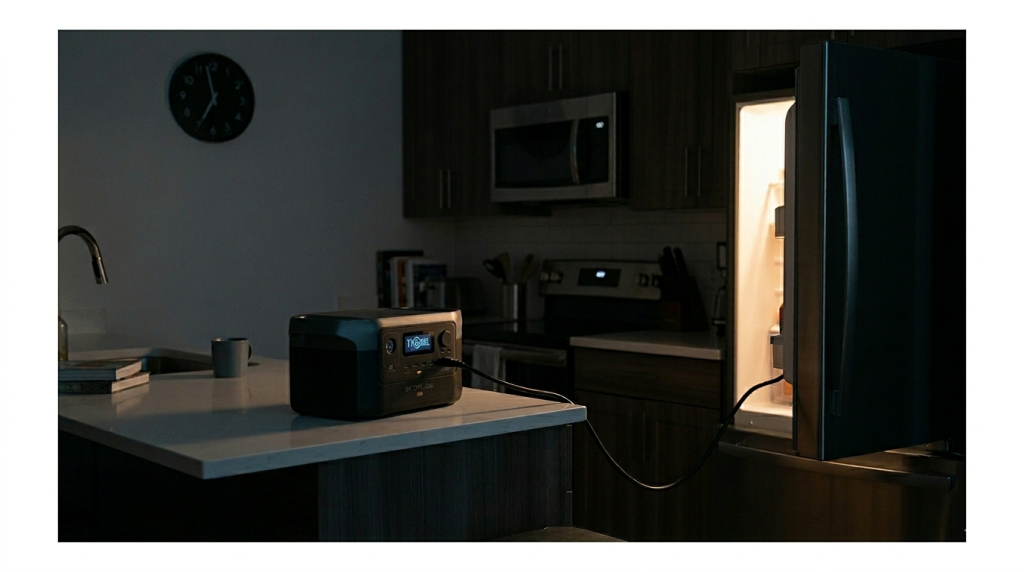
How to Keep Your Fridge Running During a Blackout: The 2026 Renter’s Survival Kit
By UnitVerseHQ | Updated February 2026
A power outage hits your apartment at 11 PM. Your fridge has a week’s worth of groceries — easily $150–$200 worth of food. The USDA says perishables become unsafe after just four hours without refrigeration. You have no gas generator option (you’re in an apartment), no backup power, and no plan.
This guide fixes that. Whether you’re in a hurricane corridor, an ice storm belt, or just a city with aging grid infrastructure, knowing how many watts to run a fridge and which portable power station can actually keep it running is the most practical emergency prep a renter can do in 2026.
Why Renters Are the Most Vulnerable During Blackouts
Homeowners have options — whole-home standby generators, transfer switches, large solar installations. Renters have whatever they can plug into a wall outlet.
During major grid events, apartment dwellers face a specific combination of challenges:
- No ability to install permanent backup power equipment
- Shared building systems that may cut elevator and hallway power independently
- Higher food spoilage risk due to typically smaller, less-insulated refrigerators
- No safe way to run a gas generator indoors
The answer for emergency power for apartment dwellers has fundamentally changed in the last three years. Portable power stations have become large enough, smart enough, and affordable enough to run a full-size refrigerator for 24 hours or more — entirely indoors, entirely silently, and entirely safely.
But only if you buy the right one. And that starts with understanding the watt math.
How Many Watts to Run a Fridge: The Complete Breakdown
This is the question everything else depends on. How many watts to run a fridge is not a single number — it varies significantly by fridge type, age, and operating conditions.
Starting Watts vs. Running Watts
Every refrigerator has two power figures that matter:
Running watts (continuous): The steady power draw when the compressor is actively cooling. This is what you see on the energy label.
Starting watts (surge): The brief power spike when the compressor motor kicks on from a stopped state. This can be 2–3x the running wattage and lasts only 1–3 seconds — but your power station’s inverter must handle it, or the fridge won’t start at all.
This distinction is where many renters make a costly mistake — buying a power station with enough continuous wattage but not enough surge capacity.
How Many Watts to Run a Fridge by Type
| Fridge Type | Running Watts | Starting Watts | Daily Energy Use |
|---|---|---|---|
| Mini fridge (1.7–4.5 cu ft) | 80–150W | 200–400W | 150–300Wh |
| Compact fridge (4.5–10 cu ft) | 100–200W | 300–600W | 200–500Wh |
| Full-size top freezer (14–20 cu ft) | 150–400W | 600–1,200W | 400–800Wh |
| French door / side-by-side | 200–400W | 800–1,500W | 500–1,000Wh |
| Energy Star certified (any size) | 30–50% less than above | Same surge ratios | 30–50% less |
Practical rule of thumb: If you don’t know your fridge’s exact specs, assume 150–200W running watts and 800W starting watts for a standard apartment refrigerator. Any power station you choose must exceed both figures comfortably.
Finding your exact numbers takes 30 seconds: check the sticker inside your fridge door or search your model number plus “watts” online. Knowing precisely how many watts to run a fridge in your specific unit is the foundation of choosing the right portable power station for refrigerator backup.
Best Solar Generator for Refrigerator Use: What to Look For
The term “solar generator” is commonly used to describe a portable power station that also accepts solar panel input. When evaluating the best solar generator for refrigerator backup, four specifications matter above everything else.
1. Inverter Surge Capacity
This is the most overlooked spec. Your inverter’s surge rating must comfortably exceed your fridge’s starting watts. For a standard apartment fridge with 800W starting watts, you need an inverter with at least 1,200W surge capacity — preferably 1,600W or more for margin.
2. Battery Capacity (Wh)
This determines runtime. A 1,000Wh station running a 150W fridge (which cycles on roughly 30–40% of the time) will realistically power that fridge for 16–20 hours. A 2,000Wh station extends that to 32–40 hours — well past most outage scenarios.
3. Battery Chemistry
As covered in our safety guide: LiFePO4 only for indoor use. This is non-negotiable for a portable power station for refrigerator application where the unit will be running continuously under sustained load.
4. Solar Recharge Input
For extended outages, solar recharge capability turns a finite battery into a renewable supply. The best solar generator for refrigerator use accepts at least 400W of solar input — enough to meaningfully offset fridge consumption during daylight hours even in a northern US city.
The Top 4 Portable Power Stations for Refrigerator Backup in 2026
1. EcoFlow DELTA 2 — Best Overall Portable Power Station for Refrigerator Use
Capacity: 1,024Wh | AC Output: 1,800W continuous / 2,700W surge | Battery: LiFePO4 | Solar Input: 500W max | Weight: 27 lbs
The EcoFlow DELTA 2 fridge runtime on a standard 150W apartment refrigerator works out to approximately 14–18 hours of real-world use — enough to cover the vast majority of urban outages, which average 3.5 hours nationally but can reach 24+ hours during storm events.
What makes it the top-ranked portable power station for refrigerator backup for renters specifically:
- 2,700W surge capacity handles even older, less efficient compressors without flinching
- X-Boost technology allows it to run appliances rated up to 2,200W through intelligent power management
- Charges from 0–80% in just 50 minutes via AC — meaning if power flickers back briefly, you can top it up fast
- 500W max solar input pairs with two 220W panels for genuine solar sustainability during extended outages
- App-based monitoring shows real-time fridge consumption and estimated runtime remaining
EcoFlow DELTA 2 fridge runtime estimates by fridge type:
| Fridge Type | Estimated Runtime |
|---|---|
| Mini fridge (100W avg) | 20–24 hours |
| Standard apartment fridge (150W avg) | 14–18 hours |
| Full-size top freezer (250W avg) | 9–12 hours |
| French door (350W avg) | 6–8 hours |
Best for: Renters who want the fastest recharge, best app integration, and proven EcoFlow DELTA 2 fridge runtime performance in a manageable 27 lb package.
2. EcoFlow DELTA 2 Max — Best for Extended Outages
Capacity: 2,048Wh | AC Output: 2,400W continuous / 5,000W surge | Battery: LiFePO4 | Solar Input: 1,000W max | Weight: 50 lbs
If you live in a hurricane zone, an ice storm corridor, or anywhere that sees multi-day outages, the DELTA 2 Max doubles the capacity of the standard DELTA 2 and nearly doubles the solar input. This is the most serious best solar generator for refrigerator option in the portable class.
EcoFlow DELTA 2 Max fridge runtime on a standard 150W apartment fridge reaches approximately 28–36 hours — and with 1,000W solar input from two 500W panels, you can realistically keep a fridge running indefinitely during daylight-heavy weather windows.
- 5,000W surge capacity — handles any residential refrigerator without question
- Expandable to 6,144Wh with additional battery modules
- Smart generator integration for hybrid backup strategies
- Heavier at 50 lbs — stationary rather than truly portable, but fine for apartment use
Best for: Gulf Coast and Southeast renters, anyone in a high-outage zone, renters who store significant medication requiring refrigeration.
3. Bluetti AC200L — Best Capacity-to-Price for Refrigerator Backup
Capacity: 2,048Wh | AC Output: 2,400W continuous / 3,600W surge | Battery: LiFePO4 | Solar Input: 1,200W max | Weight: 61.9 lbs
The Bluetti AC200L is the best solar generator for refrigerator use if maximum solar charging capacity is your priority. Its 1,200W solar input is the highest of any unit in this class — meaning on a clear day with adequate panels, it can fully recharge from empty in under two hours while simultaneously powering your fridge.
Key advantages for emergency power for apartment dwellers:
- Highest solar input of any portable unit on this list
- LiFePO4 rated for 3,500+ cycles
- Dual AC charging plus solar simultaneously
- Extremely quiet operation — important during a stressful outage in close quarters
The tradeoff is weight — at nearly 62 lbs, the AC200L stays where you put it. But for apartment renters who want a semi-permanent emergency station in a closet or laundry room, that’s a reasonable compromise for the capacity.
Best for: Renters who prioritize solar recharge speed and maximum capacity over portability.
4. Jackery Explorer 2000 Pro — Best for Quiet Operation During Outages
Capacity: 2,160Wh | AC Output: 2,200W continuous / 4,400W surge | Battery: NMC with advanced BMS | Solar Input: 1,400W max | Weight: 43 lbs
The Jackery Explorer 2000 Pro earns its place on this list through sheer capacity and near-silent operation. A quick note on chemistry: this unit uses NMC rather than LiFePO4. Jackery’s battery management system is among the best in the consumer market, and this unit has a strong safety track record — but renters should be aware of the distinction and keep it in a ventilated location.
For how many watts to run a fridge math purposes:
- 2,160Wh capacity runs a standard 150W apartment fridge for approximately 30–40 hours
- 4,400W surge handles any residential compressor
- 1,400W solar input is the highest on this list — exceptional for off-grid resilience
Best for: Renters who prioritize maximum solar input and runtime, comfortable with NMC chemistry under proper ventilation conditions.
The Fridge Runtime Formula: Calculate Your Own Numbers
Stop guessing. Here’s the exact formula for calculating your own portable power station for refrigerator runtime:
Step 1: Find your fridge’s running wattage (sticker inside door or model number search)
Step 2: Multiply by your compressor duty cycle. Most fridges run their compressor 30–40% of the time when the room is cool, 50–60% when warm.
Step 3: Apply the formula:
Runtime (hours) = Station Capacity (Wh) × 0.85 ÷ (Running Watts × Duty Cycle)
The 0.85 factor accounts for inverter efficiency losses. Example calculation for an EcoFlow DELTA 2 fridge runtime estimate:
- Station: 1,024Wh × 0.85 = 870Wh usable
- Fridge: 180W running × 0.35 duty cycle = 63W average draw
- Runtime: 870 ÷ 63 = ~13.8 hours
Run this calculation for your specific fridge before buying. It takes two minutes and ensures you buy the right capacity for your actual needs.
How to Maximize Fridge Runtime During a Blackout
Buying the right station is step one. Getting the most out of it during an actual outage is step two. These practices can extend your portable power station for refrigerator runtime by 20–40%:
Before the outage (preparation):
- Set your fridge to its coldest setting 24 hours before an expected storm event
- Fill empty space in the freezer with water bottles — thermal mass keeps temperatures stable longer when the compressor cycles off
- Keep the fridge and freezer as full as possible — a full fridge retains cold significantly better than a half-empty one
- Charge your power station to 100% when a storm is forecast
During the outage:
- Open the fridge as infrequently as possible — every door opening replaces cold air with warm room air and triggers a compressor cycle
- If using solar recharge, position panels first thing in the morning to maximize daylight charging hours
- Use your power station’s app to monitor real-time consumption and remaining runtime
- If runtime is running low, prioritize the freezer over the fridge — frozen food stays safe much longer
Power triage if capacity runs critically low:
- Disconnect non-essential loads (phone chargers, lights) and dedicate all remaining capacity to refrigeration
- A full freezer stays safely frozen for approximately 48 hours with no power at all — you have more buffer than you think
- A full refrigerator stays safe for approximately 4 hours without power — prioritize keeping the compressor running
Emergency Power for Apartment Dwellers: Complete Blackout Readiness Kit
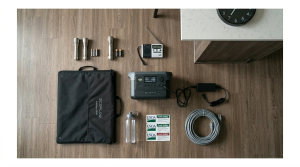
Beyond the power station and refrigerator backup, a complete emergency power for apartment dwellers kit should include:
Power hardware:
- Primary portable power station (1,000–2,000Wh)
- 1–2 solar panels for recharge (200–400W for balcony mounting)
- Short extension cord for routing power station to fridge location
Food safety:
- Refrigerator thermometer — know exactly when your fridge crosses the 40°F unsafe threshold
- Cooler with ice or dry ice as a secondary food storage option for extended outages
- USDA food safety magnet — quick reference for what’s safe and what isn’t after various time/temperature exposures
Monitoring and communication:
- Battery-powered or hand-crank weather radio for outage updates
- Power bank for phone charging separate from your main station (don’t deplete fridge power on phone charging)
- Flashlights with fresh batteries — keep LED lights off the main power station during fridge-priority mode
Frequently Asked Questions
How many watts does a refrigerator use per day?
A standard apartment refrigerator uses between 300–800Wh per day depending on size, age, and efficiency rating. Energy Star certified models use significantly less — often under 400Wh/day. To find your exact figure, check the yellow Energy Guide label on your fridge, which shows annual kWh consumption. Divide that number by 365 to get your daily average. This calculation is the foundation of any portable power station for refrigerator sizing decision.
Can a 1,000Wh power station run a full-size refrigerator?
Yes, for approximately 12–20 hours depending on your specific fridge’s consumption. A 1,000Wh unit is sufficient for most single-day outage scenarios. For multi-day resilience, a 2,000Wh station with solar recharge capability is a more appropriate choice. Always verify your fridge’s starting watt requirement against the station’s surge capacity before purchasing.
What is the EcoFlow DELTA 2 fridge runtime in real-world conditions?
In real-world testing with a standard 18 cu ft top-freezer apartment refrigerator drawing approximately 150W average, EcoFlow DELTA 2 fridge runtime comes out to 14–18 hours. With a 200W balcony solar panel adding 600–800Wh on a clear day, that effectively extends indefinitely during daylight hours. The DELTA 2 Max doubles this baseline runtime to 28–36 hours.
Is it safe to run a fridge on a portable power station all the time?
Yes, with appropriate equipment. Ensure your station’s continuous output rating exceeds your fridge’s running wattage with comfortable margin, and that the surge capacity handles compressor startup. LiFePO4 units are specifically suited to sustained continuous loads. Running your portable power station for refrigerator backup during regular power situations also keeps the battery exercised, which is better for long-term cell health than prolonged storage at full charge.
What size generator do I need for a refrigerator and other appliances?
For a fridge (150W) plus a laptop (65W), router (10W), and phone chargers (20W), your total continuous draw is approximately 245W with periodic fridge surge up to 800W. A 1,000W continuous / 1,600W+ surge station covers this combination comfortably. Add a CPAP machine (30–60W) and LED lighting (30W) and you’re still well within a quality 1,500W continuous station’s capability. The key is always checking how many watts to run a fridge versus your station’s surge — not just its continuous rating.
How long will food stay safe without power?
According to USDA guidelines: refrigerator food stays safe for up to 4 hours with the door kept closed. A full freezer maintains safe temperatures for 48 hours (24 hours if half-full). This timeline is why keeping your fridge running — rather than relying on passive cold retention — is so critical for renters without access to outdoor cooler storage space.
UnitVerseHQ covers emergency preparedness, energy resilience, and smart home solutions for American apartment renters. Product runtimes are estimates based on typical use conditions. Always verify specifications with the manufacturer for your specific appliance pairing.