Is it Safe to Charge Large Batteries Indoors? (2026 Renter’s Safety Guide)
By UnitVerseHQ | Updated February 2026
The short answer is yes but only if you’re using the right battery technology and following basic safety practices. If you’ve been wondering whether your portable power station poses a fire or health risk inside your apartment, you’re asking exactly the right question. And the answer, thankfully, is more reassuring than alarming.
This guide breaks down the science, the regulations, and the real-world safety practices that matter most for indoor safe battery backup use in a US apartment. No unnecessary jargon — just accurate, actionable information that protects you and your home.
Why Battery Safety Indoors Became a Serious Conversation
The consumer battery market exploded in the early 2020s. E-bikes, e-scooters, large power stations, and home energy storage systems all entered American apartments at scale — and not all of them were safe. Between 2021 and 2024, the US Consumer Product Safety Commission documented a significant rise in lithium battery-related fires, particularly in dense urban housing.
The fires weren’t random. They were almost entirely concentrated in one battery type: standard lithium-ion (NMC chemistry) — the same chemistry in cheap e-bike batteries and lower-cost portable power stations. The chemistry is energy-dense but thermally unstable under stress.
This history is exactly why understanding LiFePO4 safety vs lithium-ion differences isn’t just technical trivia — it’s the single most important purchasing decision a renter can make when choosing an indoor safe battery backup system.
LiFePO4 Safety vs Lithium-Ion: Understanding the Core Difference
All lithium batteries are not created equal. The term “lithium battery” covers a broad family of chemistries with dramatically different safety profiles. For apartment renters, two matter most.
Standard Lithium-Ion (NMC — Nickel Manganese Cobalt)
NMC chemistry is widely used because it packs significant energy into a small, lightweight cell. It powers most laptops, smartphones, and lower-cost portable power stations.
The problem is thermal stability. NMC cells can enter thermal runaway — a self-sustaining chain reaction of heat generation — when overcharged, punctured, exposed to high temperatures, or subjected to manufacturing defects. Thermal runaway in NMC cells can produce temperatures exceeding 900°F and release toxic gases including hydrogen fluoride.
In a 600 sq ft apartment, that’s a life-threatening scenario with very little warning time.
LiFePO4 (Lithium Iron Phosphate)
LiFePO4 safety vs lithium-ion comparisons consistently favor iron phosphate chemistry for one overriding reason: the oxygen atoms in its crystal structure are bound so tightly that they cannot be easily released during thermal stress. This eliminates the primary mechanism that makes NMC dangerous.
Key safety advantages of LiFePO4:
- Thermal runaway threshold: 518°F vs. approximately 320°F for NMC
- No toxic off-gassing under normal operation or most fault conditions
- No combustion in standard failure modes — cells may vent minimally but do not ignite
- Stable under overcharge — far more tolerant of charging irregularities
- 3,000–5,000 cycle lifespan — meaning fewer replacement cycles and less long-term risk exposure
For charging power station in small apartment environments, LiFePO4 isn’t a premium feature. It’s a fundamental safety requirement. Any indoor safe battery backup worth considering in 2026 should use LiFePO4 chemistry exclusively.
The New Class L Fire Classification (ISO 3941:2026)
In January 2026, the International Organization for Standardization released ISO 3941:2026, which formally introduced the Class L fire classification — the first globally recognized fire category specifically covering lithium battery fires.
Previously, lithium battery fires were awkwardly categorized under Class B (flammable liquids) or Class C (electrical fires), neither of which accurately described their behavior or appropriate suppression methods.
What Class L Means for Renters
Class L fires behave differently from every other fire category:
- They reignite repeatedly even after apparent suppression
- Water accelerates the reaction in some chemistries by generating hydrogen gas
- Standard dry chemical extinguishers are largely ineffective
- They require massive cooling — typically hundreds of gallons of water — to permanently suppress in large battery packs
The ISO 3941:2026 classification has two immediate practical implications for US apartment renters:
- Fire suppression products are now being redesigned and labeled specifically for Class L fires — look for Class L rated extinguishers when purchasing fire safety equipment for rooms where you store and charge battery equipment
- Building codes in several states are already referencing the classification in updated fire safety annexes, which will accelerate apartment-specific apartment battery storage regulations over the next 12–24 months
The critical takeaway: LiFePO4 units are dramatically less likely to produce a Class L fire event than NMC units. This is precisely why the ISO 3941:2026 development process heavily influenced purchasing guidance toward iron phosphate chemistry for residential indoor storage.
NFPA 855: The Standard That Actually Governs Your Apartment
NFPA 855 — the Standard for the Installation of Stationary Energy Storage Systems — is the primary US regulatory framework governing battery storage in residential buildings. Understanding it helps renters make informed decisions and pushes back on landlords who may impose arbitrary battery restrictions.
Key NFPA 855 Provisions Relevant to Renters
Size limits for residential units: NFPA 855 limits energy storage systems inside dwelling units to 20 kWh without requiring sprinkler system integration or special construction. Every portable power station discussed in renter contexts falls well under this threshold — most consumer units are 0.5–5 kWh. You are comfortably within NFPA 855 limits with any standard portable unit.
Separation requirements: The standard recommends maintaining clearance between energy storage units and sleeping areas, HVAC intakes, and egress paths. In practical apartment terms, this means: don’t charge your power station in a closed bedroom closet overnight, and don’t block your front door with it.
Ventilation: NFPA 855 specifies minimum ventilation requirements for larger installations. For consumer-scale LiFePO4 units under 2 kWh, the standard’s provisions are met by normal room ventilation in any standard apartment.
Apartment Battery Storage Regulations: What Your Landlord Can and Cannot Do
Apartment battery storage regulations vary by state and municipality, but several principles apply broadly across the US:
- Landlords cannot broadly ban all battery storage — this would prohibit laptop computers and smartphones
- Landlords can restrict specific high-risk equipment (such as cheap NMC e-bike batteries) with documented safety justification
- LiFePO4 portable power stations from reputable manufacturers are not reasonably prohibited under existing apartment battery storage regulations in any US state as of 2026
- Always document the make, model, and certification status of your unit in case questions arise
UL 9540A Certification Explained
UL 9540A is the test method developed by Underwriters Laboratories specifically to evaluate the fire risk of energy storage systems — including how they behave during thermal runaway events.
UL 9540A Certification Explained: What the Test Actually Measures
The UL 9540A process tests battery systems at four levels: cell, module, unit, and installation. It specifically evaluates:
- Propagation — does a thermal event in one cell spread to adjacent cells?
- Gas generation — what gases are produced, and at what volumes?
- Fire behavior — does the unit ignite, and how intensely?
- Suppression response — how does the unit respond to fire suppression attempts?
LiFePO4 units from major manufacturers consistently pass UL 9540A with the lowest hazard classifications. NMC units frequently require additional engineering controls to pass.
What to Look For When Buying
When evaluating any indoor safe battery backup, check for:
- UL 9540 listing (the system-level certification, distinct from 9540A which is the test method)
- UL 1973 (battery system safety standard)
- IEC 62619 (international safety standard for secondary lithium cells)
- CE marking (for units sold in both US and European markets)
- If you’re looking for units that already meet these strict safety standards, check out our [2026 Review of the 5 Best Portable Power Stations for Apartments] where we only selected LiFePO4 models.
All five units recommended in our companion buyer’s guide carry at least two of these certifications. UL 9540A certification explained simply: if a unit has been tested under this standard and carries the listing, it has demonstrated that a thermal event will not propagate catastrophically — which is exactly the assurance you need for charging power station in small apartment environments.
Charging Power Station in Small Apartment: The Practical Safety Rules
Understanding the chemistry and regulations matters — but so does day-to-day practice. Here are the non-negotiable habits for charging power station in small apartment living.
Surface Choice
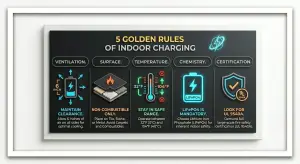
Always charge on hard, non-flammable surfaces. Concrete floors, tile, and hardwood are ideal. Never charge on carpet, beds, sofas, or upholstered furniture. Heat dissipation from the unit’s base requires contact with a thermally neutral surface.
Temperature Control
LiFePO4 units charge most safely between 50°F and 95°F. Avoid charging in:
- Closed vehicles during summer (interior temps can exceed 140°F)
- Unheated storage units during winter
- Direct sunlight on a balcony
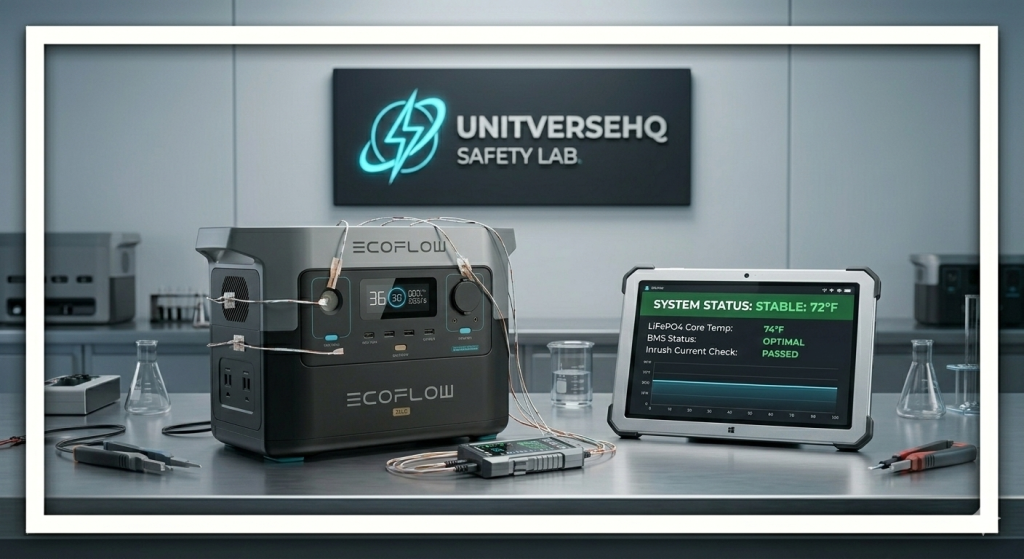
Most modern units have built-in Battery Management Systems (BMS) that will pause charging outside safe temperature ranges but don’t rely on this as your primary protection.
Charging Overnight
LiFePO4 chemistry is significantly safer for overnight charging than NMC. That said, best practice is to charge to 80% for routine use and only reach 100% when you need full capacity. Most EcoFlow and Bluetti stations allow you to set a charge ceiling in the app.
Renter’s Safety Checklist: Before You Charge
Use this checklist every time you set up or relocate your indoor safe battery backup unit.
Placement:
- ✅ Unit is on a hard, flat, non-flammable surface
- ✅ Minimum 12 inches of clearance on all sides for ventilation
- ✅ Not blocking any doorway or egress path
- ✅ Away from HVAC return air vents
- ✅ Not in a fully enclosed cabinet or closet during charging
Temperature:
- ✅ Room temperature is between 50°F and 95°F
- ✅ Unit is not in direct sunlight
- ✅ No heat sources within 3 feet (space heaters, radiators, ovens)
Electrical:
- ✅ Plugged directly into a wall outlet — not a daisy-chained power strip
- ✅ Outlet is on a dedicated circuit if possible (especially for units over 1,000Wh)
- ✅ Power cable is not pinched under furniture or routed under rugs
Monitoring:
- ✅ Manufacturer app installed and showing normal charge status
- ✅ Smoke detector in the room is functional and recently tested
- ✅ Class L or Class ABC fire extinguisher accessible nearby
Long-term storage:
- ✅ Store at 50–60% charge if not using for more than two weeks
- ✅ Store in a cool, dry location — not a hot attic or damp basement storage unit
- ✅ Inspect cable and connectors monthly for damage or corrosion
The Honest Bottom Line
Charging a quality indoor safe battery backup in a US apartment is safe — provided you choose LiFePO4 chemistry from a certified manufacturer and follow basic placement and charging practices. The risk profile of a well-made LiFePO4 portable power station is genuinely comparable to other common household appliances.
The risks that make headlines — apartment battery fires, toxic fume incidents — are almost exclusively associated with cheap NMC lithium cells in uncertified products, particularly budget e-bike batteries. They are not representative of the certified, LiFePO4-based indoor safe battery backup market.
Understanding LiFePO4 safety vs lithium-ion differences, knowing what UL 9540A certification explained means in practice, staying within apartment battery storage regulations, and following NFPA 855 guidance puts you in an informed, protected position. The technology is sound. The regulations support it. And with the right habits, charging power station in small apartment environments is a low-risk, high-reward addition to any renter’s energy strategy.
Frequently Asked Questions
Is it safe to leave a portable power station charging overnight?
Yes, for LiFePO4 units from certified manufacturers. These units have multi-layer Battery Management Systems that prevent overcharge, overtemperature, and short circuit events. For additional peace of mind, set your unit’s charge ceiling to 80% in the app — this extends battery life and reduces heat generation during the final charge phase.
What’s the difference between UL 9540 and UL 9540A?
UL 9540A certification explained briefly: UL 9540A is the test method — the fire exposure protocol used to evaluate how a battery system behaves in a thermal event. UL 9540 is the system listing — the certification a complete energy st
-
-
battery overheating signs
-
orage system receives after passing relevant tests including 9540A. When shopping for an indoor safe battery backup, look for UL 9540 on the product listing.
Do I need to tell my landlord I have a portable power station?
There is generally no legal requirement to disclose standard consumer electronics to your landlord, and a certified LiFePO4 power station falls into this category under most apartment battery storage regulations. However, if your lease has specific electronics or battery clauses, review them carefully. A proactive conversation with your property manager, backed by certification documentation, can prevent future disputes.
Can I store a portable power station in a bedroom?
Yes, with proper placement. Keep it on a hard floor surface, away from bedding and curtains, with clearance on all sides. Avoid charging power station in small apartment bedrooms with the door fully closed overnight — maintain normal room airflow. A functioning smoke detector in the room is strongly recommended.
What should I do if my battery unit gets very hot during charging?
Stop charging immediately, disconnect from the wall outlet, move the unit to a hard floor surface away from flammable materials, and monitor it. A warm unit during charging is normal — a hot unit (too hot to touch) is not. Contact the manufacturer’s support line. Do not place an overheating unit in water or an enclosed space.
UnitVerseHQ provides independent safety education for American renters. This article reflects publicly available regulatory standards and manufacturer safety data as of February 2026. Always consult your local fire marshal or building inspector for jurisdiction-specific guidance.