
Off-Grid Solar System Cost 2026: Full Price Breakdown
How much does an off-grid solar system cost in 2026?
Most articles give you a range. Something like “$10,000 to $50,000” technically true, practically useless. This guide gives you actual builds, real 2026 pricing, and a cost-per-kWh formula you can use to compare every option on equal footing.
The short answer: a complete off-grid solar system in 2026 costs between $3,000 and $25,000 for most residential and cabin setups. Where you land in that range depends on three variables: how much power you need, whether you buy an all-in-one system or build your own, and what you pay for installation — which swings wildly by state.
Quick summary: Entry-level cabin system (2 kWh): $3K–$5K. Full home off-grid (15–25 kWh): $18K–$25K. DIY builds save $2,000–$5,000 over all-in-one systems but require 20–40 hours of your time.
The table below shows the full picture by system size and type. We’ll break down each row in detail throughout this guide.
EcoFlow system tiers: $3,000 to $25,000 explained
EcoFlow has become the dominant all-in-one off-grid brand for a reason: their systems ship pre-configured, require no electrician for the DC components, and come with a five-year warranty that covers the entire system — not just individual parts. Here’s what each tier actually costs in 2026, and what you get for the money.
| Tier | System | Capacity | Typical Cost | Cost/kWh (10yr) | Best For |
| Entry | DELTA Pro + 2 panels | 2 kWh / 400W solar | $3,000–$5,000 | $0.14–$0.25 | Cabin/van |
| Mid | Power Kit 5 kWh | 5 kWh / 800W solar | $8,000–$12,000 | $0.11–$0.16 | Small cabin |
| Pro | Power Kit 10 kWh | 10 kWh / 1.6kW solar | $13,000–$18,000 | $0.09–$0.12 | Full-time off-grid |
| Premium | Power Kit 25 kWh | 25 kWh / 3.2kW solar | $20,000–$25,000 | $0.07–$0.09 | Full home backup |
Note: cost-per-kWh is calculated as total system cost divided by estimated kWh delivered over 10 years (daily usable capacity × 3,650 days), assuming 80% depth of discharge and 15% solar efficiency loss over time.
Entry tier: EcoFlow DELTA Pro + 2 panels ($3,000–$5,000)
The DELTA Pro with two 400W panels is the starting point for anyone who wants off-grid capability without a full system overhaul. It delivers 2 kWh of usable storage and up to 800W of solar input — enough to run lighting, a small fridge, phone charging, and a laptop for 12–16 hours.
Who it’s for: weekend cabin owners, van dwellers, and anyone testing off-grid living before committing to a larger system. The DELTA Pro is also expandable — you can add extra batteries (DELTA Pro Extra) to scale up to 6 kWh without replacing any hardware.
Cost-per-kWh: At $4,000 all-in for a 2 kWh system, you’re paying around $0.19/kWh over 10 years. That’s competitive with grid electricity in high-rate states like California ($0.28/kWh average in 2026).
Mid tier: EcoFlow Power Kit 5 kWh ($8,000–$12,000)
The Power Kit is EcoFlow’s dedicated whole-home off-grid platform. Unlike the DELTA Pro, it’s designed to be mounted in a utility room, supports AC coupling, and integrates directly with your home’s electrical panel — which means it powers everything, including high-draw appliances like washing machines and power tools.
The 5 kWh configuration is the right fit for a small cabin running full-time, or a primary residence that already has efficient appliances and low daily consumption (under 10 kWh/day). At $10,000 installed, the cost-per-kWh lands around $0.12–$0.16 over a decade.
Pro tier: EcoFlow Power Kit 10 kWh ($13,000–$18,000)
Double the storage, double the solar input — this configuration is the sweet spot for full-time off-grid households of 1–3 people with moderate energy habits. Expect to cover: refrigerator, lighting, HVAC fans, device charging, and a washing machine on solar-heavy days.
One important note: EcoFlow’s Power Kit handles the battery and inverter side, but you still need to size your solar array correctly. At 1.6 kW of panels, you’re looking at 6–9 kWh of daily solar production in good sun regions — matched well to the 10 kWh battery bank for a 1:1 harvest-to-storage ratio.
Premium tier: EcoFlow Power Kit 25 kWh ($20,000–$25,000)
The 25 kWh configuration is EcoFlow’s ceiling for residential use. It’s built for households with high daily consumption (15–20 kWh/day), multi-person families, or anyone running electric heat or a well pump off-grid. At this system size, the cost-per-kWh drops to $0.07–$0.09 over 10 years — genuinely competitive with utility rates in most of the country.
This tier also has the clearest payback logic: if your current electricity bill is $250–$350/month, a $22,000 off-grid system pays for itself in 8–12 years with no ongoing utility costs and no exposure to rate increases.
Affiliate note: EcoFlow’s Power Kit is available directly at ecoflow.com. Use our link for the latest bundle pricing — EcoFlow runs quarterly promotions that can cut $500–$2,000 from the above prices.
Installation cost by state: electrician vs DIY
Hardware is only part of the bill. Installation can add anywhere from $0 (full DIY) to $7,500 (professional install in a high-cost state) to the total system cost. Here’s what th
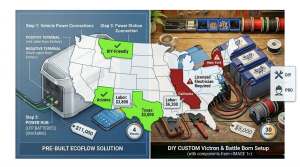
at actually looks like — broken down by state, system size, and what you can realistically do yourself.
| State | Labor (small) | Labor (mid) | Labor (large) | Permit Fees | DIY-Friendly? |
| California | $2,800 | $4,500 | $6,200 | $300–$800 | Moderate (licensed sign-off req.) |
| Texas | $2,200 | $3,800 | $5,500 | $150–$400 | Yes — very DIY-friendly |
| Florida | $2,400 | $4,000 | $5,800 | $200–$500 | Moderate |
| Montana | $1,800 | $3,200 | $4,800 | $100–$250 | Yes — most DIY-friendly |
| Arizona | $2,100 | $3,600 | $5,200 | $150–$350 | Yes — DIY-friendly |
| New York | $3,200 | $5,400 | $7,500 | $400–$1,200 | No — licensed electrician req. |
Labor costs based on 2026 national averages from HomeAdvisor and Angi. Permit fees are typical ranges — always verify with your county before budgeting.
What DIY actually saves — and what it costs you
The DIY math is appealing: skip the electrician, save $2,000–$6,000. But “DIY” in off-grid solar isn’t all or nothing. There’s a realistic breakdown of what most homeowners can safely do themselves versus what should involve a licensed professional.
DIY-safe tasks:
- Panel mounting on roof or ground mount (most states allow this without a permit)
- Running DC wiring from panels to combiner box
- Connecting battery bank to BMS or battery management system
- Installing and configuring an EcoFlow Power Kit (plug-and-play DC side)
Hire a professional for:
- Any AC wiring from inverter to your main panel — this is live current and triggers permit requirements in nearly every state
- 48V battery banks with custom wiring — mistakes at high voltage carry serious electrical risk
- Grid-tied hybrid systems where you’re connecting to utility power alongside solar
- Any work in California, New York, or similar states that require a licensed electrician’s signature on permit applications
DIY savings estimate: A mid-tier system (5 kWh) with a $10,000 EcoFlow Power Kit costs $14,000 installed professionally in Texas and $10,500 with DIY installation — saving $3,500. In California, the same savings shrinks to ~$1,500 because even partial DIY requires a licensed sign-off on the AC side.
Permit cost breakdown by state category
States generally fall into three categories for off-grid solar permitting:
Lenient (Montana, Texas, Arizona, rural Midwest): $100–$400 total in permit fees. DIY installation is accepted. Inspections are minimal or waived for systems under a certain size threshold.
Moderate (Florida, Colorado, Oregon): $200–$600 in permits. DIY is allowed but inspections are required. AC wiring must be done to code — most homeowners hire an electrician for that portion only, reducing labor costs by 60–70%.
Strict (California, New York, Massachusetts): $400–$1,200 in permits, plus mandatory licensed electrician involvement. Budget for full professional installation costs in these states — the permit savings from partial DIY rarely justify the risk of failed inspections.
EcoFlow Power Kit vs DIY Victron / Battle Born: full cost comparison
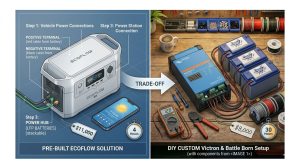
This is the question most buyers wrestle with the longest: do you pay the premium for an all-in-one system that just works, or build your own with best-in-class components that cost significantly less on paper? Here’s the honest breakdown for a 5 kWh system — the most common off-grid build size.
EcoFlow Power Kit 5 kWh — full cost breakdown
The EcoFlow Power Kit at the 5 kWh tier includes the hub unit, LFP batteries, integrated BMS, monitoring gateway, and a 5-year system warranty. Here’s what the full bill looks like:
Power Kit hub (5 kWh config): $7,200–$8,500 direct from EcoFlow
Solar panels (800W, 2× 400W): $500–$700
Mounting hardware and racking: $200–$400
Wiring, breakers, and connectors: $150–$250 (included partially in kit)
Professional install (DC only, DIY AC): $800–$1,500 in most states
Total: $8,850–$11,350 installed
DIY Victron / Battle Born 5 kWh — parts list and pricing
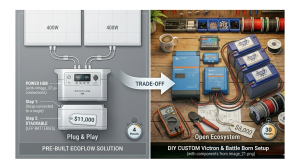
A comparable DIY build uses the Victron MultiPlus-II 48/3000 inverter/charger, four Battle Born 100Ah 12V LiFePO4 batteries wired in series for a 48V/5.12 kWh bank, and a Victron SmartSolar MPPT charge controller. This is considered the gold-standard DIY combination — reliable, proven, with excellent community support.
Victron MultiPlus-II 48/3000 inverter/charger: $1,100–$1,300
Battle Born 100Ah 12V batteries × 4: $3,600–$4,000
Victron SmartSolar MPPT 100/50: $280–$340
Lynx distributor / bus bars / fuses: $200–$350
Solar panels (800W, same as above): $500–$700
Mounting hardware and racking: $200–$400
Wiring, conduit, breakers, and connectors: $300–$500
Victron Cerbo GX (monitoring): $190–$250
Labor (your time — ~30 hours): $0 (or ~$1,500 if valued at $50/hr)
Total hardware only: $6,370–$7,840
Total with professional wiring assist: $7,870–$10,340
Head-to-head comparison
| Category | EcoFlow Power Kit (5kWh) | DIY Victron / Battle Born (5kWh) | Winner | Margin |
| Hardware cost | $8,000–$10,000 | $5,200–$7,000 | DIY | ~$2,500 |
| Install time | 4–8 hours | 20–40 hours | EcoFlow | ~30 hrs |
| Electrician needed | No (plug-and-play) | Recommended for AC wiring | EcoFlow | Clear |
| Expandability | Up to 15 kWh (modular) | Unlimited (custom) | DIY | Long-term |
| Warranty | 5 years (full system) | 2–5 yrs (per component) | EcoFlow | Simplicity |
| App/monitoring | Yes — native EcoFlow app | Victron VRM (requires setup) | EcoFlow | UX |
| Repairability | Proprietary parts | Open ecosystem | DIY | Long-term |
| Total cost of ownership | $9,500–$12,000 (10yr) | $6,500–$9,500 (10yr) | DIY | ~$3,000 |
Pricing based on 2026 retail pricing from EcoFlow, Battle Born Batteries, and Victron distributors. Warranty terms verified as of Q1 2026.
The honest verdict
If you’re technically confident and willing to spend 30+ hours on the build, the DIY Victron/Battle Born system saves you $2,000–$5,000 in upfront cost and gives you an open, expandable platform that isn’t tied to any single manufacturer’s ecosystem. Long-term, it’s the better deal.
If you want something installed in a weekend, backed by a single warranty, managed from a phone app, and expandable without re-engineering — the EcoFlow Power Kit is worth the premium. The plug-and-play advantage is real, and the 5-year system warranty covers a period when DIY systems are most likely to surface issues from installation errors.
Affiliate note: Battle Born Batteries and Victron components are available through authorized distributors including Signature Solar and AM Solar. EcoFlow Power Kit is available directly at ecoflow.com — see our resource section for current pricing links.
What’s the right system for your budget?
Not everyone who reads this guide has the same situation. Here’s a quick persona-based guide to matching system type to buyer.
| Buyer Persona | Budget Range | Recommended System | Why |
| Weekend cabin owner | $3K–$6K | EcoFlow DELTA Pro + 2 panels | Low install friction, no electrician needed, easy to expand later |
| Full-time off-grid homesteader | $12K–$20K | DIY Victron / Battle Born build | Better long-term value, full customization, expandable without limits |
| RV or van traveler | $4K–$9K | EcoFlow Power Kit 2 kWh | Space-efficient, app control, portable — plug-and-play for mobile use |
How to calculate what you actually need
Before buying anything, run this simple calculation to right-size your system:
- Add up your daily kWh consumption (check your electric bill, or use a plug-in energy monitor for a week)
- Multiply by 1.25 for a 20% buffer — off-grid systems need headroom
- Divide by your average peak sun hours (4–6 hours/day depending on your region)
- That’s your required solar array size in kW
- Your battery bank should store 1.5–2× your daily consumption for 1–2 days of cloudy weather autonomy
Example: a household using 8 kWh/day needs 10 kWh of storage (8 × 1.25) and roughly 2.5 kW of solar in a 4-peak-sun-hour region. That points to EcoFlow’s Power Kit 10 kWh tier or an equivalent DIY build.
Frequently asked questions
How much does a 10 kWh off-grid solar system cost in 2026?
A complete 10 kWh off-grid system including panels, battery storage, inverter, and basic installation costs $13,000–$18,000 for an all-in-one system like the EcoFlow Power Kit, or $10,000–$14,000 for a DIY Victron/Battle Born build. Add $2,000–$5,000 for professional installation depending on your state.
Is DIY off-grid solar cheaper than buying a kit?
Yes — by $2,000–$5,000 at the 5 kWh system level. The trade-off is installation time (20–40 hours), greater technical complexity, and managing warranties across multiple manufacturers. For buyers comfortable with electrical DIY, the savings are meaningful. For everyone else, an all-in-one system like EcoFlow eliminates most of that friction.
What does an electrician charge to install an off-grid solar system?
Expect $2,000–$6,000 in labor depending on system size and your state. Texas and Montana are on the low end ($1,800–$3,200 for small systems). California and New York are significantly higher ($3,200–$7,500 for the same work). Many buyers do the DC wiring themselves and hire an electrician only for the AC panel connection, which typically costs $500–$1,500.
How long does an off-grid solar system last?
LiFePO4 batteries — the chemistry used by both EcoFlow and Battle Born — are rated for 3,000–4,000 charge cycles, which translates to 8–12 years of daily use. Solar panels typically carry 25-year performance warranties. Inverters and charge controllers have a practical lifespan of 10–15 years. Plan for battery replacement as the primary long-term cost.
What is a realistic payback period for off-grid solar?
For a household eliminating a $200–$300/month electricity bill with a $15,000 off-grid system, the payback period is 4–7 years. For a cabin that currently uses a generator ($150–$250/month in fuel), payback is often 3–5 years. The calculation shifts significantly if you qualify for the federal solar Investment Tax Credit (ITC), which covered 30% of system costs as of early 2026.
Can I add more batteries to an EcoFlow system later?
Yes — all EcoFlow Power Kit configurations are modular and expandable. You can add battery modules without replacing the hub or inverter. The DELTA Pro line supports expansion via DELTA Pro Extra battery units. This makes EcoFlow a lower-commitment entry point: start at 5 kWh and expand to 15 kWh as budget allows, without reinstalling the system from scratch.
Bottom line
Off-grid solar in 2026 is more accessible than it’s ever been — both in terms of product availability and cost. The technology has matured, prices have stabilized, and all-in-one systems like the EcoFlow Power Kit have removed the technical barrier that kept most buyers on the sidelines.
For most readers, the decision comes down to one question: is your priority saving money upfront (DIY Victron/Battle Born), or saving time and complexity (EcoFlow Power Kit)? Both paths lead to genuine energy independence — it’s a matter of what you’re willing to trade.
Use the cost-per-kWh table and the buyer persona guide in this article to match the right system to your situation, then verify current pricing — EcoFlow in particular runs seasonal promotions that can meaningfully change the all-in cost.
Next steps:
- Calculate your daily kWh consumption before choosing a system size
- Check your state’s permitting requirements before budgeting for installation
- Compare EcoFlow Power Kit pricing at ecoflow.com
- Compare Battle Born + Victron bundle pricing at Signature Solar or AM Solar